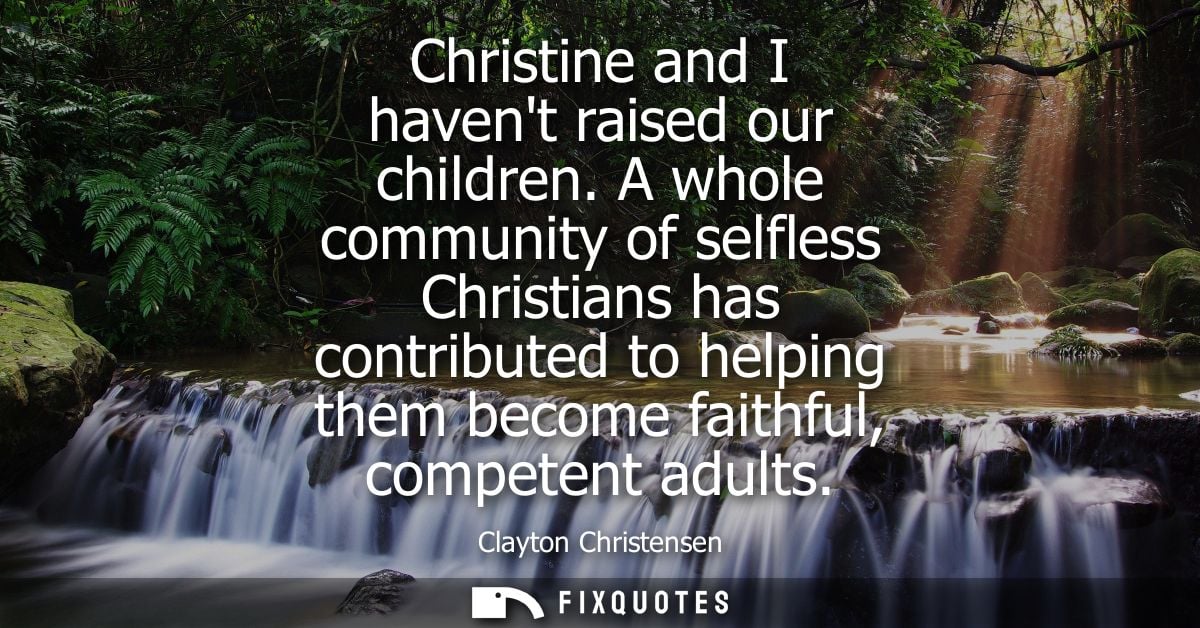
"Christine and I haven't raised our children. A whole community of selfless Christians has contributed to helping them become faithful, competent adults"
About this Quote
The phrasing matters. “A whole community” doesn’t just mean neighbors who occasionally babysit; it implies an ecosystem of repeated, unglamorous acts - rides, meals, correction, example, patience - the social infrastructure that quietly forms a person. By calling them “selfless Christians,” Christensen locates the source of that infrastructure in shared moral obligation rather than mere convenience. It’s a values claim, not just a gratitude note: faith communities don’t only produce belief; they produce competence. “Faithful, competent adults” is a striking pairing, insisting that character and capability grow together when adults outside the nuclear family take responsibility.
The subtext is also a warning to ambitious professionals: the cost of building a life is often paid by others in your orbit, and the honest accounting requires naming them. In an era of parental burnout and individualized pressure, Christensen’s statement reframes child-rearing as collective work - and quietly asks whether we’ve dismantled the very communities that make “raising kids” possible.
Quote Details
| Topic | Parenting |
|---|---|
| Source | Help us find the source |
| Cite |
Citation Formats
APA Style (7th ed.)
Christensen, Clayton. (2026, January 17). Christine and I haven't raised our children. A whole community of selfless Christians has contributed to helping them become faithful, competent adults. FixQuotes. https://fixquotes.com/quotes/christine-and-i-havent-raised-our-children-a-66351/
Chicago Style
Christensen, Clayton. "Christine and I haven't raised our children. A whole community of selfless Christians has contributed to helping them become faithful, competent adults." FixQuotes. January 17, 2026. https://fixquotes.com/quotes/christine-and-i-havent-raised-our-children-a-66351/.
MLA Style (9th ed.)
"Christine and I haven't raised our children. A whole community of selfless Christians has contributed to helping them become faithful, competent adults." FixQuotes, 17 Jan. 2026, https://fixquotes.com/quotes/christine-and-i-havent-raised-our-children-a-66351/. Accessed 3 Apr. 2026.