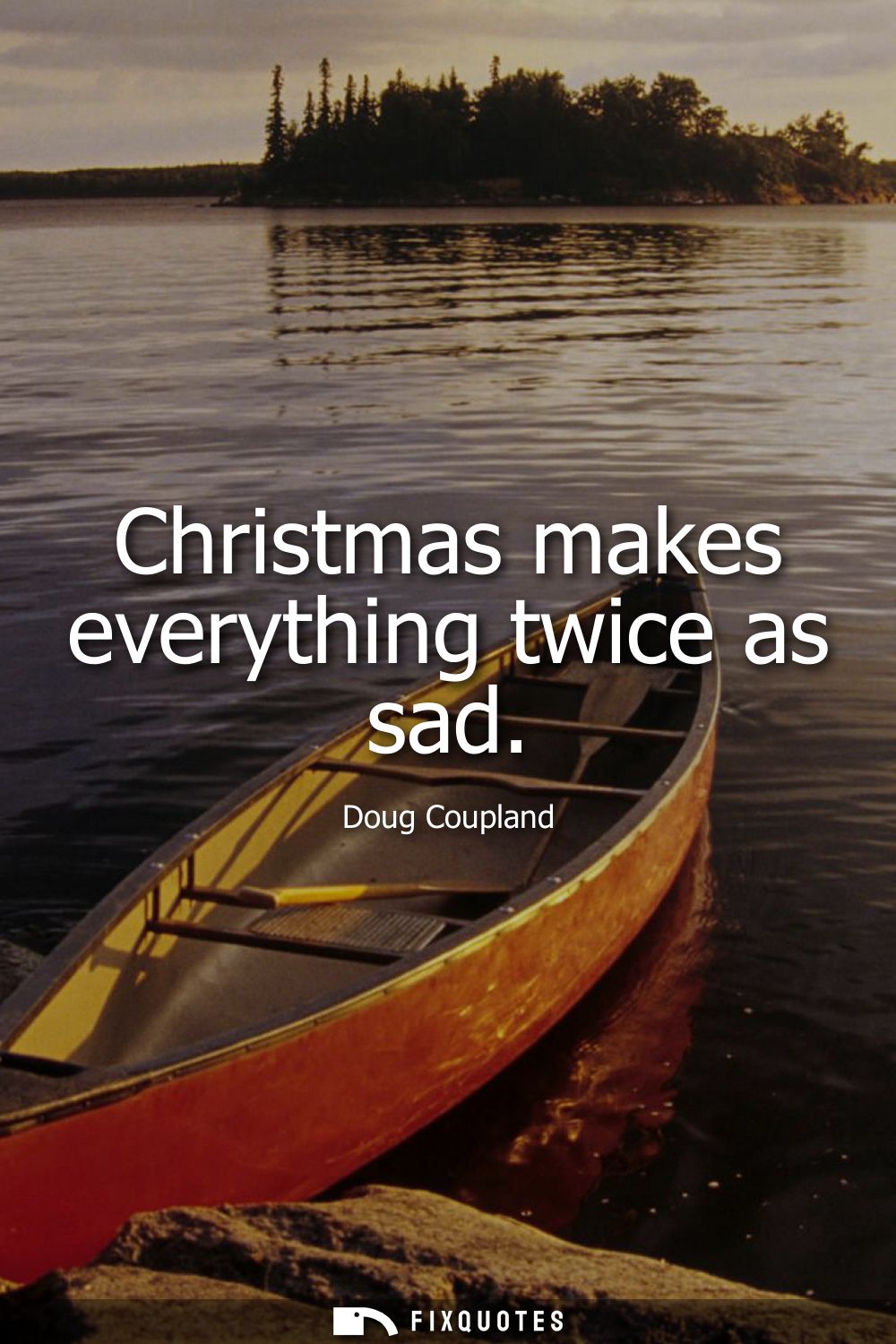
"Christmas makes everything twice as sad"
About this Quote
Coupland’s line is a small grenade tossed into the tinsel. It works because it refuses the default script of December-as-salvation and instead treats Christmas as an emotional amplifier: whatever you’re carrying gets turned up, not transformed. Joy becomes performance; loneliness becomes inventory. The holiday doesn’t create sadness so much as it spotlights it with fluorescent cheer, the way a bright mall atrium makes you suddenly aware of your own silence.
The intent feels characteristically Coupland: to puncture the corporate-liturgical mood of late capitalism without preaching. “Twice as sad” is deliberately blunt, almost adolescent in its phrasing, which is the point. Christmas sells itself as uncomplicated comfort, so the counterclaim has to be equally simple, like a slogan flipped inside out. Under the subtext is a critique of expectation management: when a culture insists on mandatory warmth, anyone who can’t access it experiences not just grief, but grief plus failure.
Context matters because Coupland’s work has long been about the spiritual hangover of consumer culture: people with full carts and empty narratives. Christmas is the year’s most concentrated dose of that dynamic, when family mythology, nostalgia, and advertising converge. The day becomes a referendum on belonging. If your family is fractured, your bank account tight, your body tired, or your history complicated, the holiday doesn’t offer respite; it offers a comparison chart.
“Twice” hints at the double exposure: the present hurt laid over an idealized past (or an imagined alternate life). Christmas, in Coupland’s hands, isn’t a cure. It’s a high-gloss mirror.
The intent feels characteristically Coupland: to puncture the corporate-liturgical mood of late capitalism without preaching. “Twice as sad” is deliberately blunt, almost adolescent in its phrasing, which is the point. Christmas sells itself as uncomplicated comfort, so the counterclaim has to be equally simple, like a slogan flipped inside out. Under the subtext is a critique of expectation management: when a culture insists on mandatory warmth, anyone who can’t access it experiences not just grief, but grief plus failure.
Context matters because Coupland’s work has long been about the spiritual hangover of consumer culture: people with full carts and empty narratives. Christmas is the year’s most concentrated dose of that dynamic, when family mythology, nostalgia, and advertising converge. The day becomes a referendum on belonging. If your family is fractured, your bank account tight, your body tired, or your history complicated, the holiday doesn’t offer respite; it offers a comparison chart.
“Twice” hints at the double exposure: the present hurt laid over an idealized past (or an imagined alternate life). Christmas, in Coupland’s hands, isn’t a cure. It’s a high-gloss mirror.
Quote Details
| Topic | Christmas |
|---|
More Quotes by Doug
Add to List