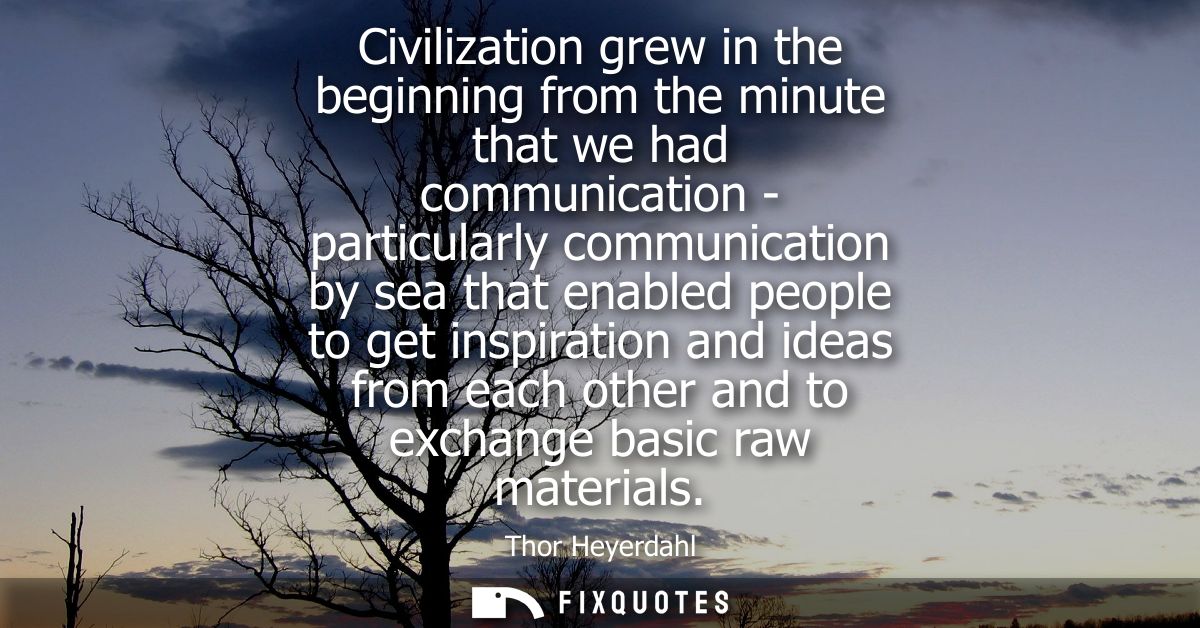
"Civilization grew in the beginning from the minute that we had communication - particularly communication by sea that enabled people to get inspiration and ideas from each other and to exchange basic raw materials"
About this Quote
The intent is quietly polemical. By placing the origin of civilization at the advent of communication, he demotes conquest and kingship and promotes contact. The subtext is anti-parochial: if ideas and “basic raw materials” circulate, then purity myths collapse. Civilizations aren’t sealed jars; they’re busy ports. That’s a pointed stance for the 20th century, when archaeology and anthropology were still shaking off diffusion-versus-isolation debates, and when nationalist narratives loved to claim indigenous exceptionalism or pristine beginnings.
It also reveals Heyerdahl’s signature bias: he’s happiest when the sea gets to be the engine of history. “Minute” is doing work here, overstating for effect to make interconnection feel like a switch being flipped. The line compresses centuries of messy development into a clean causal chain because he wants the reader to feel an almost modern truth: infrastructure shapes imagination. Build routes, and you don’t just move goods; you manufacture possibility.
Quote Details
| Topic | Ocean & Sea |
|---|---|
| Source | Help us find the source |
| Cite |
Citation Formats
APA Style (7th ed.)
Heyerdahl, Thor. (2026, January 18). Civilization grew in the beginning from the minute that we had communication - particularly communication by sea that enabled people to get inspiration and ideas from each other and to exchange basic raw materials. FixQuotes. https://fixquotes.com/quotes/civilization-grew-in-the-beginning-from-the-18993/
Chicago Style
Heyerdahl, Thor. "Civilization grew in the beginning from the minute that we had communication - particularly communication by sea that enabled people to get inspiration and ideas from each other and to exchange basic raw materials." FixQuotes. January 18, 2026. https://fixquotes.com/quotes/civilization-grew-in-the-beginning-from-the-18993/.
MLA Style (9th ed.)
"Civilization grew in the beginning from the minute that we had communication - particularly communication by sea that enabled people to get inspiration and ideas from each other and to exchange basic raw materials." FixQuotes, 18 Jan. 2026, https://fixquotes.com/quotes/civilization-grew-in-the-beginning-from-the-18993/. Accessed 6 Mar. 2026.