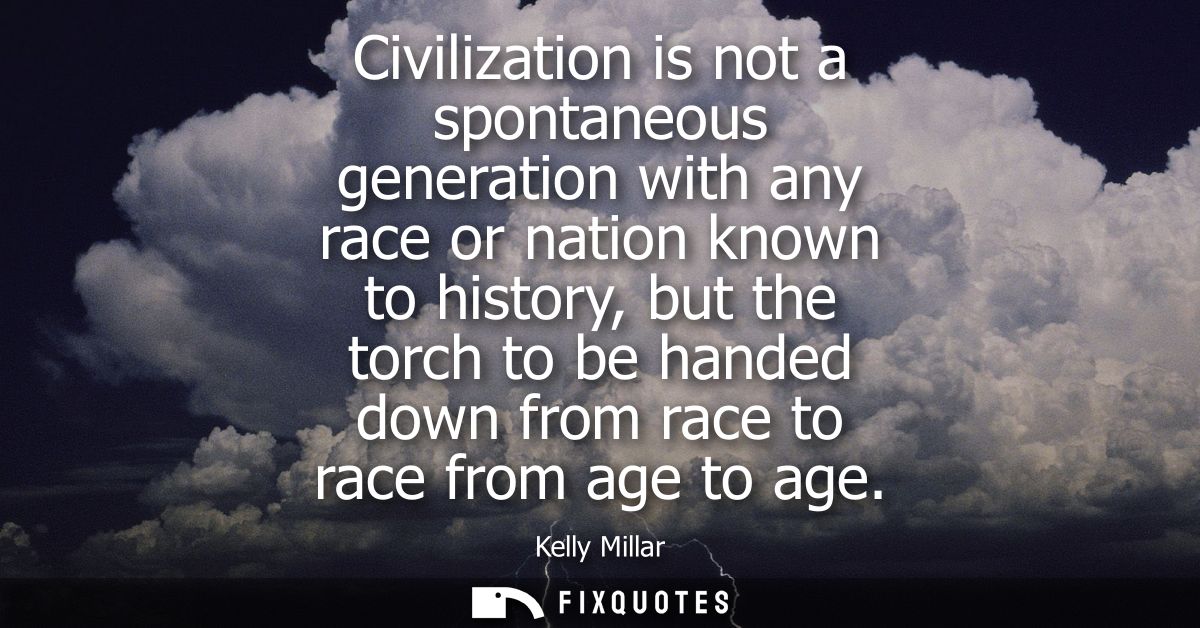
"Civilization is not a spontaneous generation with any race or nation known to history, but the torch to be handed down from race to race, from age to age"
About this Quote
The intent is corrective and political. Millar is writing against racial essentialism, the kind that turns cultural achievement into evidence of biological hierarchy. Notice the phrasing “with any race or nation known to history”: it preempts exceptions, closing the loophole of “but this one people…” That’s not just historical humility; it’s an argument about responsibility. If civilization is inherited labor, then every generation’s job is maintenance, transmission, and stewardship. You don’t get to preen over past triumphs; you have to keep the flame alive.
The subtext also nudges at empire and appropriation. “Handed down from race to race” can sound generous, but history’s handoffs are rarely polite. Knowledge moves through trade, translation, migration, conquest, and cultural borrowing. By framing civilization as portable rather than rooted, Millar quietly normalizes cross-pollination - and punctures the anxiety that influence equals contamination. The torch metaphor flatters continuity while admitting fragility: progress is real, but never guaranteed.
Quote Details
| Topic | Legacy & Remembrance |
|---|---|
| Source | Help us find the source |
| Cite |
Citation Formats
APA Style (7th ed.)
Millar, Kelly. (2026, February 16). Civilization is not a spontaneous generation with any race or nation known to history, but the torch to be handed down from race to race, from age to age. FixQuotes. https://fixquotes.com/quotes/civilization-is-not-a-spontaneous-generation-with-118291/
Chicago Style
Millar, Kelly. "Civilization is not a spontaneous generation with any race or nation known to history, but the torch to be handed down from race to race, from age to age." FixQuotes. February 16, 2026. https://fixquotes.com/quotes/civilization-is-not-a-spontaneous-generation-with-118291/.
MLA Style (9th ed.)
"Civilization is not a spontaneous generation with any race or nation known to history, but the torch to be handed down from race to race, from age to age." FixQuotes, 16 Feb. 2026, https://fixquotes.com/quotes/civilization-is-not-a-spontaneous-generation-with-118291/. Accessed 30 Mar. 2026.