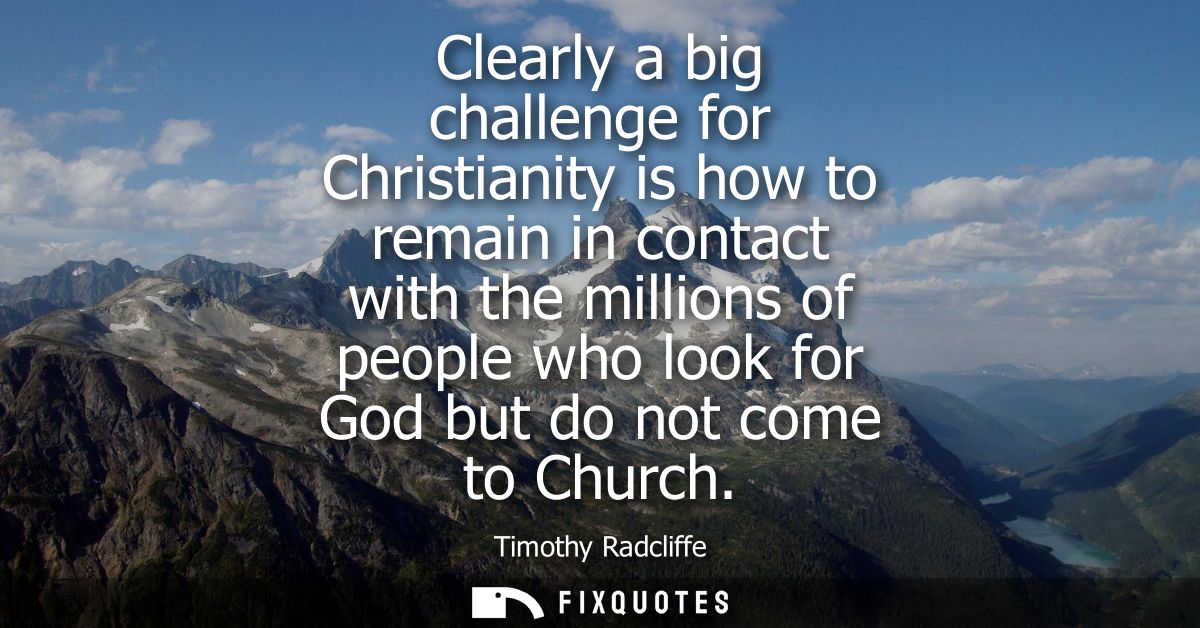
"Clearly a big challenge for Christianity is how to remain in contact with the millions of people who look for God but do not come to Church"
About this Quote
His diction does quiet rhetorical work. “Look for God” concedes sincerity and agency to seekers: they’re not lapsed customers to be won back with better branding, they’re already engaged in a serious search. “Do not come to Church” is pointedly descriptive rather than condemnatory, dodging the moralizing tone that often turns pastoral concern into scolding. That restraint signals a strategic shift: if the Church wants to speak credibly, it has to start by listening without demanding immediate compliance.
The subtext is also institutional humility, bordering on an indictment. If people want God but avoid Church, the problem may be less the message than the medium: a culture of gatekeeping, clericalism, sexual-abuse crisis fallout, or a liturgical and moral language that feels like a closed dialect. Radcliffe, a Dominican known for intellectual openness, is nudging Christianity toward presence rather than conquest - toward contact as relationship, not recruitment.
Context matters: late-20th and early-21st century Western Christianity has watched “spiritual but not religious” become a stable identity. Radcliffe reads that not as defeat, but as a diagnostic. The Church’s real test is whether it can meet desire where it actually lives now: in doubt, in private prayer, in activism, in digital communities - without insisting the first step toward God is a threshold and a membership card.
Quote Details
| Topic | God |
|---|---|
| Source | Help us find the source |
| Cite |
Citation Formats
APA Style (7th ed.)
Radcliffe, Timothy. (2026, January 16). Clearly a big challenge for Christianity is how to remain in contact with the millions of people who look for God but do not come to Church. FixQuotes. https://fixquotes.com/quotes/clearly-a-big-challenge-for-christianity-is-how-106031/
Chicago Style
Radcliffe, Timothy. "Clearly a big challenge for Christianity is how to remain in contact with the millions of people who look for God but do not come to Church." FixQuotes. January 16, 2026. https://fixquotes.com/quotes/clearly-a-big-challenge-for-christianity-is-how-106031/.
MLA Style (9th ed.)
"Clearly a big challenge for Christianity is how to remain in contact with the millions of people who look for God but do not come to Church." FixQuotes, 16 Jan. 2026, https://fixquotes.com/quotes/clearly-a-big-challenge-for-christianity-is-how-106031/. Accessed 3 Apr. 2026.