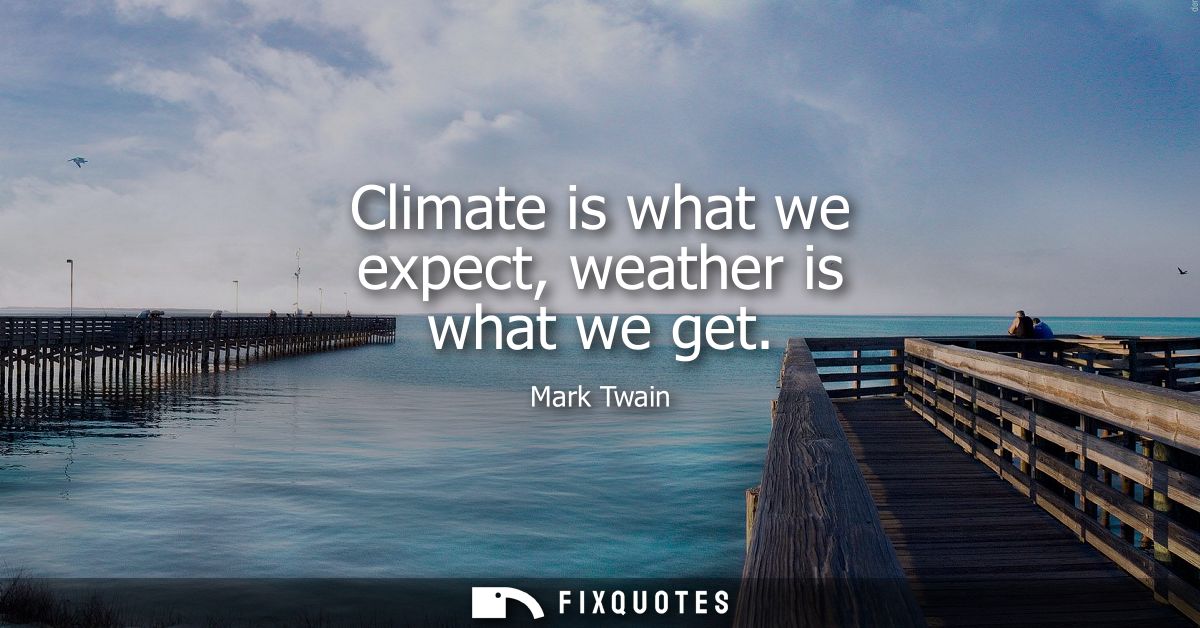
"Climate is what we expect, weather is what we get"
About this Quote
Twain’s line lands because it sounds like a folksy clarification, then quietly indicts the way people argue. “Expect” versus “get” is a neat little trap: expectation is tidy, statistical, and long-range; what we “get” is messy, immediate, and emotionally loud. He’s not just defining terms. He’s sketching a permanent human weakness: we treat the last thing that happened to us as if it’s the whole story.
The wit is in the phrasing’s deadpan inevitability. “Climate” is a calm, almost bureaucratic category; “weather” is the daily ambush. Twain makes the distinction feel obvious, which is how satire often works: it shows you your confusion was never intellectual, it was psychological. You don’t mistake climate for weather because you lack information; you do it because weather is what ruins your picnic, floods your town, or saves your crops. The present tense has better PR.
In Twain’s era, “climate” also carried older connotations - a region’s character, its supposed influence on temperament, even a faint whiff of moral geography. By reducing it to “what we expect,” he punctures grand narratives and brings it back to lived experience and pattern recognition. That’s why the line has been recycled so effectively in modern climate-change debates: it exposes the rhetorical sleight of hand where a cold week gets waved like a rebuttal to decades of data. Twain’s joke doubles as a warning about narrative addiction: we trust anecdotes because they feel like reality, even when they’re just today.
The wit is in the phrasing’s deadpan inevitability. “Climate” is a calm, almost bureaucratic category; “weather” is the daily ambush. Twain makes the distinction feel obvious, which is how satire often works: it shows you your confusion was never intellectual, it was psychological. You don’t mistake climate for weather because you lack information; you do it because weather is what ruins your picnic, floods your town, or saves your crops. The present tense has better PR.
In Twain’s era, “climate” also carried older connotations - a region’s character, its supposed influence on temperament, even a faint whiff of moral geography. By reducing it to “what we expect,” he punctures grand narratives and brings it back to lived experience and pattern recognition. That’s why the line has been recycled so effectively in modern climate-change debates: it exposes the rhetorical sleight of hand where a cold week gets waved like a rebuttal to decades of data. Twain’s joke doubles as a warning about narrative addiction: we trust anecdotes because they feel like reality, even when they’re just today.
Quote Details
| Topic | Wisdom |
|---|---|
| Source | Later attribution: A Field Guide to Climate Change (Adam Briggle, 2024) modern compilationISBN: 9781770489592 · ID: 37IFEQAAQBAJ
Evidence:
... Mark Twain once quipped , " Climate is what we expect , weather is what we get . " We " get " weather , meaning that is what we actually experience - shivering in a blizzard , sweating in a heatwave , or sheltering from a thunderstorm ... |
| Cite |
Citation Formats
APA Style (7th ed.)
Twain, Mark. (2026, February 27). Climate is what we expect, weather is what we get. FixQuotes. https://fixquotes.com/quotes/climate-is-what-we-expect-weather-is-what-we-get-26371/
Chicago Style
Twain, Mark. "Climate is what we expect, weather is what we get." FixQuotes. February 27, 2026. https://fixquotes.com/quotes/climate-is-what-we-expect-weather-is-what-we-get-26371/.
MLA Style (9th ed.)
"Climate is what we expect, weather is what we get." FixQuotes, 27 Feb. 2026, https://fixquotes.com/quotes/climate-is-what-we-expect-weather-is-what-we-get-26371/. Accessed 30 Mar. 2026.
More Quotes by Mark
Add to List