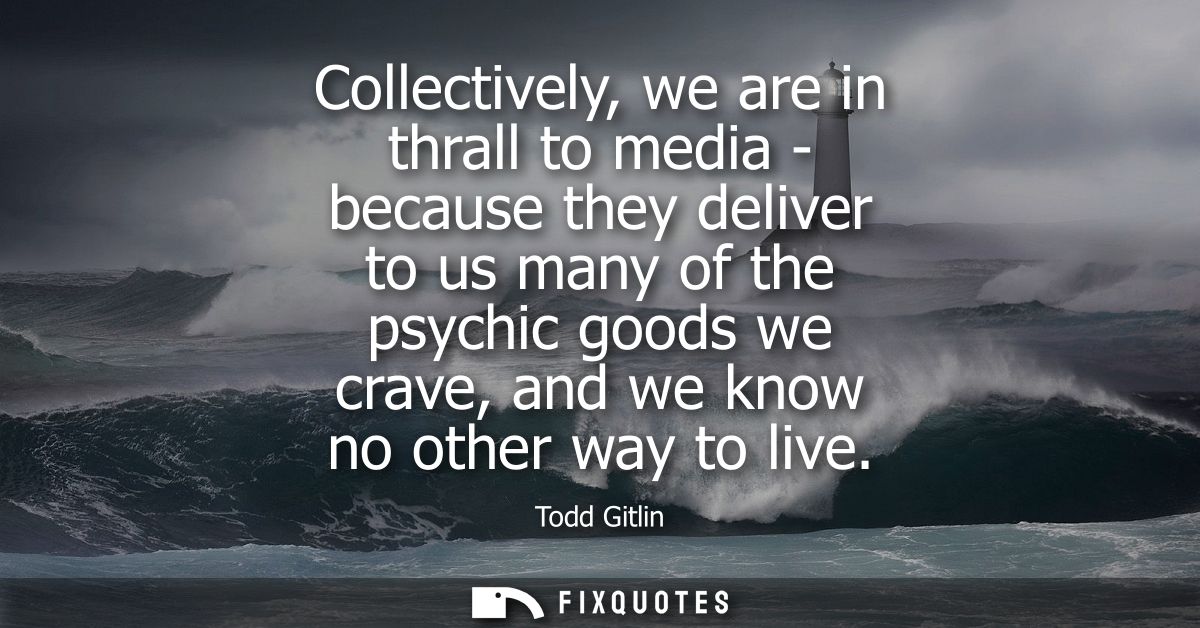
"Collectively, we are in thrall to media - because they deliver to us many of the psychic goods we crave, and we know no other way to live"
About this Quote
The subtext is a critique of modern autonomy. “Collectively” matters: Gitlin isn’t blaming individuals for weak will. He’s pointing at a shared social arrangement where attention becomes the default currency of public life and private coping. “We know no other way to live” is the real knife. It suggests that media saturation isn’t simply hard to quit; it’s become the operating system for social reality itself. To opt out risks social invisibility, informational ignorance, even a kind of civic illiteracy.
Contextually, Gitlin comes out of a tradition of media sociology shaped by mass broadcast culture, propaganda studies, and the politics of spectacle. Read today, the line feels eerily predictive of algorithmic feeds: the more precisely media learn what psychic goods we crave, the more they can sell those cravings back to us as necessity. The quote works because it refuses moral panic and goes for something colder: complicity without conspiracy, captivity without chains.
Quote Details
| Topic | Deep |
|---|---|
| Source | Help us find the source |
| Cite |
Citation Formats
APA Style (7th ed.)
Gitlin, Todd. (2026, January 18). Collectively, we are in thrall to media - because they deliver to us many of the psychic goods we crave, and we know no other way to live. FixQuotes. https://fixquotes.com/quotes/collectively-we-are-in-thrall-to-media-because-17092/
Chicago Style
Gitlin, Todd. "Collectively, we are in thrall to media - because they deliver to us many of the psychic goods we crave, and we know no other way to live." FixQuotes. January 18, 2026. https://fixquotes.com/quotes/collectively-we-are-in-thrall-to-media-because-17092/.
MLA Style (9th ed.)
"Collectively, we are in thrall to media - because they deliver to us many of the psychic goods we crave, and we know no other way to live." FixQuotes, 18 Jan. 2026, https://fixquotes.com/quotes/collectively-we-are-in-thrall-to-media-because-17092/. Accessed 5 Mar. 2026.