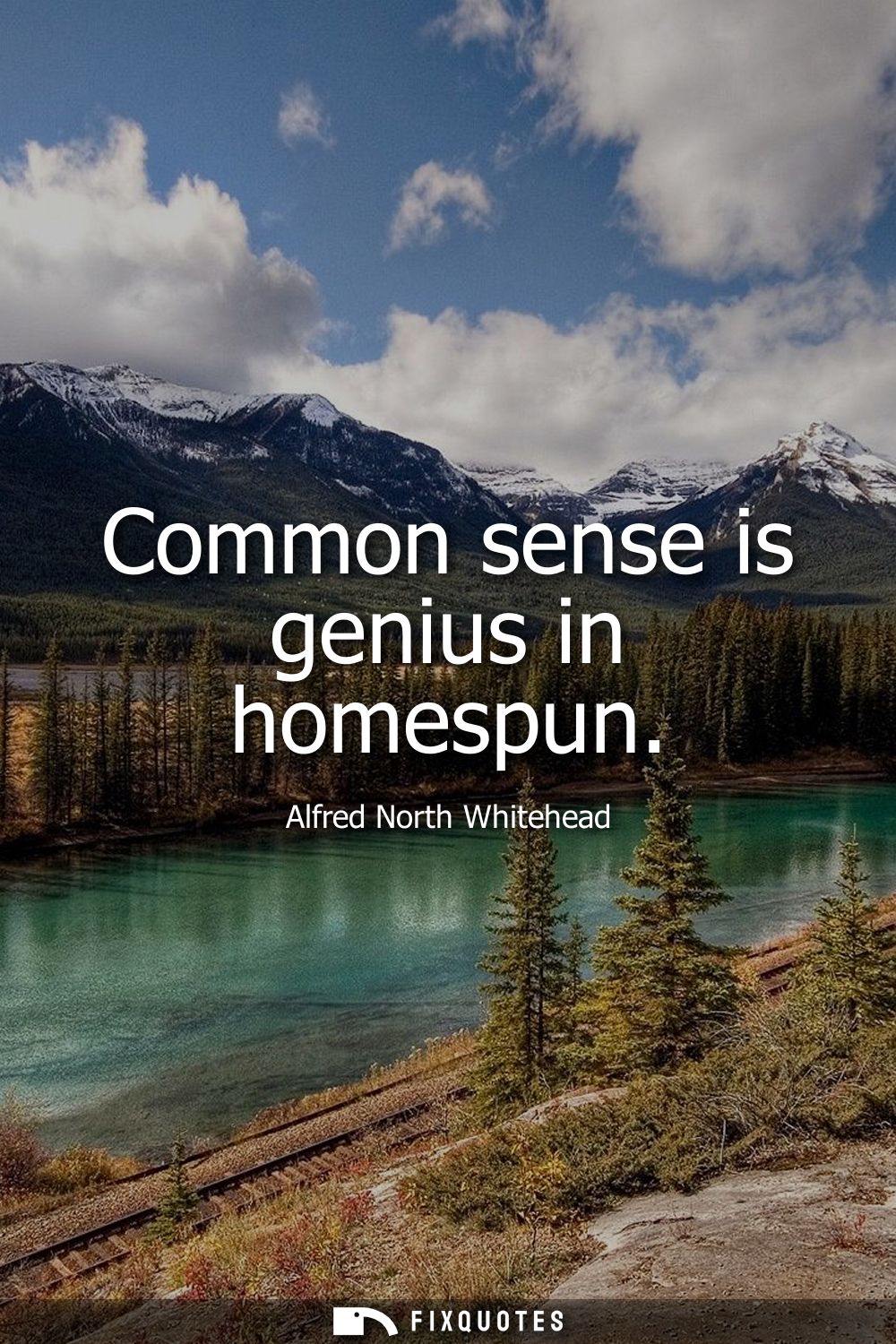
"Common sense is genius in homespun"
About this Quote
Whitehead’s line flatters the everyday mind while quietly redefining what counts as “genius.” By calling common sense “genius in homespun,” he’s not sentimentalizing folksiness; he’s reframing it as a kind of low-cost, high-function intelligence that doesn’t bother with academic costume. “Homespun” does heavy work here: it suggests something handmade, practical, locally produced, and slightly unfashionable. Genius, in this framing, isn’t only the rarefied spark that wins prizes and writes proofs. It’s the same underlying capacity for pattern-recognition and judgment, just expressed in plain materials.
The subtext is a jab at intellectual vanity. Whitehead, a mathematician-philosopher steeped in abstraction, knew how easily specialized language can masquerade as insight. The quote implies that what people call “common sense” is often the distilled result of long cultural testing: heuristics that survived because they reliably map onto reality. That doesn’t make it infallible; it makes it adaptive. He’s also nudging experts to remember that explanation is not the same as understanding. If your theory can’t cash out into intuitive bearings for living, it risks being genius in brocade: impressive, fragile, and designed to be admired rather than used.
Context matters: Whitehead worked during an era when science and logic were remaking authority, and when the prestige of technical expertise was rising fast. He doesn’t reject rigor; he warns against confusing sophistication with wisdom. The intent is democratic without being anti-intellectual: honor the mind that navigates the world well, even when it can’t (or won’t) speak in equations.
The subtext is a jab at intellectual vanity. Whitehead, a mathematician-philosopher steeped in abstraction, knew how easily specialized language can masquerade as insight. The quote implies that what people call “common sense” is often the distilled result of long cultural testing: heuristics that survived because they reliably map onto reality. That doesn’t make it infallible; it makes it adaptive. He’s also nudging experts to remember that explanation is not the same as understanding. If your theory can’t cash out into intuitive bearings for living, it risks being genius in brocade: impressive, fragile, and designed to be admired rather than used.
Context matters: Whitehead worked during an era when science and logic were remaking authority, and when the prestige of technical expertise was rising fast. He doesn’t reject rigor; he warns against confusing sophistication with wisdom. The intent is democratic without being anti-intellectual: honor the mind that navigates the world well, even when it can’t (or won’t) speak in equations.
Quote Details
| Topic | Wisdom |
|---|
More Quotes by Alfred
Add to List