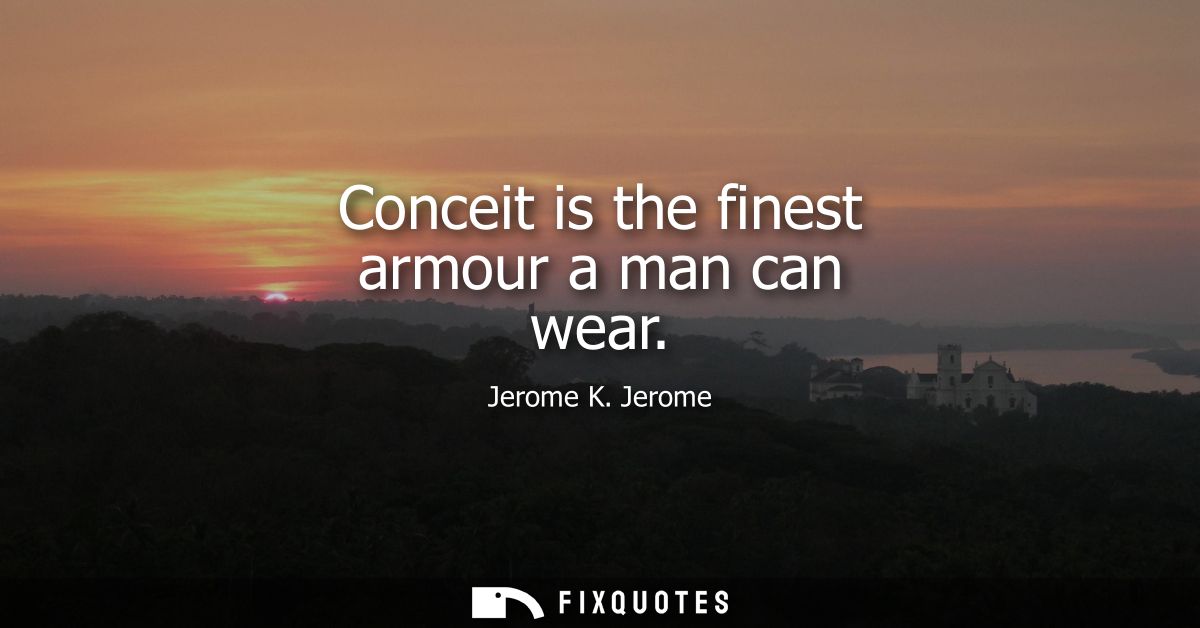
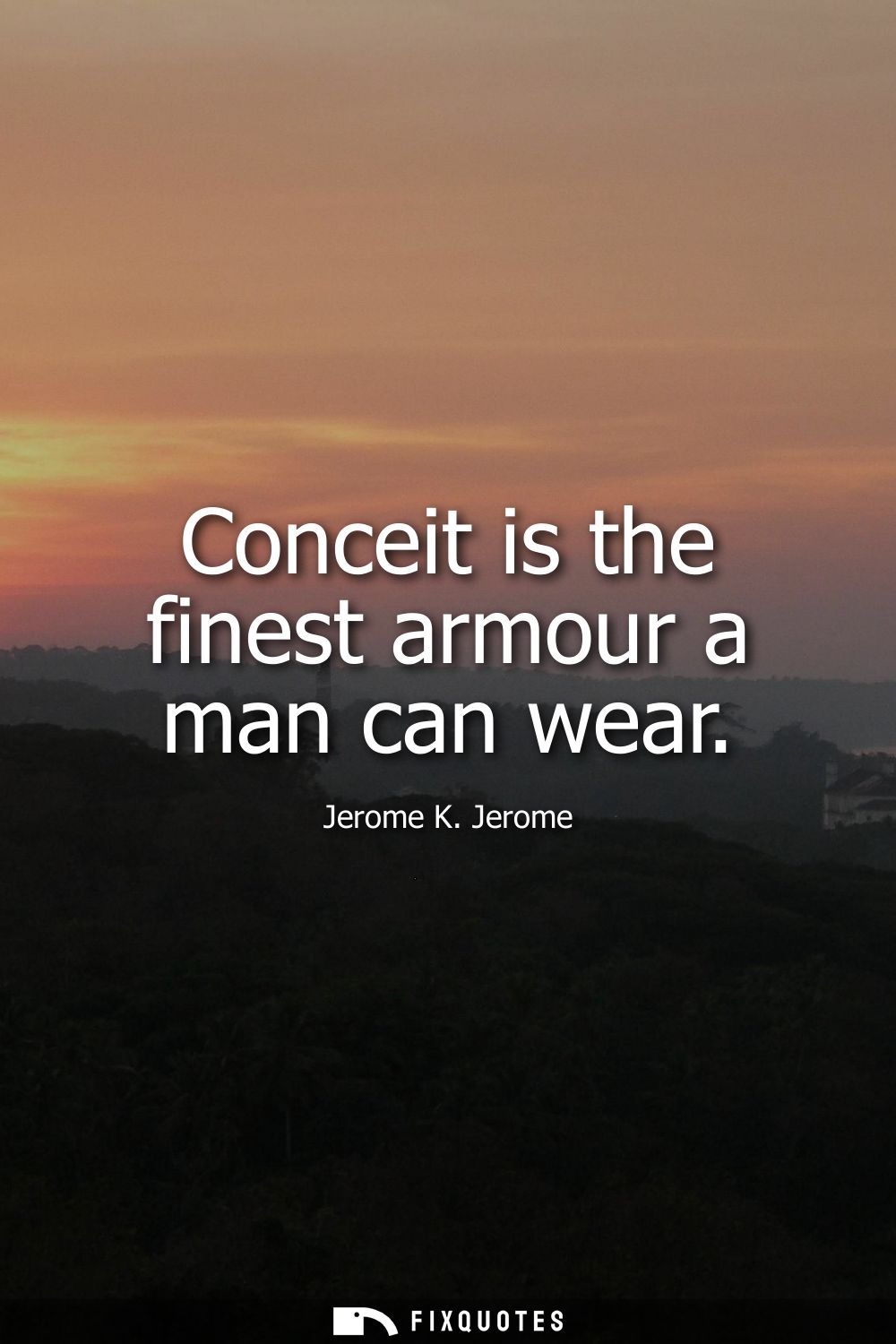
"Conceit is the finest armour a man can wear"
About this Quote
“Conceit” lands first as a moral failing, then Jerome flips it into survival gear. Calling it “the finest armour” is a sly Victorian bait-and-switch: he’s not praising vanity so much as diagnosing why it’s so stubbornly useful. Armour isn’t about virtue; it’s about not getting hurt. In a society obsessed with manners, reputation, and the constant social audit of class and taste, a thick layer of self-regard functions like plated steel. It lets a person walk through small humiliations, slights, and failures without bleeding out emotionally.
Jerome’s comic intelligence is in the word “finest.” Conceit isn’t just protective; it’s flattering, tailored, lightweight compared to heavier defenses like cynicism or cruelty. Conceit lets you reinterpret reality on the fly: criticism becomes jealousy, rejection becomes ignorance, your own mistakes become evidence of how difficult it is to be you. That’s the subtextual punchline: vanity isn’t merely a personality defect, it’s a psychological technology for maintaining a coherent self.
Context matters. Jerome wrote in an era when the modern “self” was being remodeled by mass literacy, urban anonymity, and new forms of public judgment. Conceit, in that landscape, reads like an early form of personal branding: a confidence costume that keeps you afloat in rooms where you’re being measured. The irony is sharp because it’s plausible. He’s winking at the reader: you may despise conceit, but you probably rely on it whenever the world gets a clean shot at your ego.
Jerome’s comic intelligence is in the word “finest.” Conceit isn’t just protective; it’s flattering, tailored, lightweight compared to heavier defenses like cynicism or cruelty. Conceit lets you reinterpret reality on the fly: criticism becomes jealousy, rejection becomes ignorance, your own mistakes become evidence of how difficult it is to be you. That’s the subtextual punchline: vanity isn’t merely a personality defect, it’s a psychological technology for maintaining a coherent self.
Context matters. Jerome wrote in an era when the modern “self” was being remodeled by mass literacy, urban anonymity, and new forms of public judgment. Conceit, in that landscape, reads like an early form of personal branding: a confidence costume that keeps you afloat in rooms where you’re being measured. The irony is sharp because it’s plausible. He’s winking at the reader: you may despise conceit, but you probably rely on it whenever the world gets a clean shot at your ego.
Quote Details
| Topic | Witty One-Liners |
|---|---|
| Source | Help us find the source |
| Cite |
Citation Formats
APA Style (7th ed.)
Jerome, Jerome K. (2026, January 18). Conceit is the finest armour a man can wear. FixQuotes. https://fixquotes.com/quotes/conceit-is-the-finest-armour-a-man-can-wear-23597/
Chicago Style
Jerome, Jerome K. "Conceit is the finest armour a man can wear." FixQuotes. January 18, 2026. https://fixquotes.com/quotes/conceit-is-the-finest-armour-a-man-can-wear-23597/.
MLA Style (9th ed.)
"Conceit is the finest armour a man can wear." FixQuotes, 18 Jan. 2026, https://fixquotes.com/quotes/conceit-is-the-finest-armour-a-man-can-wear-23597/. Accessed 16 Mar. 2026.
More Quotes by Jerome
Add to List