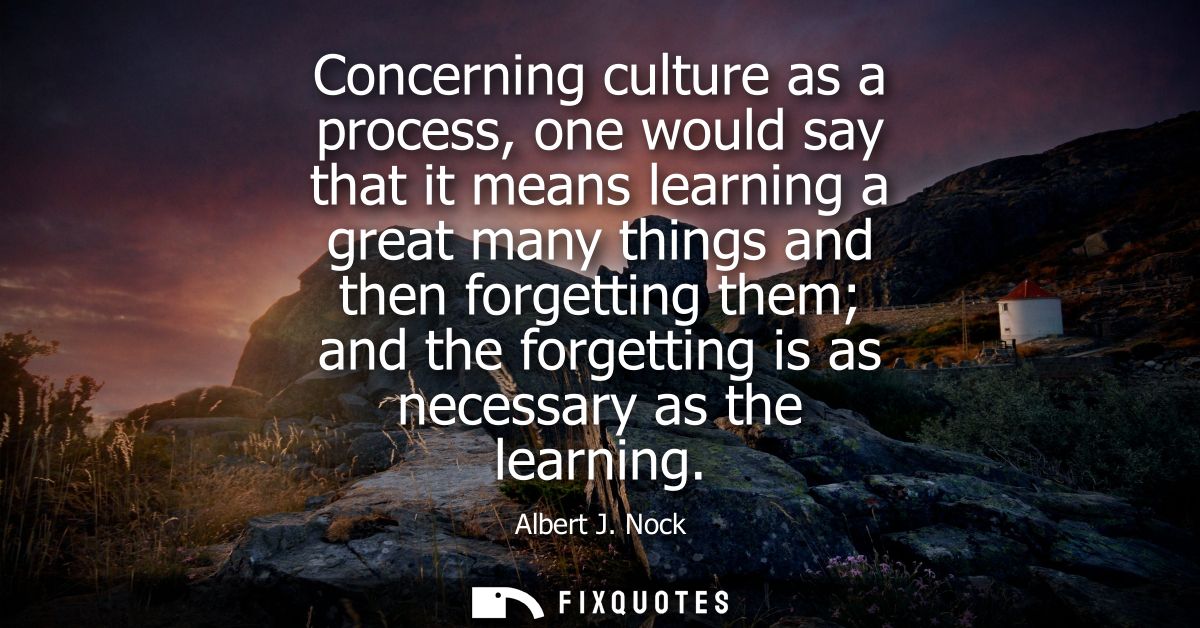
"Concerning culture as a process, one would say that it means learning a great many things and then forgetting them; and the forgetting is as necessary as the learning"
About this Quote
Culture, for Nock, isn’t a trophy case of facts; it’s a kind of mental composting. The line swerves away from the museum model of education (collect, label, display) and toward something more ruthless: you learn widely, then you let most of it rot so a smaller, richer intelligence can grow. The provocation is that forgetting isn’t failure. It’s the point. Only what has been digested, metabolized, and made instinctive remains - not as trivia, but as judgment.
The subtext carries Nock’s patrician suspicion of credentialism. “Learning a great many things” nods to the dutiful accumulation prized by schools and polite society, then the dagger: culture requires forgetting, meaning the cultured person is not the one with the best recall but the one who can discard. That’s an implicit critique of both mass education and mass opinion: systems that reward repetition, not discernment. Forgetting becomes a selective act, a kind of intellectual taste. It’s also a defense against the noise of modernity; culture, in this view, is partly the art of not being endlessly impressed.
Context matters. Nock wrote in an early-20th-century America intoxicated with progress, standardization, and the expanding bureaucratic state. His work often framed “education” as social training and “culture” as inner formation. This sentence does what his larger project does: it separates the cultivated mind from the well-schooled mind, insisting that real culture is process, not possession - less a hard drive than a palate.
The subtext carries Nock’s patrician suspicion of credentialism. “Learning a great many things” nods to the dutiful accumulation prized by schools and polite society, then the dagger: culture requires forgetting, meaning the cultured person is not the one with the best recall but the one who can discard. That’s an implicit critique of both mass education and mass opinion: systems that reward repetition, not discernment. Forgetting becomes a selective act, a kind of intellectual taste. It’s also a defense against the noise of modernity; culture, in this view, is partly the art of not being endlessly impressed.
Context matters. Nock wrote in an early-20th-century America intoxicated with progress, standardization, and the expanding bureaucratic state. His work often framed “education” as social training and “culture” as inner formation. This sentence does what his larger project does: it separates the cultivated mind from the well-schooled mind, insisting that real culture is process, not possession - less a hard drive than a palate.
Quote Details
| Topic | Learning |
|---|
More Quotes by Albert
Add to List