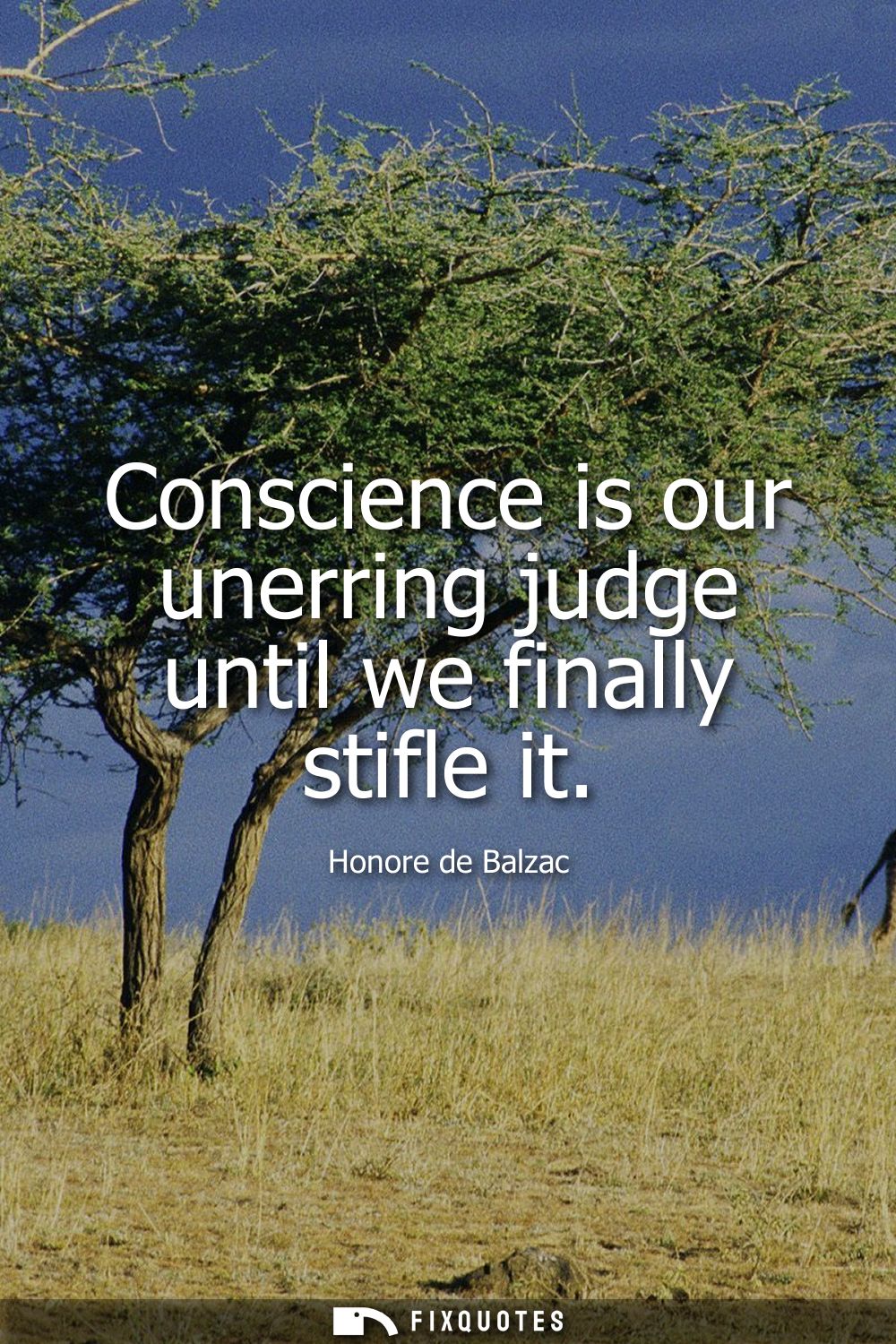
"Conscience is our unerring judge until we finally stifle it"
About this Quote
Balzac’s line lands like a moral trapdoor: conscience is “unerring” right up to the moment we take a hand to its throat. The bite is in the timing. He doesn’t deny conscience’s accuracy; he questions our capacity to live with that accuracy. The real accusation isn’t that people can’t tell right from wrong, but that they can - and then choose to sabotage the instrument that tells the truth.
The verb “stifle” is doing heavy work. It’s intimate, physical, almost panicked. This isn’t the clean, philosophical drift of ethics; it’s the desperate muffling of an internal witness. Balzac implies that self-deception is less an intellectual error than a practiced violence. Conscience doesn’t fail; we train ourselves to stop hearing it. That makes moral decline feel incremental and domestic: not a single villainous leap, but a sequence of small accommodations that eventually require silence to keep the story going.
In Balzac’s 19th-century realist universe - a France reorganizing itself around money, mobility, and social performance - this reads as both diagnosis and social critique. His characters are often brilliant at rationalization, building careers and reputations on compromises they can initially feel. The line captures the psychology of ambition: the first transgression hurts, the second is explained, the tenth is normalized. “Unerring” is the haunting part. The judge remains competent; the defendant just rigs the courtroom.
The verb “stifle” is doing heavy work. It’s intimate, physical, almost panicked. This isn’t the clean, philosophical drift of ethics; it’s the desperate muffling of an internal witness. Balzac implies that self-deception is less an intellectual error than a practiced violence. Conscience doesn’t fail; we train ourselves to stop hearing it. That makes moral decline feel incremental and domestic: not a single villainous leap, but a sequence of small accommodations that eventually require silence to keep the story going.
In Balzac’s 19th-century realist universe - a France reorganizing itself around money, mobility, and social performance - this reads as both diagnosis and social critique. His characters are often brilliant at rationalization, building careers and reputations on compromises they can initially feel. The line captures the psychology of ambition: the first transgression hurts, the second is explained, the tenth is normalized. “Unerring” is the haunting part. The judge remains competent; the defendant just rigs the courtroom.
Quote Details
| Topic | Ethics & Morality |
|---|---|
| Source | Help us find the source |
| Cite |
Citation Formats
APA Style (7th ed.)
Balzac, Honore de. (2026, January 17). Conscience is our unerring judge until we finally stifle it. FixQuotes. https://fixquotes.com/quotes/conscience-is-our-unerring-judge-until-we-finally-24205/
Chicago Style
Balzac, Honore de. "Conscience is our unerring judge until we finally stifle it." FixQuotes. January 17, 2026. https://fixquotes.com/quotes/conscience-is-our-unerring-judge-until-we-finally-24205/.
MLA Style (9th ed.)
"Conscience is our unerring judge until we finally stifle it." FixQuotes, 17 Jan. 2026, https://fixquotes.com/quotes/conscience-is-our-unerring-judge-until-we-finally-24205/. Accessed 3 Apr. 2026.
More Quotes by Honore
Add to List