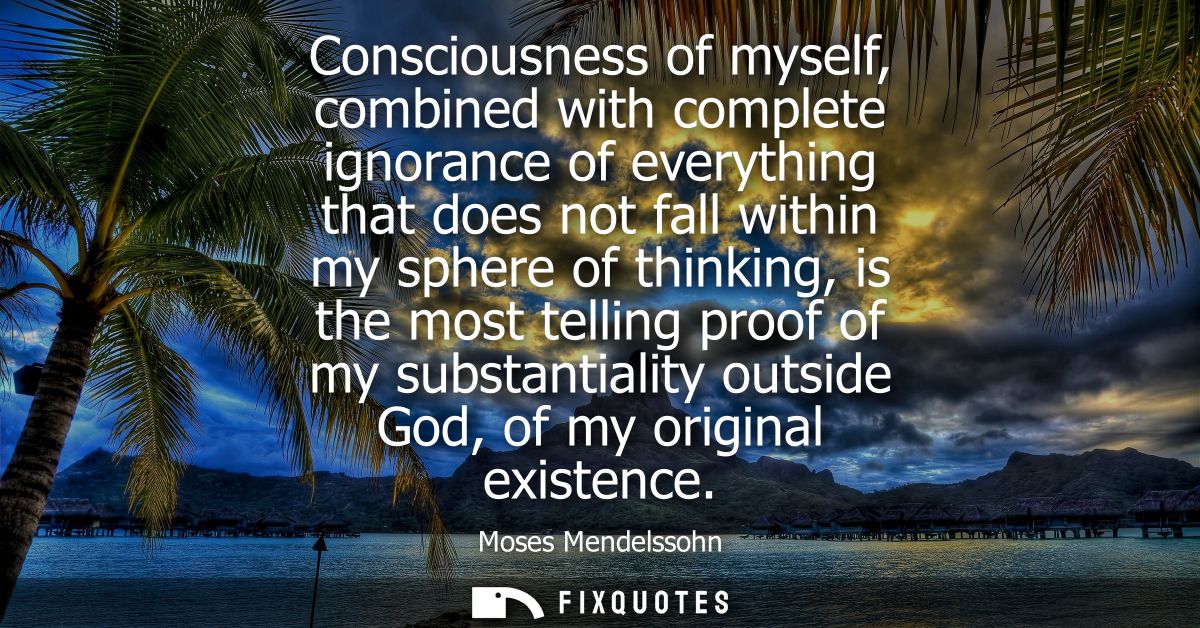
"Consciousness of myself, combined with complete ignorance of everything that does not fall within my sphere of thinking, is the most telling proof of my substantiality outside God, of my original existence"
About this Quote
The intent is philosophical, but the rhetoric is quietly strategic. Mendelssohn is working in the long shadow of Spinoza’s monism, where individuality risks dissolving into a single substance. Against that, he offers a phenomenological argument avant la lettre: lived experience carries metaphysical clues. The subtext is a defense of personhood with moral stakes. If the self is “original” and substantial, then responsibility, dignity, and the possibility of a rational religious life aren’t theatrical illusions staged by an all-consuming system.
Context matters: Mendelssohn, a central figure of the Jewish Enlightenment, is writing in an era hungry for rational foundations that can survive skepticism without surrendering God. Notice the careful phrase “outside God.” He’s not dethroning divinity; he’s carving out space where the human subject can stand without being swallowed. Ignorance, here, isn’t anti-intellectual. It’s the border that proves you have a shape.
Quote Details
| Topic | Reason & Logic |
|---|---|
| Source | Help us find the source |
| Cite |
Citation Formats
APA Style (7th ed.)
Mendelssohn, Moses. (2026, January 17). Consciousness of myself, combined with complete ignorance of everything that does not fall within my sphere of thinking, is the most telling proof of my substantiality outside God, of my original existence. FixQuotes. https://fixquotes.com/quotes/consciousness-of-myself-combined-with-complete-58356/
Chicago Style
Mendelssohn, Moses. "Consciousness of myself, combined with complete ignorance of everything that does not fall within my sphere of thinking, is the most telling proof of my substantiality outside God, of my original existence." FixQuotes. January 17, 2026. https://fixquotes.com/quotes/consciousness-of-myself-combined-with-complete-58356/.
MLA Style (9th ed.)
"Consciousness of myself, combined with complete ignorance of everything that does not fall within my sphere of thinking, is the most telling proof of my substantiality outside God, of my original existence." FixQuotes, 17 Jan. 2026, https://fixquotes.com/quotes/consciousness-of-myself-combined-with-complete-58356/. Accessed 17 Feb. 2026.