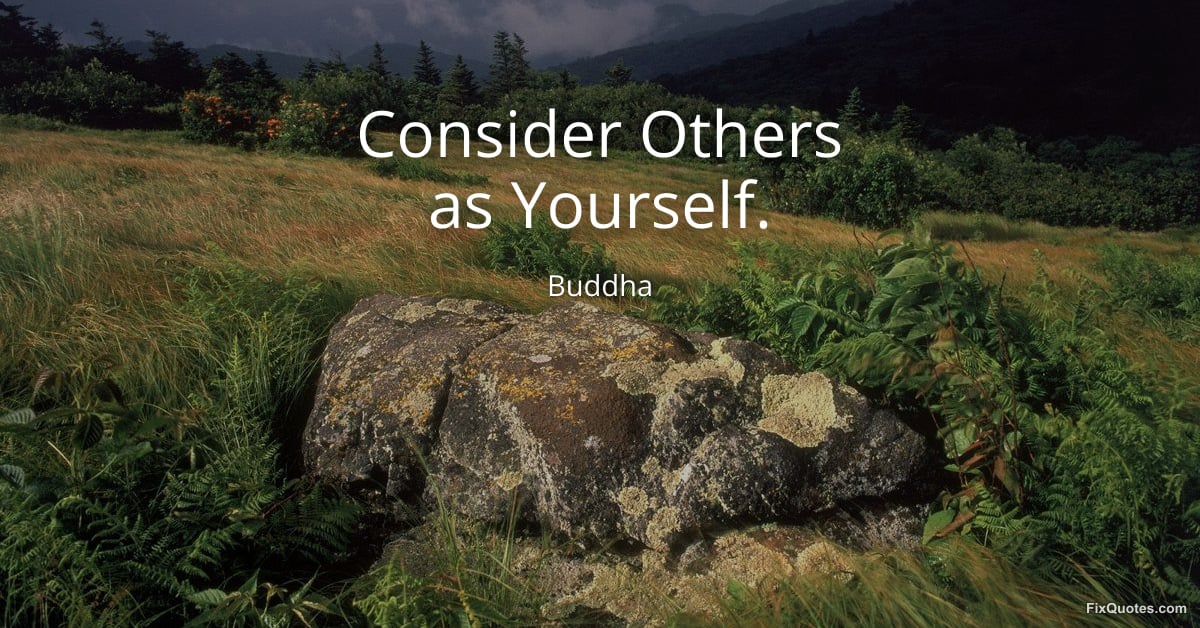
"Consider Others as Yourself"
About this Quote
Not a slogan of niceness, but a radical dismantling of the self's usual hierarchy. "Consider Others as Yourself" compresses an enormous moral and spiritual project into five plain words. Its force lies in how quietly it overturns instinct: most people do not merely care about themselves first; they experience themselves as more real, more urgent, more worthy of protection than anyone else. Buddha targets that reflex at the root.
The line works because it is not framed as sentimental charity. It is a disciplined shift in perception. In the Buddhist context, the self is not a fixed, sovereign entity but a bundle of attachments, fears, and illusions. If that boundary is less solid than it feels, then the distinction that justifies selfishness begins to erode. "Others" are no longer background characters in your private drama; their suffering carries the same moral weight as your own.
That makes the statement both ethical and diagnostic. It tells you how to behave, but it also exposes why cruelty, greed, and indifference persist: we overinvest in the fiction of separateness. The command is simple; the implication is severe. A society organized around status, caste, power, or conquest depends on treating some lives as cheaper than others. Buddha's phrasing quietly rejects that entire arrangement.
Its durability comes from that blend of intimacy and scale. It speaks to a person's daily conduct, yet it also gestures toward a social vision in which compassion is not ornamental virtue but a correction to delusion. The moral claim lands because the psychological claim underneath it is so unsettling: the self you defend so fiercely may not deserve its privileged throne.
The line works because it is not framed as sentimental charity. It is a disciplined shift in perception. In the Buddhist context, the self is not a fixed, sovereign entity but a bundle of attachments, fears, and illusions. If that boundary is less solid than it feels, then the distinction that justifies selfishness begins to erode. "Others" are no longer background characters in your private drama; their suffering carries the same moral weight as your own.
That makes the statement both ethical and diagnostic. It tells you how to behave, but it also exposes why cruelty, greed, and indifference persist: we overinvest in the fiction of separateness. The command is simple; the implication is severe. A society organized around status, caste, power, or conquest depends on treating some lives as cheaper than others. Buddha's phrasing quietly rejects that entire arrangement.
Its durability comes from that blend of intimacy and scale. It speaks to a person's daily conduct, yet it also gestures toward a social vision in which compassion is not ornamental virtue but a correction to delusion. The moral claim lands because the psychological claim underneath it is so unsettling: the self you defend so fiercely may not deserve its privileged throne.
Quote Details
| Topic | Kindness |
|---|---|
| Source | Help us find the source |
| Cite |
Citation Formats
APA Style (7th ed.)
Buddha. (2026, March 10). Consider Others as Yourself. FixQuotes. https://fixquotes.com/quotes/consider-others-as-yourself-185960/
Chicago Style
Buddha. "Consider Others as Yourself." FixQuotes. March 10, 2026. https://fixquotes.com/quotes/consider-others-as-yourself-185960/.
MLA Style (9th ed.)
"Consider Others as Yourself." FixQuotes, 10 Mar. 2026, https://fixquotes.com/quotes/consider-others-as-yourself-185960/. Accessed 12 Mar. 2026.
More Quotes by Buddha
Add to List