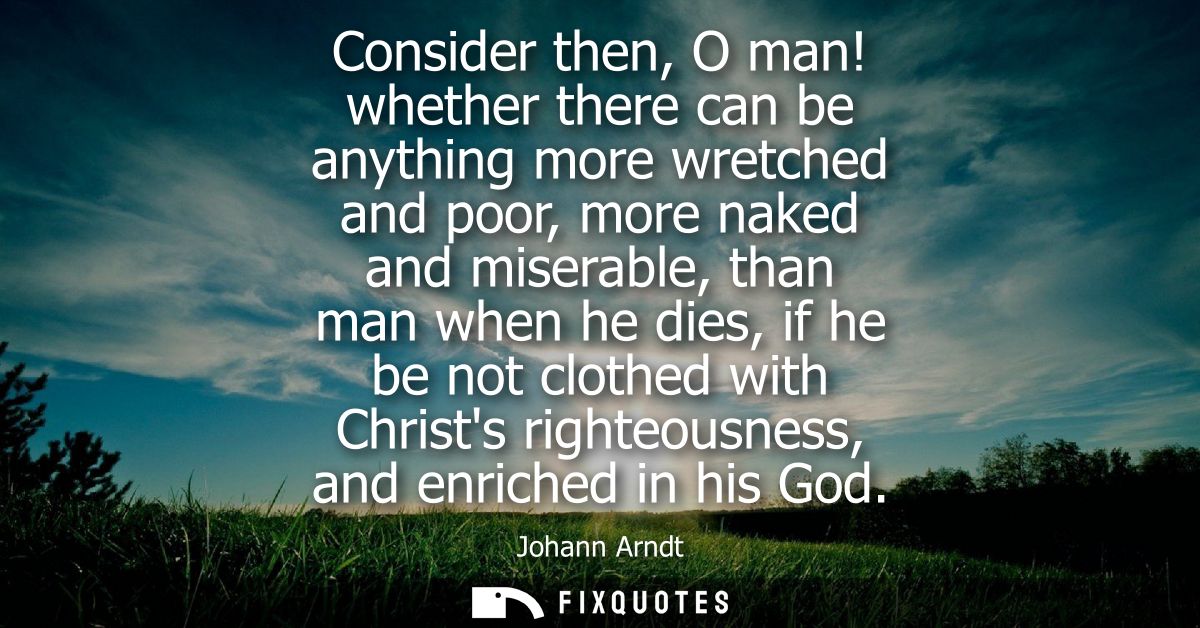
"Consider then, O man! whether there can be anything more wretched and poor, more naked and miserable, than man when he dies, if he be not clothed with Christ's righteousness, and enriched in his God"
About this Quote
Arndt doesn’t soothe; he strips. The line is built like a spiritual undressing, piling up “wretched and poor, more naked and miserable” until “man when he dies” looks less like a dignified passage and more like exposure under a harsh light. It’s classic early modern Protestant rhetoric: death is the ultimate audit, and whatever social status or moral self-confidence you’ve accrued won’t survive the moment your body can’t prop it up anymore.
The intent is pastoral, but it’s pastoral with teeth. Arndt is aiming at the kind of Christianity that functions as cultural affiliation or moral résumé. By framing righteousness as something you must be “clothed” in, he echoes the Reformation’s insistence on an alien righteousness: not self-produced virtue, but Christ’s righteousness counted and worn by faith. The garment metaphor isn’t decorative; it’s a demolition tool for merit. If righteousness is clothing, then human achievement is, at best, a costume that won’t count at the grave.
The subtext is social as much as spiritual. In an era marked by plague, war, and precarious life, the promise of control was thin. Arndt harnesses that instability: if death makes everyone equally “naked,” then the only real wealth is being “enriched in his God.” That phrasing quietly relocates value from churchly performance to inner renewal, anticipating Pietism’s emphasis on lived devotion. Fear is the accelerant, but the target is not despair; it’s dependence.
The intent is pastoral, but it’s pastoral with teeth. Arndt is aiming at the kind of Christianity that functions as cultural affiliation or moral résumé. By framing righteousness as something you must be “clothed” in, he echoes the Reformation’s insistence on an alien righteousness: not self-produced virtue, but Christ’s righteousness counted and worn by faith. The garment metaphor isn’t decorative; it’s a demolition tool for merit. If righteousness is clothing, then human achievement is, at best, a costume that won’t count at the grave.
The subtext is social as much as spiritual. In an era marked by plague, war, and precarious life, the promise of control was thin. Arndt harnesses that instability: if death makes everyone equally “naked,” then the only real wealth is being “enriched in his God.” That phrasing quietly relocates value from churchly performance to inner renewal, anticipating Pietism’s emphasis on lived devotion. Fear is the accelerant, but the target is not despair; it’s dependence.
Quote Details
| Topic | Faith |
|---|
More Quotes by Johann
Add to List