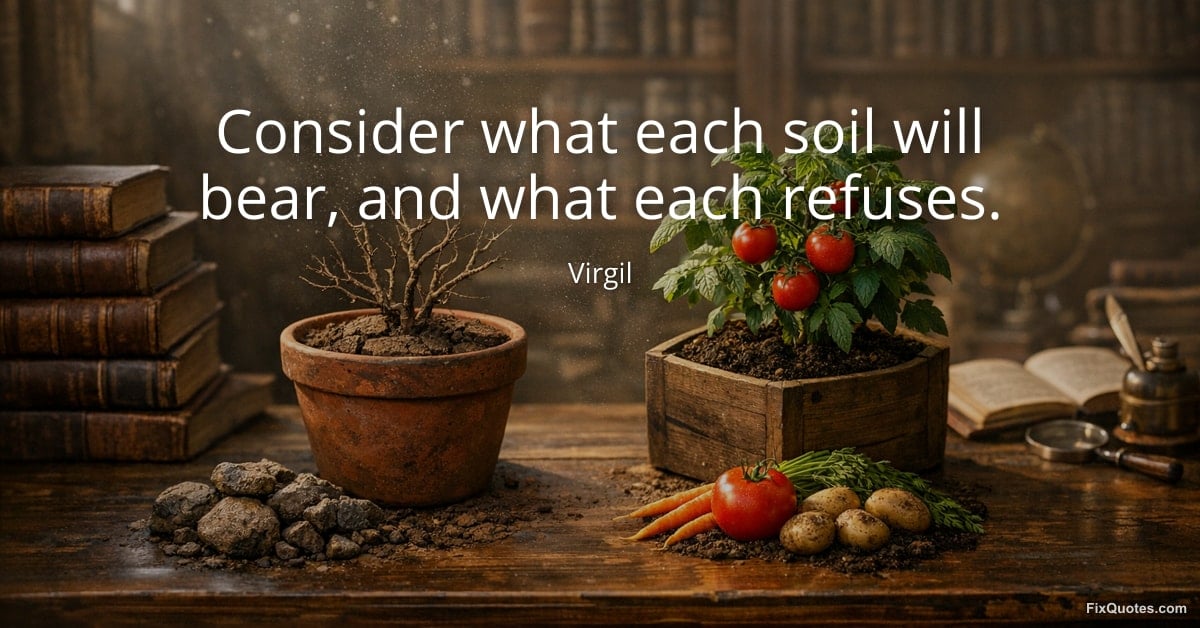
"Consider what each soil will bear, and what each refuses"
About this Quote
An agronomy tip that doubles as a quietly hard-nosed philosophy: know the limits before you start preaching possibility. Virgil, writing in a Rome freshly bloodied by civil war, isn’t merely admiring pastoral life in the abstract. In the Georgics, farming becomes a civic metaphor for rebuilding - not through grand speeches, but through disciplined attention to what reality will actually yield.
The line’s power comes from its split logic: “will bear” versus “refuses.” It’s not optimistic advice about growth; it’s an instruction manual for constraint. Virgil’s farmer is a reader of signs, a technician of patience. That posture carries subtext for an empire trying to stabilize itself: governance, like cultivation, fails when it treats land (or people) as interchangeable. Different fields demand different labor, different crops, different expectations. Ignore that, and you don’t get heroism - you get famine.
There’s also a pointed moral edge. “Consider” implies deliberation, prudence, even humility: the farmer doesn’t dominate nature so much as negotiate with it. That’s a corrective to Roman fantasies of total mastery, the same fantasies that make conquest seem clean and politics seem simple. Virgil’s realism is almost political therapy: accept refusal early, and you can redirect effort toward what’s viable.
Read now, it lands as a critique of one-size-fits-all thinking - in policy, in education, in self-help. The line refuses the seduction of brute willpower. It asks for intelligence that isn’t glamorous: the kind that listens to the ground.
The line’s power comes from its split logic: “will bear” versus “refuses.” It’s not optimistic advice about growth; it’s an instruction manual for constraint. Virgil’s farmer is a reader of signs, a technician of patience. That posture carries subtext for an empire trying to stabilize itself: governance, like cultivation, fails when it treats land (or people) as interchangeable. Different fields demand different labor, different crops, different expectations. Ignore that, and you don’t get heroism - you get famine.
There’s also a pointed moral edge. “Consider” implies deliberation, prudence, even humility: the farmer doesn’t dominate nature so much as negotiate with it. That’s a corrective to Roman fantasies of total mastery, the same fantasies that make conquest seem clean and politics seem simple. Virgil’s realism is almost political therapy: accept refusal early, and you can redirect effort toward what’s viable.
Read now, it lands as a critique of one-size-fits-all thinking - in policy, in education, in self-help. The line refuses the seduction of brute willpower. It asks for intelligence that isn’t glamorous: the kind that listens to the ground.
Quote Details
| Topic | Wisdom |
|---|---|
| Source | Verified source: Georgics (Book 1) (Virgil, -29)
Evidence: et quid quaeque ferat regio et quid quaeque recuset. (Book 1, line 53 (often numbered 1.50–53 in editions; Latin line: "et quid quaeque ferat regio et quid quaeque recuset")). This is the primary-source line in Virgil’s Georgics (Latin: Georgica), Book 1, commonly dated to around 29 BCE (the poem was composed in the late 30s BCE and published around 29 BCE). The widely-circulated English quotation “Consider what each soil will bear, and what each refuses” is a translation/paraphrase of this Latin line, which more literally means “and what each region/area produces and what each rejects/refuses.” A readily-checkable public-domain English rendering close in sense is: “...and what each quarter will bear and what each will reject.” (Georgics 1, in an English translation hosted at Sacred Texts). ([nodictionaries.com](https://nodictionaries.com/vergil/georgic-1/43-70?utm_source=openai)) Other candidates (1) Field Methods in Marine Science (Scott Milroy, 2022) compilation95.0% ... Consider what each soil will bear, and what each refuses.” – Virgil Unlike hydrologic data, the information we se... |
| Cite |
Citation Formats
APA Style (7th ed.)
Virgil. (2026, February 7). Consider what each soil will bear, and what each refuses. FixQuotes. https://fixquotes.com/quotes/consider-what-each-soil-will-bear-and-what-each-8671/
Chicago Style
Virgil. "Consider what each soil will bear, and what each refuses." FixQuotes. February 7, 2026. https://fixquotes.com/quotes/consider-what-each-soil-will-bear-and-what-each-8671/.
MLA Style (9th ed.)
"Consider what each soil will bear, and what each refuses." FixQuotes, 7 Feb. 2026, https://fixquotes.com/quotes/consider-what-each-soil-will-bear-and-what-each-8671/. Accessed 31 Mar. 2026.
More Quotes by Virgil
Add to List