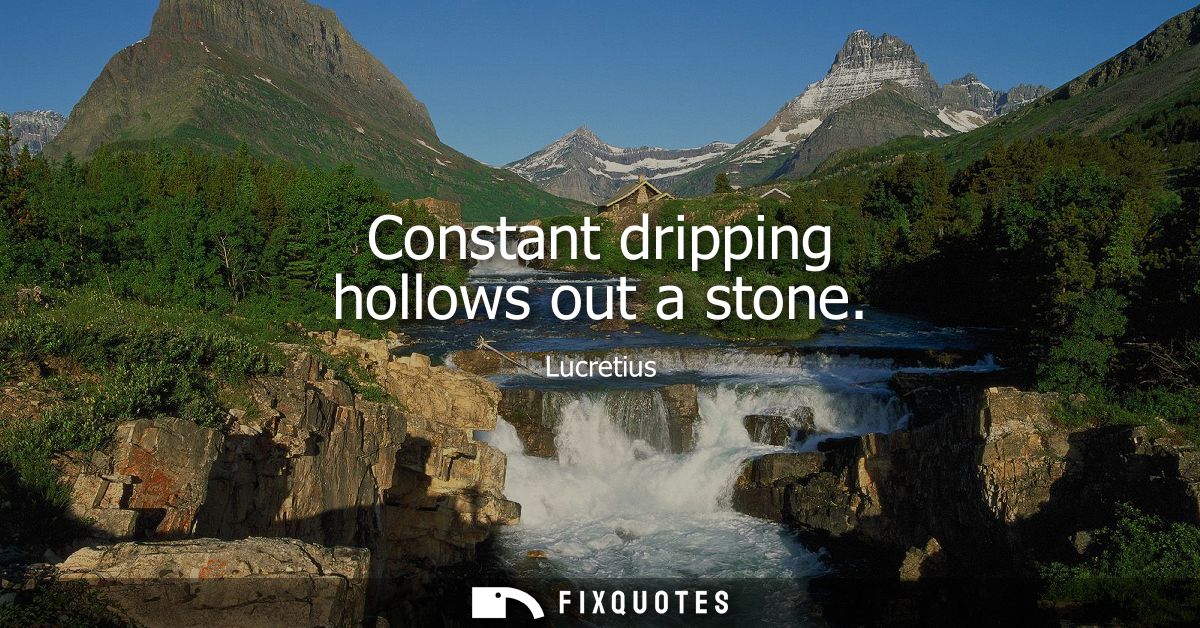
"Constant dripping hollows out a stone"
About this Quote
“Constant dripping hollows out a stone” is persuasion disguised as geology: the quiet claim that time, not drama, is the real engine of change. Lucretius, the Roman poet-philosopher behind De Rerum Natura, wrote in a culture that prized heroic spectacle and civic grandeur. His Epicurean project cut against that grain. He wanted readers to trade superstition and panic for a materialist view of the world, where tiny, consistent forces accumulate into outcomes that look miraculous only if you ignore the process.
The line works because it collapses scale. A drip is almost nothing; a stone is stubborn, heavy, status-quo itself. Put them in the same sentence and you get an argument about power that doesn’t flatter the powerful. No gods are required, no single decisive blow, no epic turning point. Just physics and patience. That’s Lucretius’s broader subtext: the universe is made of small particles and small motions; our fears and institutions are, too. If superstition feels unmovable, that’s because it’s been deposited over generations. If it can be undone, it will be undone the same way: by repeated contact with a clearer explanation.
There’s also a sly moral instruction hiding in the natural image. Don’t wait for inspiration. Don’t fetishize the grand gesture. Keep applying the gentle pressure of thought, habit, and evidence. The drip is unglamorous, even tedious, which is exactly why it’s convincing: it frames persistence as a law of nature rather than a self-help slogan.
The line works because it collapses scale. A drip is almost nothing; a stone is stubborn, heavy, status-quo itself. Put them in the same sentence and you get an argument about power that doesn’t flatter the powerful. No gods are required, no single decisive blow, no epic turning point. Just physics and patience. That’s Lucretius’s broader subtext: the universe is made of small particles and small motions; our fears and institutions are, too. If superstition feels unmovable, that’s because it’s been deposited over generations. If it can be undone, it will be undone the same way: by repeated contact with a clearer explanation.
There’s also a sly moral instruction hiding in the natural image. Don’t wait for inspiration. Don’t fetishize the grand gesture. Keep applying the gentle pressure of thought, habit, and evidence. The drip is unglamorous, even tedious, which is exactly why it’s convincing: it frames persistence as a law of nature rather than a self-help slogan.
Quote Details
| Topic | Perseverance |
|---|---|
| Source | Lucretius, De Rerum Natura (On the Nature of Things), 1st century BCE — English rendering of the Latin proverb from Lucretius (commonly from the line expressing 'gutta cavat lapidem'). |
| Cite |
Citation Formats
APA Style (7th ed.)
Lucretius. (2026, January 15). Constant dripping hollows out a stone. FixQuotes. https://fixquotes.com/quotes/constant-dripping-hollows-out-a-stone-557/
Chicago Style
Lucretius. "Constant dripping hollows out a stone." FixQuotes. January 15, 2026. https://fixquotes.com/quotes/constant-dripping-hollows-out-a-stone-557/.
MLA Style (9th ed.)
"Constant dripping hollows out a stone." FixQuotes, 15 Jan. 2026, https://fixquotes.com/quotes/constant-dripping-hollows-out-a-stone-557/. Accessed 12 Feb. 2026.
More Quotes by Lucretius
Add to List