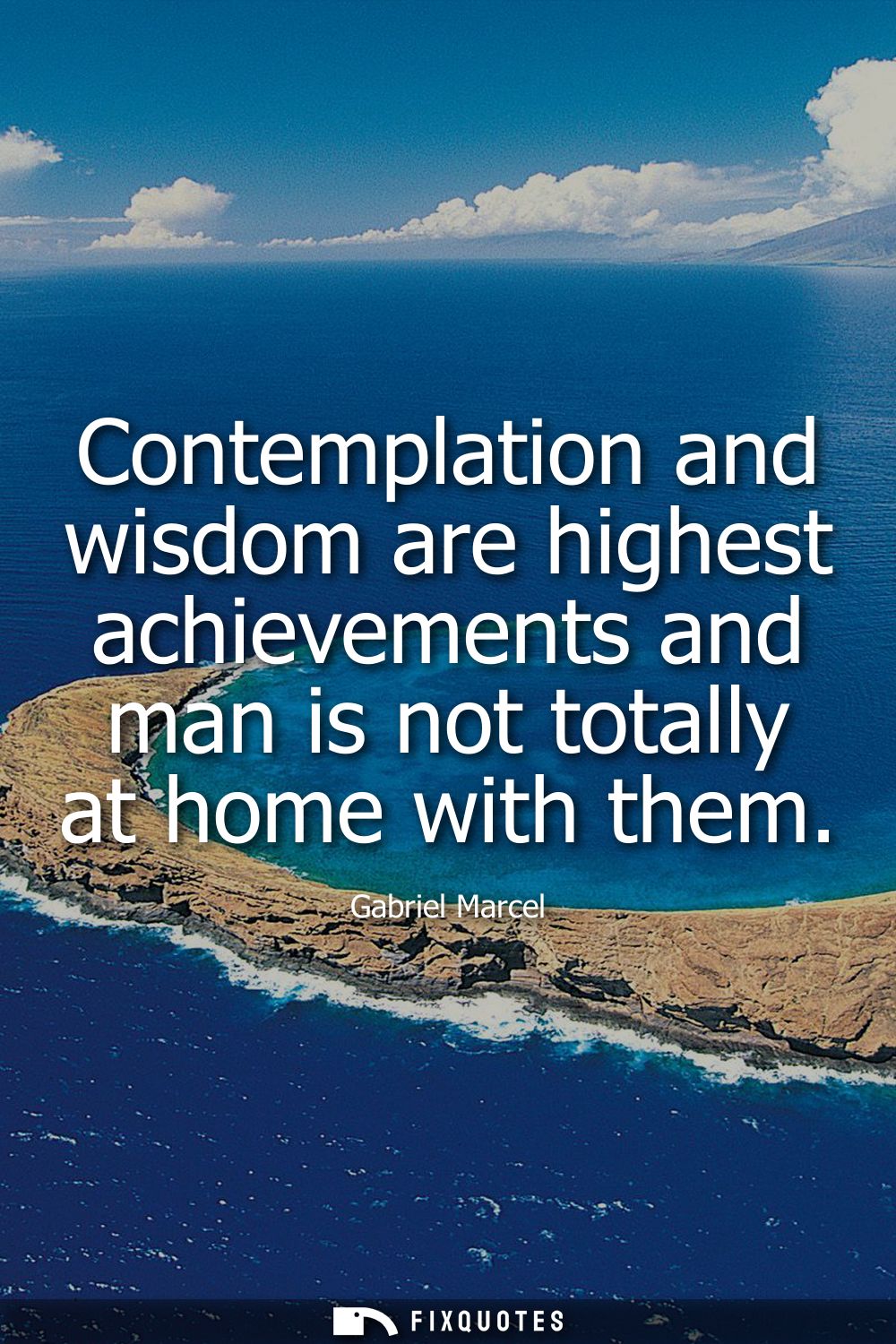
"Contemplation and wisdom are highest achievements, and man is not totally at home with them"
About this Quote
The intent is less to romanticize philosophy than to expose its cost. Marcel, an existentialist with Christian inflections, wrote in the shadow of two world wars and the rising prestige of technical rationality. His work often distinguishes between "problem" and "mystery": problems can be solved from the outside; mysteries are lived from within. Contemplation and wisdom belong to the second category, which is why they unsettle. They demand vulnerability, patience, and a willingness to be changed by what you perceive. That’s incompatible with the modern self-image of mastery and control.
The subtext is also moral: our discomfort with wisdom isn’t just cognitive, it’s existential. Wisdom implies limits, dependence, and responsibility. Contemplation implies slowing down and noticing what our busyness keeps hidden. Marcel’s line lands because it refuses the flattering story that humans are simply rational animals waiting to optimize. It suggests we’re also runaways from our own interior life, homesick for a home we resist inhabiting.
Quote Details
| Topic | Wisdom |
|---|---|
| Source | Help us find the source |
| Cite |
Citation Formats
APA Style (7th ed.)
Marcel, Gabriel. (2026, February 20). Contemplation and wisdom are highest achievements, and man is not totally at home with them. FixQuotes. https://fixquotes.com/quotes/contemplation-and-wisdom-are-highest-achievements-2778/
Chicago Style
Marcel, Gabriel. "Contemplation and wisdom are highest achievements, and man is not totally at home with them." FixQuotes. February 20, 2026. https://fixquotes.com/quotes/contemplation-and-wisdom-are-highest-achievements-2778/.
MLA Style (9th ed.)
"Contemplation and wisdom are highest achievements, and man is not totally at home with them." FixQuotes, 20 Feb. 2026, https://fixquotes.com/quotes/contemplation-and-wisdom-are-highest-achievements-2778/. Accessed 29 Mar. 2026.