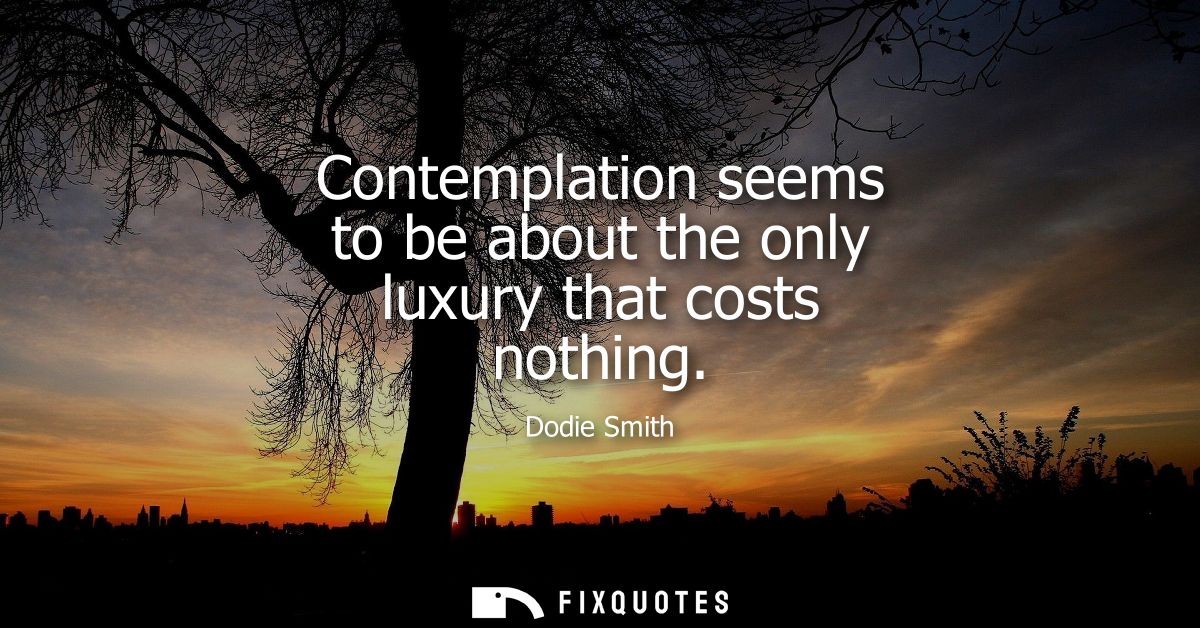
"Contemplation seems to be about the only luxury that costs nothing"
About this Quote
In an economy of attention, Dodie Smith elevates the cheapest activity into an almost subversive form of wealth. The line is deceptively light: “seems to be” softens the claim, as if she’s letting you in on a private observation rather than preaching. That understatement is the key. Smith isn’t romanticizing idleness; she’s pointing at how thoroughly modern life monetizes relief. Rest has a price tag. Escapism comes with subscriptions. Even “self-care” gets sold back to you in jars, apps, and retreats.
Calling contemplation a “luxury” is the sly turn. Luxury usually signals exclusivity and consumption, something you display. Contemplation is neither. It’s invisible, unmarketable, and stubbornly interior. By framing it as luxury, Smith flips the hierarchy: the richest experience may be the one that can’t be purchased, only claimed. That’s a quietly democratic idea, but it carries an edge. If contemplation costs nothing, why do so few people allow themselves to have it? The answer implied is not financial but social: time is policed by expectations, labor, gender roles, and the moral suspicion that thinking without producing is indulgent.
As a dramatist, Smith also knows contemplation isn’t passive. It’s rehearsal for living: the pause before the line, the beat that gives meaning to action. In that sense, the quote is a defense of inwardness as a necessary counterweight to a culture that treats busyness as virtue and purchases as proof of vitality.
Calling contemplation a “luxury” is the sly turn. Luxury usually signals exclusivity and consumption, something you display. Contemplation is neither. It’s invisible, unmarketable, and stubbornly interior. By framing it as luxury, Smith flips the hierarchy: the richest experience may be the one that can’t be purchased, only claimed. That’s a quietly democratic idea, but it carries an edge. If contemplation costs nothing, why do so few people allow themselves to have it? The answer implied is not financial but social: time is policed by expectations, labor, gender roles, and the moral suspicion that thinking without producing is indulgent.
As a dramatist, Smith also knows contemplation isn’t passive. It’s rehearsal for living: the pause before the line, the beat that gives meaning to action. In that sense, the quote is a defense of inwardness as a necessary counterweight to a culture that treats busyness as virtue and purchases as proof of vitality.
Quote Details
| Topic | Wisdom |
|---|---|
| Source | Verified source: I Capture the Castle (Dodie Smith, 1948)
Evidence: Contemplation seems to be about the only luxury that costs nothing.. Primary-source attribution: the line is widely attributed to Dodie Smith's novel I Capture the Castle, which was first published in 1948. However, I could not access/verify the quote directly in a fully viewable scan of the 1948 first edition within this search session, so I cannot reliably provide the first-edition publisher or the exact first-edition page/chapter. Many quote sites also attach varying page numbers tied to later reprints/ebooks, which are not stable across editions. For a definitive FIRST-publication verification, the best next step is to check a scan or physical copy of the 1948 first edition and locate the sentence in context (or use a library database/Google Books snippet view that shows the line in-page with bibliographic details). Other candidates (1) Wisdom of Wealth (Poornesh K.K., 2020) compilation95.0% ... Contemplation seems to be about the only luxury that costs nothing. Dodie Smith Businesses often succeed and fail... |
| Cite |
Citation Formats
APA Style (7th ed.)
Smith, Dodie. (2026, February 20). Contemplation seems to be about the only luxury that costs nothing. FixQuotes. https://fixquotes.com/quotes/contemplation-seems-to-be-about-the-only-luxury-143558/
Chicago Style
Smith, Dodie. "Contemplation seems to be about the only luxury that costs nothing." FixQuotes. February 20, 2026. https://fixquotes.com/quotes/contemplation-seems-to-be-about-the-only-luxury-143558/.
MLA Style (9th ed.)
"Contemplation seems to be about the only luxury that costs nothing." FixQuotes, 20 Feb. 2026, https://fixquotes.com/quotes/contemplation-seems-to-be-about-the-only-luxury-143558/. Accessed 3 Apr. 2026.
More Quotes by Dodie
Add to List