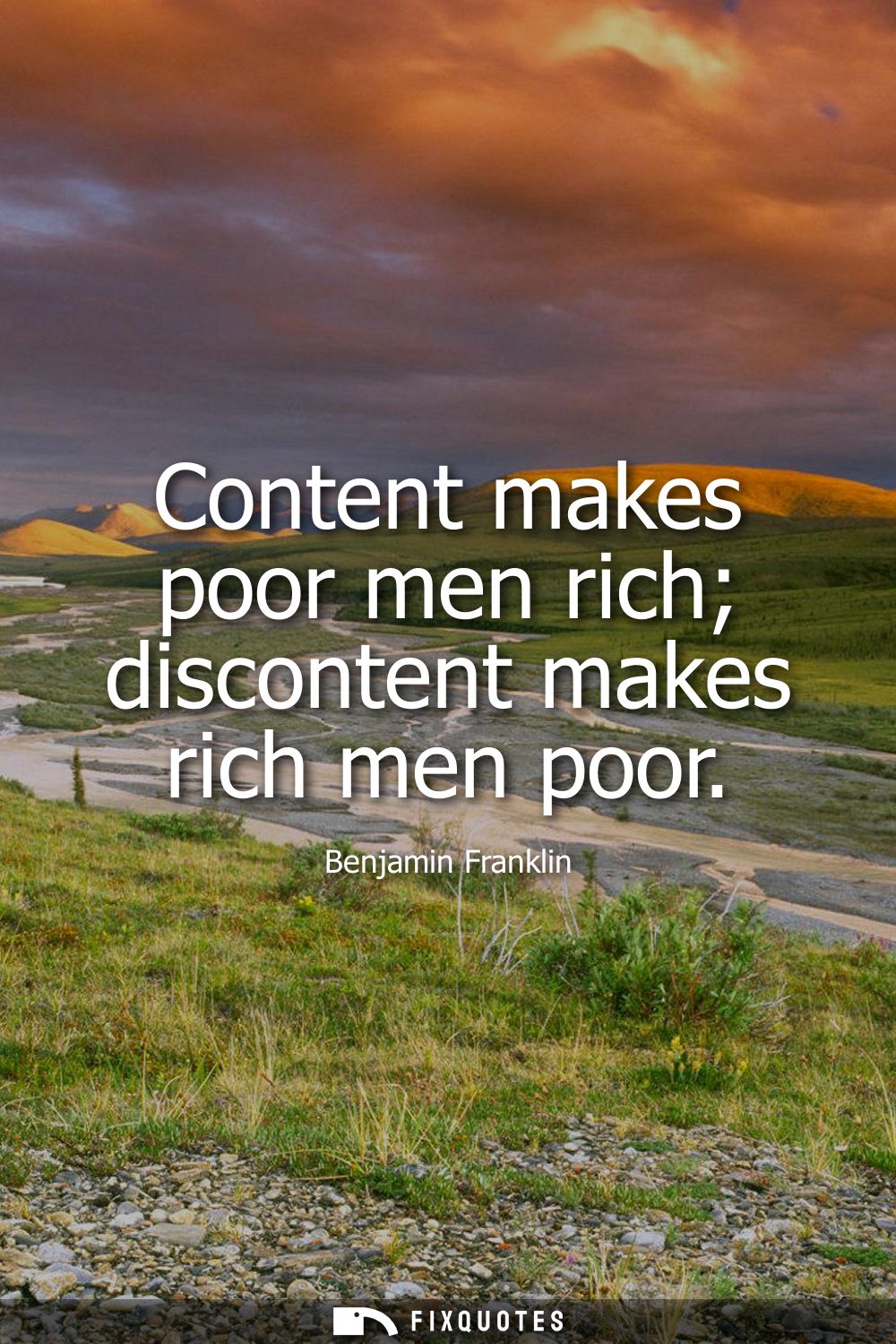
"Content makes poor men rich; discontent makes rich men poor"
About this Quote
Franklin lands the punch with a neat chiasmus: content/discontent, poor/rich, rich/poor. It reads like a proverb, but it’s also an argument about power. In a society obsessed with property and rank, he flips the usual hierarchy and says wealth is not the winning hand people think it is. The poor man’s “riches” aren’t coins; they’re a kind of sovereignty over desire. The rich man’s “poverty” isn’t literal destitution; it’s captivity to appetite, status, and comparison.
The intent is partly moral (cultivate contentment), but the subtext is political. Franklin helped build a republic that distrusted hereditary aristocracy and prized self-command as civic virtue. Contentment becomes a democratizing force: it denies elites their favorite leverage, the promise that happiness can be purchased or bestowed. Discontent, by contrast, is corrosive not because wanting more is inherently shameful, but because it makes you governable by your own restlessness. You can own everything and still live like a debtor to the next thing.
Context matters: Franklin’s America was a marketplace society in formation, where upward mobility was plausible and also spiritually perilous. His maxim is a warning shot across the bow of consumer temptation before consumer culture had a name. It’s also a subtle rebuke to both resentment and complacency: the poor can be “rich” without romanticizing poverty, and the rich can be “poor” without pretending money is meaningless. The line works because it treats wealth as psychology with consequences, not just economics.
The intent is partly moral (cultivate contentment), but the subtext is political. Franklin helped build a republic that distrusted hereditary aristocracy and prized self-command as civic virtue. Contentment becomes a democratizing force: it denies elites their favorite leverage, the promise that happiness can be purchased or bestowed. Discontent, by contrast, is corrosive not because wanting more is inherently shameful, but because it makes you governable by your own restlessness. You can own everything and still live like a debtor to the next thing.
Context matters: Franklin’s America was a marketplace society in formation, where upward mobility was plausible and also spiritually perilous. His maxim is a warning shot across the bow of consumer temptation before consumer culture had a name. It’s also a subtle rebuke to both resentment and complacency: the poor can be “rich” without romanticizing poverty, and the rich can be “poor” without pretending money is meaningless. The line works because it treats wealth as psychology with consequences, not just economics.
Quote Details
| Topic | Contentment |
|---|---|
| Source | Help us find the source |
| Cite |
Citation Formats
APA Style (7th ed.)
Franklin, Benjamin. (2026, January 17). Content makes poor men rich; discontent makes rich men poor. FixQuotes. https://fixquotes.com/quotes/content-makes-poor-men-rich-discontent-makes-rich-25476/
Chicago Style
Franklin, Benjamin. "Content makes poor men rich; discontent makes rich men poor." FixQuotes. January 17, 2026. https://fixquotes.com/quotes/content-makes-poor-men-rich-discontent-makes-rich-25476/.
MLA Style (9th ed.)
"Content makes poor men rich; discontent makes rich men poor." FixQuotes, 17 Jan. 2026, https://fixquotes.com/quotes/content-makes-poor-men-rich-discontent-makes-rich-25476/. Accessed 14 Feb. 2026.
More Quotes by Benjamin
Add to List