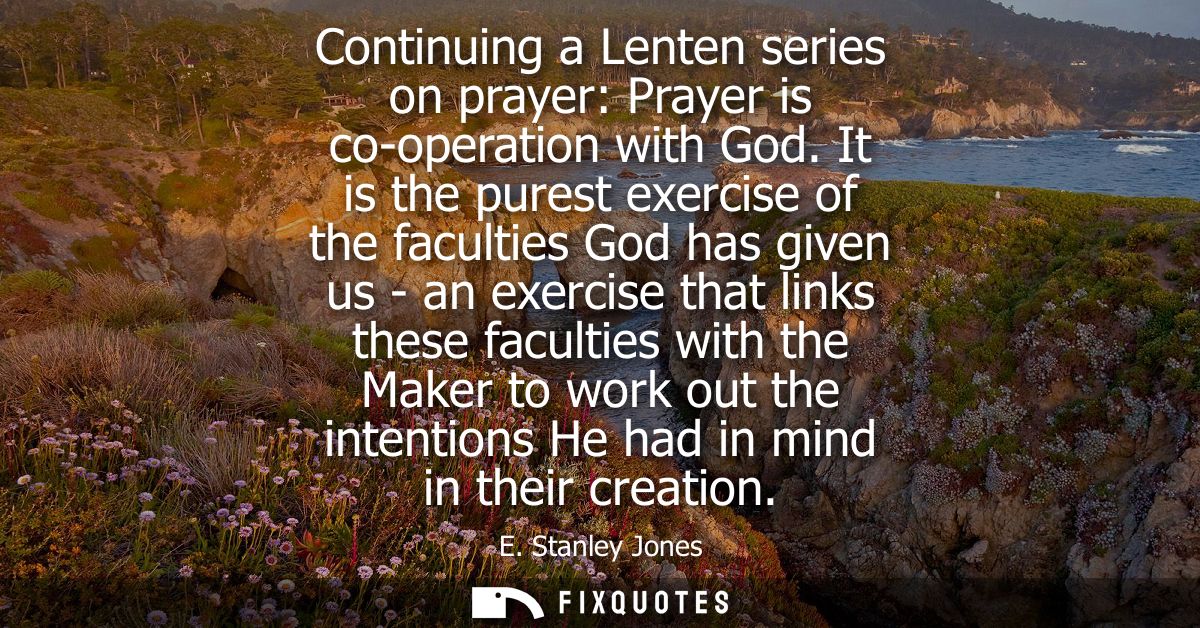
"Continuing a Lenten series on prayer: Prayer is co-operation with God. It is the purest exercise of the faculties God has given us - an exercise that links these faculties with the Maker to work out the intentions He had in mind in their creation"
About this Quote
The line about “the purest exercise of the faculties God has given us” is a deliberate elevation of prayer into the realm of disciplined practice. “Faculties” reads almost clinical - mind, will, imagination, conscience - suggesting that prayer engages the whole human instrument. The subtext: if your prayer life is sentimental, passive, or purely private, you’re underusing what you were made for. Prayer becomes a kind of spiritual ergonomics, aligning human capability with divine purpose.
Context matters: Jones, a Methodist missionary and major voice in early 20th-century evangelical social engagement, wrote in an era when Christianity was wrestling with modernity’s stress on human autonomy and psychology. His formulation holds onto divine sovereignty while refusing fatalism. “Work out the intentions He had in mind” hints at vocation and moral responsibility: prayer is participation in a project already underway, not a negotiation to change God’s mind. It’s also a subtle critique of performative piety - prayer as cooperation implies results measured in character and action, not eloquence.
Quote Details
| Topic | Prayer |
|---|---|
| Source | Help us find the source |
| Cite |
Citation Formats
APA Style (7th ed.)
Jones, E. Stanley. (2026, January 18). Continuing a Lenten series on prayer: Prayer is co-operation with God. It is the purest exercise of the faculties God has given us - an exercise that links these faculties with the Maker to work out the intentions He had in mind in their creation. FixQuotes. https://fixquotes.com/quotes/continuing-a-lenten-series-on-prayer-prayer-is-9762/
Chicago Style
Jones, E. Stanley. "Continuing a Lenten series on prayer: Prayer is co-operation with God. It is the purest exercise of the faculties God has given us - an exercise that links these faculties with the Maker to work out the intentions He had in mind in their creation." FixQuotes. January 18, 2026. https://fixquotes.com/quotes/continuing-a-lenten-series-on-prayer-prayer-is-9762/.
MLA Style (9th ed.)
"Continuing a Lenten series on prayer: Prayer is co-operation with God. It is the purest exercise of the faculties God has given us - an exercise that links these faculties with the Maker to work out the intentions He had in mind in their creation." FixQuotes, 18 Jan. 2026, https://fixquotes.com/quotes/continuing-a-lenten-series-on-prayer-prayer-is-9762/. Accessed 27 Mar. 2026.