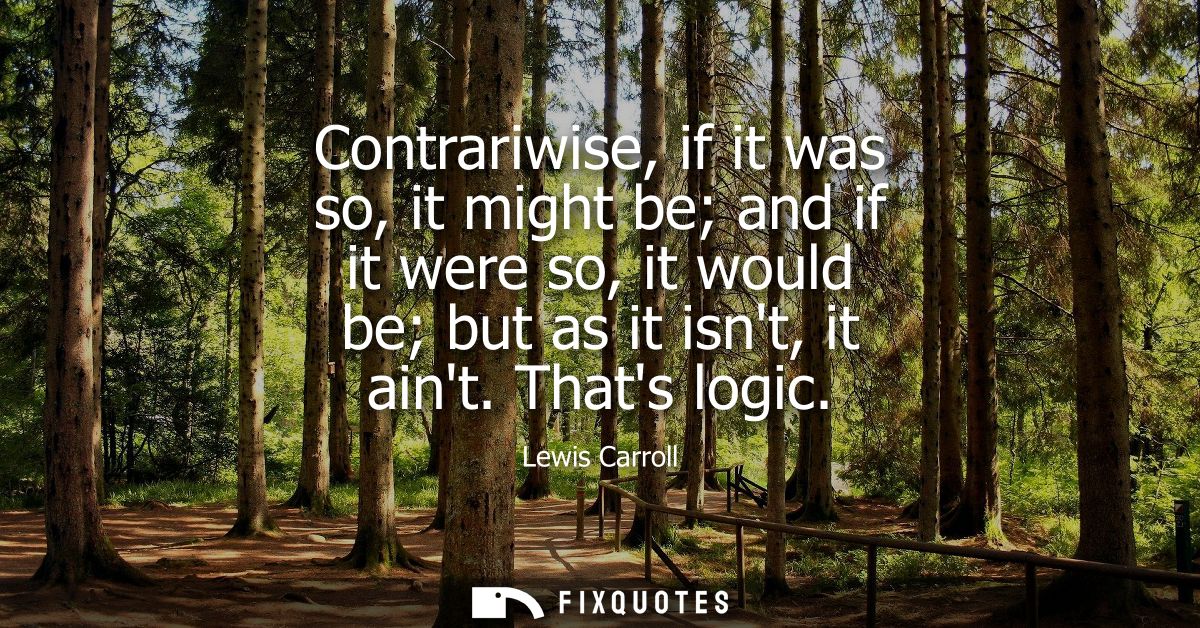
"Contrariwise, if it was so, it might be; and if it were so, it would be; but as it isn't, it ain't. That's logic"
About this Quote
Carroll’s intent is less to mock logic itself than to mock our reverence for the sound of logic. The line parodies how “reason” can be made to feel airtight through repetition and structure, even when it concludes with nothing more than a restated fact. It’s a comic loop: possibility is dangled (“it might be”), hypotheticals are stacked, and then the whole thing resolves into the obvious. “That’s logic” lands like a smug stamp of authority, exposing how people use the word logic as a social cudgel - a way to end conversation rather than clarify it.
Contextually, this belongs to Carroll’s larger project: turning language into a funhouse mirror. In Alice’s world, rules aren’t stable; they’re costumes. The subtext is sharp: when a society prizes rationality as a badge, it becomes easy to counterfeit. All you need is the cadence of certainty, and an audience trained to applaud the form.
Quote Details
| Topic | Reason & Logic |
|---|---|
| Source | Through the Looking-Glass and What Alice Found There (Lewis Carroll, 1871), chapter "Tweedledum and Tweedledee" — contains the line commonly rendered: "Contrariwise, if it was so, it might be; and if it were so, it would be; but as it isn't, it ain't. That's logic." |
| Cite |
Citation Formats
APA Style (7th ed.)
Carroll, Lewis. (2026, January 18). Contrariwise, if it was so, it might be; and if it were so, it would be; but as it isn't, it ain't. That's logic. FixQuotes. https://fixquotes.com/quotes/contrariwise-if-it-was-so-it-might-be-and-if-it-22399/
Chicago Style
Carroll, Lewis. "Contrariwise, if it was so, it might be; and if it were so, it would be; but as it isn't, it ain't. That's logic." FixQuotes. January 18, 2026. https://fixquotes.com/quotes/contrariwise-if-it-was-so-it-might-be-and-if-it-22399/.
MLA Style (9th ed.)
"Contrariwise, if it was so, it might be; and if it were so, it would be; but as it isn't, it ain't. That's logic." FixQuotes, 18 Jan. 2026, https://fixquotes.com/quotes/contrariwise-if-it-was-so-it-might-be-and-if-it-22399/. Accessed 6 Apr. 2026.