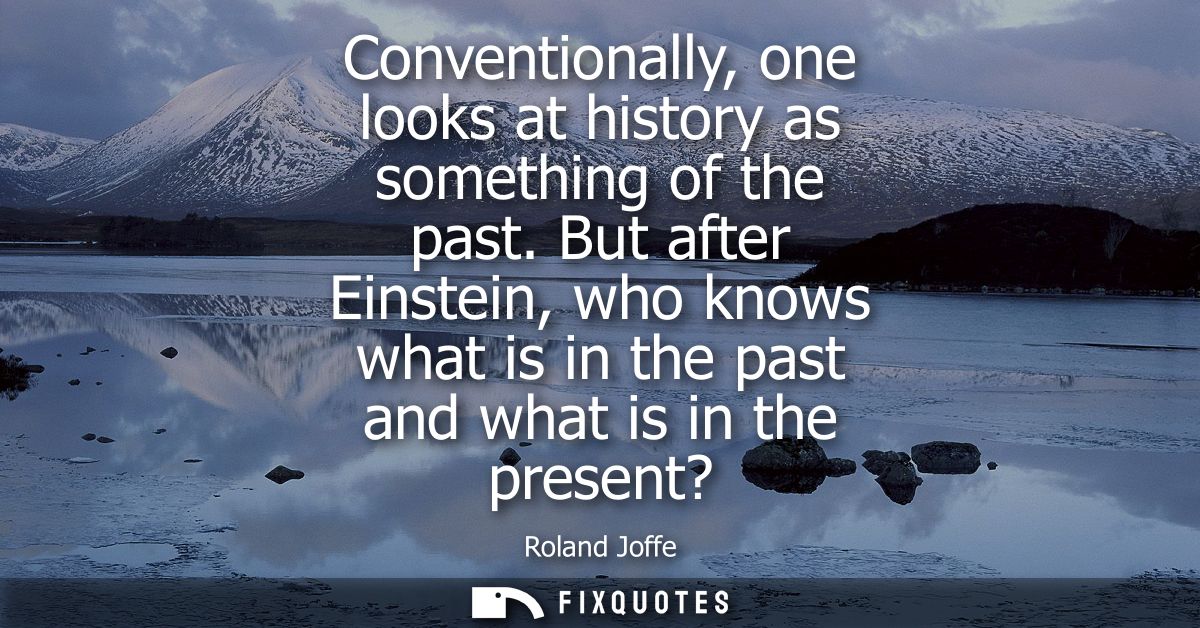
"Conventionally, one looks at history as something of the past. But after Einstein, who knows what is in the past and what is in the present?"
About this Quote
Joffe’s intent feels pointedly cultural, even political. “After Einstein” becomes shorthand for modernity’s disorientation: if simultaneity depends on where you stand, then so does the story. The subtext is that history isn’t merely recorded; it’s constantly edited by perspective, speed, and distance - by who’s looking, and from what vantage. That’s a director’s worldview in a sentence: chronology is less important than framing.
Context matters here because Joffe’s films often stage the past as a live wire, not a museum exhibit. Whether you’re watching institutions justify violence or ideals collapse under real incentives, the “past” keeps arriving as consequence, precedent, and propaganda. The line’s quiet sting is that our usual distinction between past and present isn’t just philosophically shaky; it’s socially convenient. If the past is “over,” accountability can be, too. Einstein is the alibi breaker: time is complicated, so maybe our stories about it should be treated with suspicion.
Quote Details
| Topic | Time |
|---|---|
| Source | Help us find the source |
| Cite |
Citation Formats
APA Style (7th ed.)
Joffe, Roland. (2026, January 18). Conventionally, one looks at history as something of the past. But after Einstein, who knows what is in the past and what is in the present? FixQuotes. https://fixquotes.com/quotes/conventionally-one-looks-at-history-as-something-3543/
Chicago Style
Joffe, Roland. "Conventionally, one looks at history as something of the past. But after Einstein, who knows what is in the past and what is in the present?" FixQuotes. January 18, 2026. https://fixquotes.com/quotes/conventionally-one-looks-at-history-as-something-3543/.
MLA Style (9th ed.)
"Conventionally, one looks at history as something of the past. But after Einstein, who knows what is in the past and what is in the present?" FixQuotes, 18 Jan. 2026, https://fixquotes.com/quotes/conventionally-one-looks-at-history-as-something-3543/. Accessed 5 Apr. 2026.