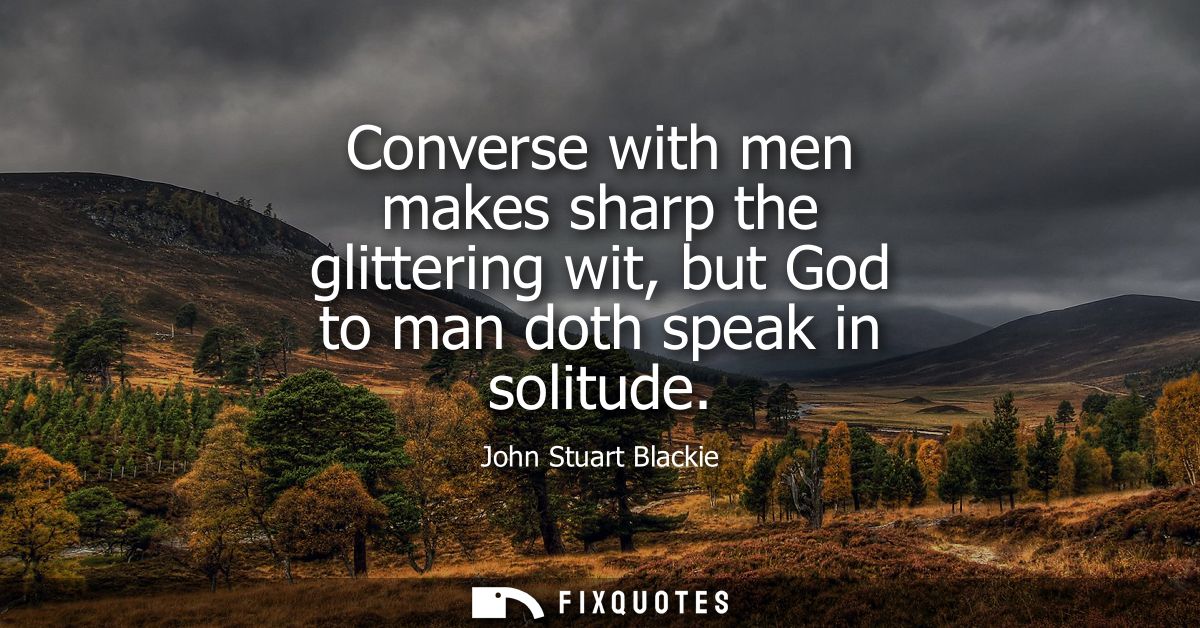
"Converse with men makes sharp the glittering wit, but God to man doth speak in solitude"
About this Quote
Then the line pivots on “but,” and the stakes jump from reputation to revelation. “God to man doth speak in solitude” isn’t just piety; it’s a claim about where authority comes from. Blackie’s subtext is that the deepest truths can’t be crowdsourced. Conversation teaches you how to win a room; solitude teaches you what you actually believe when no one is clapping. The archaic “doth” and inverted syntax give the second clause a scriptural gravity, as if the sentence itself is trying to sound like the kind of voice it recommends listening for.
Context matters: Blackie was a 19th-century Scottish man of letters, shaped by Victorian moral seriousness and a Romantic inheritance that prized inwardness. This is a culture watching modern public life accelerate - newspapers, lecture circuits, clubs - and worrying that cleverness is becoming a substitute for conscience. The line works because it doesn’t reject society; it reframes it. Social brilliance is real, even admirable, but it’s also a distraction unless it’s grounded by the quieter, harder work of being alone with something larger than yourself.
Quote Details
| Topic | God |
|---|---|
| Source | Help us find the source |
| Cite |
Citation Formats
APA Style (7th ed.)
Blackie, John Stuart. (2026, January 18). Converse with men makes sharp the glittering wit, but God to man doth speak in solitude. FixQuotes. https://fixquotes.com/quotes/converse-with-men-makes-sharp-the-glittering-wit-20466/
Chicago Style
Blackie, John Stuart. "Converse with men makes sharp the glittering wit, but God to man doth speak in solitude." FixQuotes. January 18, 2026. https://fixquotes.com/quotes/converse-with-men-makes-sharp-the-glittering-wit-20466/.
MLA Style (9th ed.)
"Converse with men makes sharp the glittering wit, but God to man doth speak in solitude." FixQuotes, 18 Jan. 2026, https://fixquotes.com/quotes/converse-with-men-makes-sharp-the-glittering-wit-20466/. Accessed 31 Mar. 2026.