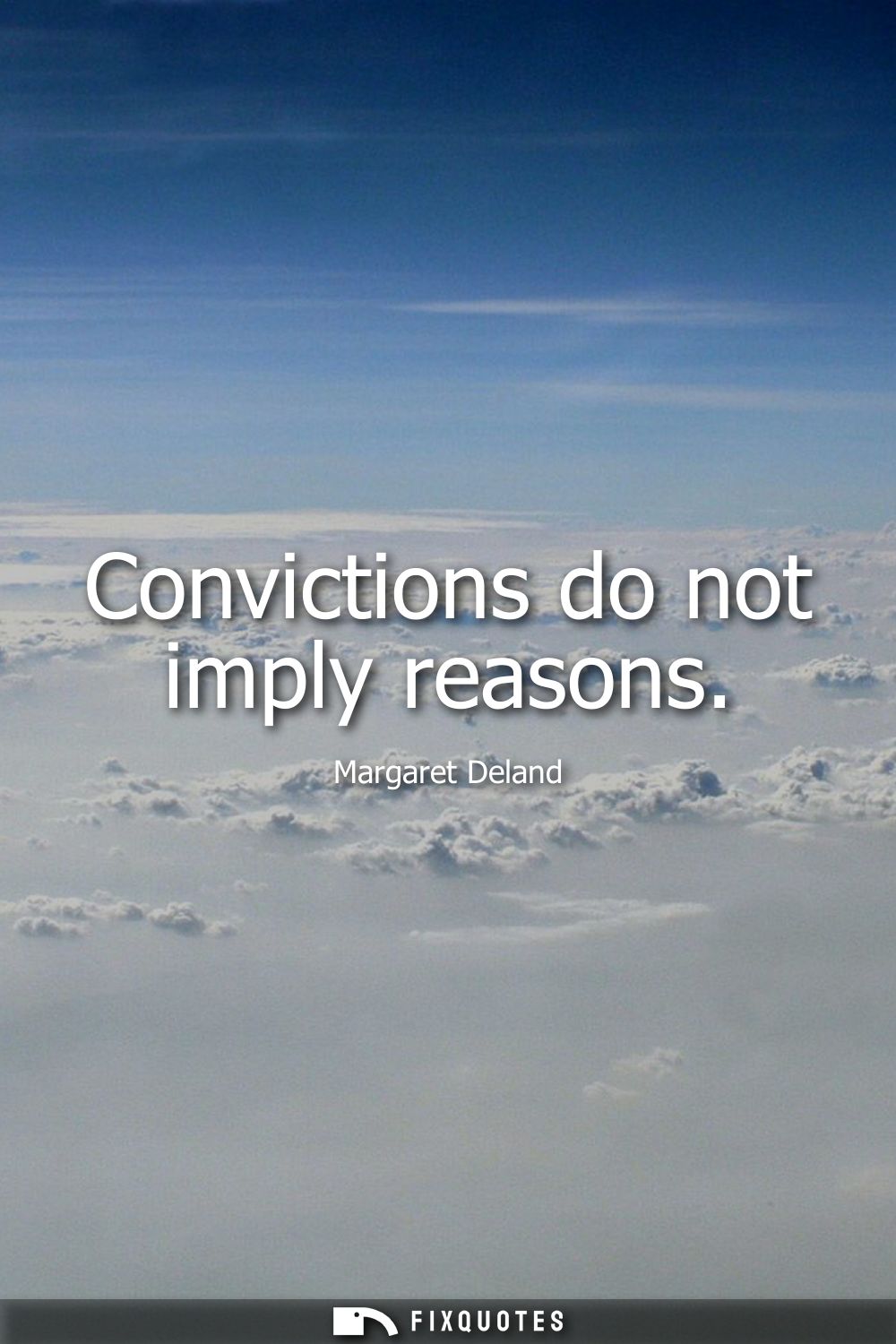
"Convictions do not imply reasons"
About this Quote
Deland’s line punctures a comforting lie modern culture still sells: that intensity is evidence. “Convictions” sounds sturdy, moral, almost architectural; “reasons” sounds procedural, explainable, accountable. By separating the two, she’s not arguing against belief so much as against the lazy prestige we grant it. The sentence is clipped and declarative, like a judge’s ruling, and that’s part of its sting: no metaphors, no soothing exceptions, just a hard boundary between what we feel certain about and what we can actually justify.
The subtext is social. Convictions often function as membership badges - signals of class, religion, nation, or “decency” - especially in the world Deland wrote about, where respectability and moral certainty were currency. In that context, a conviction can be inherited, performed, or defended because it props up a self-image. A reason, by contrast, invites scrutiny. It can be questioned, weighed against evidence, and revised. Deland is quietly highlighting why convictions are so resilient: they don’t need to persuade; they need to fortify identity.
As a novelist, she’s attuned to motives people won’t confess. Characters (and real people) routinely reverse-engineer rationales to protect what they already “know.” The quote anticipates our current age of hot takes and algorithmic tribalism, where belief arrives first and explanation is hired later. Deland’s intent isn’t cynicism for its own sake; it’s a warning about moral confidence unaccompanied by intellectual responsibility.
The subtext is social. Convictions often function as membership badges - signals of class, religion, nation, or “decency” - especially in the world Deland wrote about, where respectability and moral certainty were currency. In that context, a conviction can be inherited, performed, or defended because it props up a self-image. A reason, by contrast, invites scrutiny. It can be questioned, weighed against evidence, and revised. Deland is quietly highlighting why convictions are so resilient: they don’t need to persuade; they need to fortify identity.
As a novelist, she’s attuned to motives people won’t confess. Characters (and real people) routinely reverse-engineer rationales to protect what they already “know.” The quote anticipates our current age of hot takes and algorithmic tribalism, where belief arrives first and explanation is hired later. Deland’s intent isn’t cynicism for its own sake; it’s a warning about moral confidence unaccompanied by intellectual responsibility.
Quote Details
| Topic | Reason & Logic |
|---|---|
| Source | Help us find the source |
| Cite |
Citation Formats
APA Style (7th ed.)
Deland, Margaret. (2026, January 15). Convictions do not imply reasons. FixQuotes. https://fixquotes.com/quotes/convictions-do-not-imply-reasons-160976/
Chicago Style
Deland, Margaret. "Convictions do not imply reasons." FixQuotes. January 15, 2026. https://fixquotes.com/quotes/convictions-do-not-imply-reasons-160976/.
MLA Style (9th ed.)
"Convictions do not imply reasons." FixQuotes, 15 Jan. 2026, https://fixquotes.com/quotes/convictions-do-not-imply-reasons-160976/. Accessed 24 Mar. 2026.
More Quotes by Margaret
Add to List