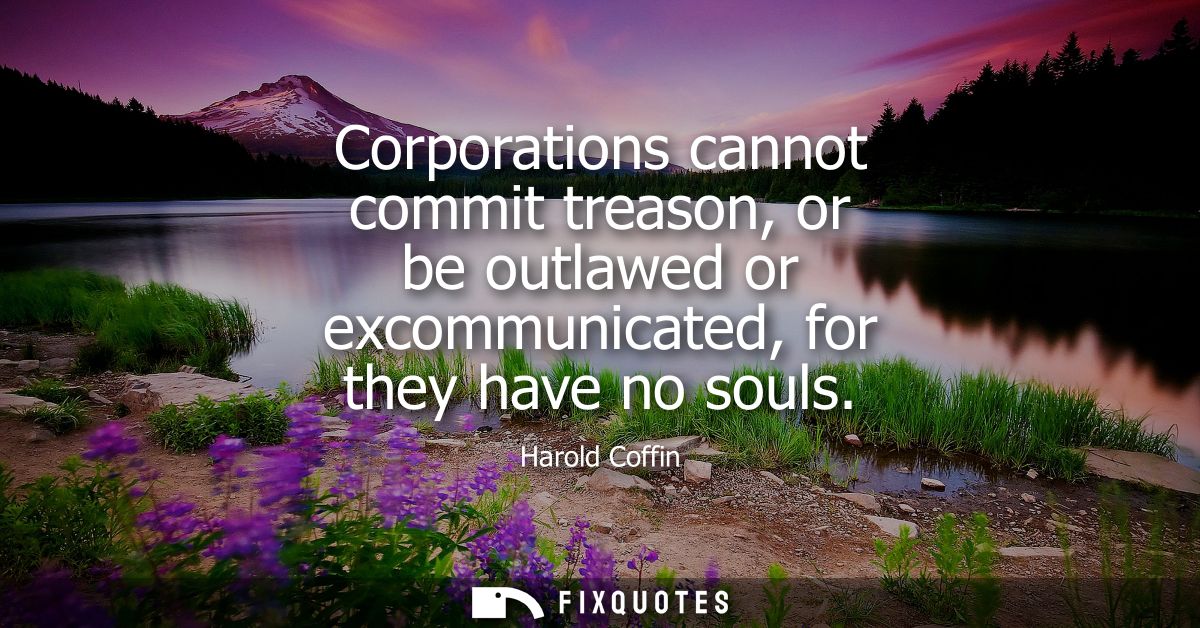
"Corporations cannot commit treason, or be outlawed or excommunicated, for they have no souls"
About this Quote
The intent is less metaphysical than tactical. By saying corporations “have no souls,” he’s attacking the mismatch between modern economic power and the older moral vocabulary societies used to restrain it. A human can be deterred by disgrace, guilt, or spiritual fear; a corporation is designed to route around those pressures. It can rebrand, restructure, merge, dissolve, reconstitute - liability as a shell game. The subtext is a warning: when we grant immense rights to entities that can’t be morally injured, we end up with accountability theater.
Context matters here. Coffin wrote in an era when industrial trusts and railroads were becoming nation-sized actors, and the law was still pretending they were basically citizens with paperwork. His sentence is a preemptive strike against the comforting idea that “the market” will self-correct through reputational consequences. He’s arguing that without coercive regulation - real penalties that hit assets and decision-makers - corporate misconduct isn’t sin. It’s strategy.
Quote Details
| Topic | Ethics & Morality |
|---|---|
| Source | Help us find the source |
| Cite |
Citation Formats
APA Style (7th ed.)
Coffin, Harold. (2026, January 17). Corporations cannot commit treason, or be outlawed or excommunicated, for they have no souls. FixQuotes. https://fixquotes.com/quotes/corporations-cannot-commit-treason-or-be-outlawed-59460/
Chicago Style
Coffin, Harold. "Corporations cannot commit treason, or be outlawed or excommunicated, for they have no souls." FixQuotes. January 17, 2026. https://fixquotes.com/quotes/corporations-cannot-commit-treason-or-be-outlawed-59460/.
MLA Style (9th ed.)
"Corporations cannot commit treason, or be outlawed or excommunicated, for they have no souls." FixQuotes, 17 Jan. 2026, https://fixquotes.com/quotes/corporations-cannot-commit-treason-or-be-outlawed-59460/. Accessed 12 Feb. 2026.