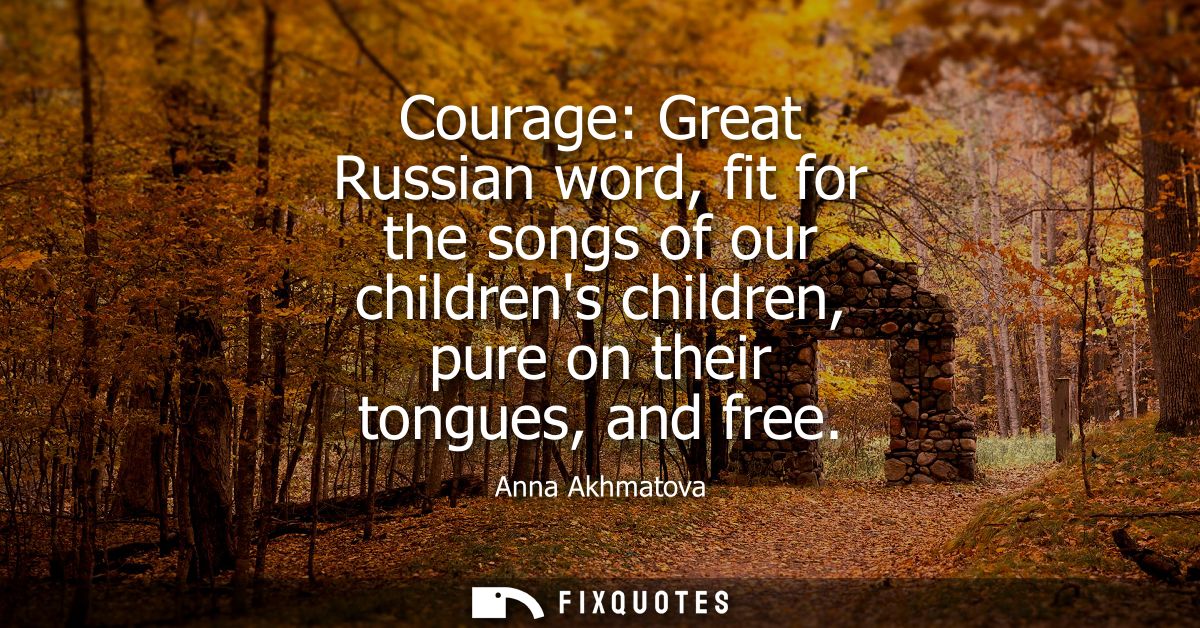
"Courage: Great Russian word, fit for the songs of our children's children, pure on their tongues, and free"
About this Quote
The line works because it shifts the battlefield from politics to pronunciation. "Fit for the songs of our children's children" imagines survival as cultural continuity, not just physical endurance. She’s writing past the present terror toward a future audience that will inherit both trauma and vocabulary. That doubled distance is the subtextual flex: the regime can control today’s newspapers, but not tomorrow’s memory.
"Pure on their tongues" is almost painfully intimate. Courage isn’t an abstract slogan; it’s a word a child can say without irony or fear, a moral taste that hasn’t been corrupted by propaganda. Then she lands on the sharpest adjective: "free". Under a system built on informants, forced confessions, and self-censorship, "free" is an argument disguised as a blessing. She’s not merely praising bravery; she’s smuggling in a definition of freedom that begins with speech and ends with history.
Quote Details
| Topic | Freedom |
|---|---|
| Source | Help us find the source |
| Cite |
Citation Formats
APA Style (7th ed.)
Akhmatova, Anna. (2026, January 16). Courage: Great Russian word, fit for the songs of our children's children, pure on their tongues, and free. FixQuotes. https://fixquotes.com/quotes/courage-great-russian-word-fit-for-the-songs-of-138896/
Chicago Style
Akhmatova, Anna. "Courage: Great Russian word, fit for the songs of our children's children, pure on their tongues, and free." FixQuotes. January 16, 2026. https://fixquotes.com/quotes/courage-great-russian-word-fit-for-the-songs-of-138896/.
MLA Style (9th ed.)
"Courage: Great Russian word, fit for the songs of our children's children, pure on their tongues, and free." FixQuotes, 16 Jan. 2026, https://fixquotes.com/quotes/courage-great-russian-word-fit-for-the-songs-of-138896/. Accessed 5 Apr. 2026.