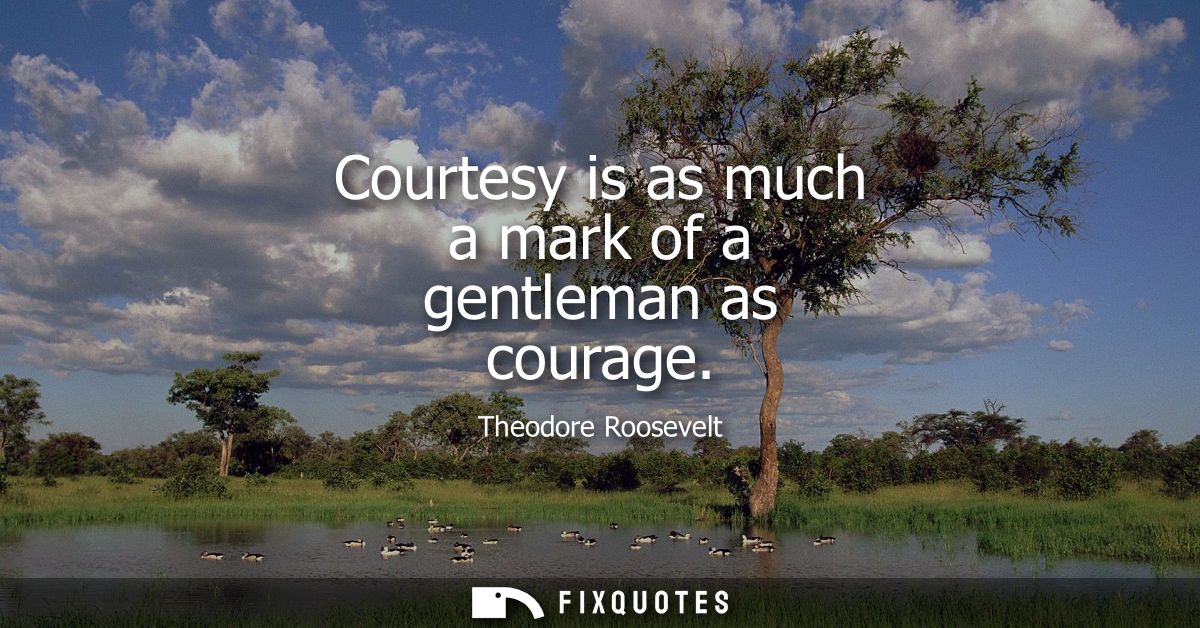
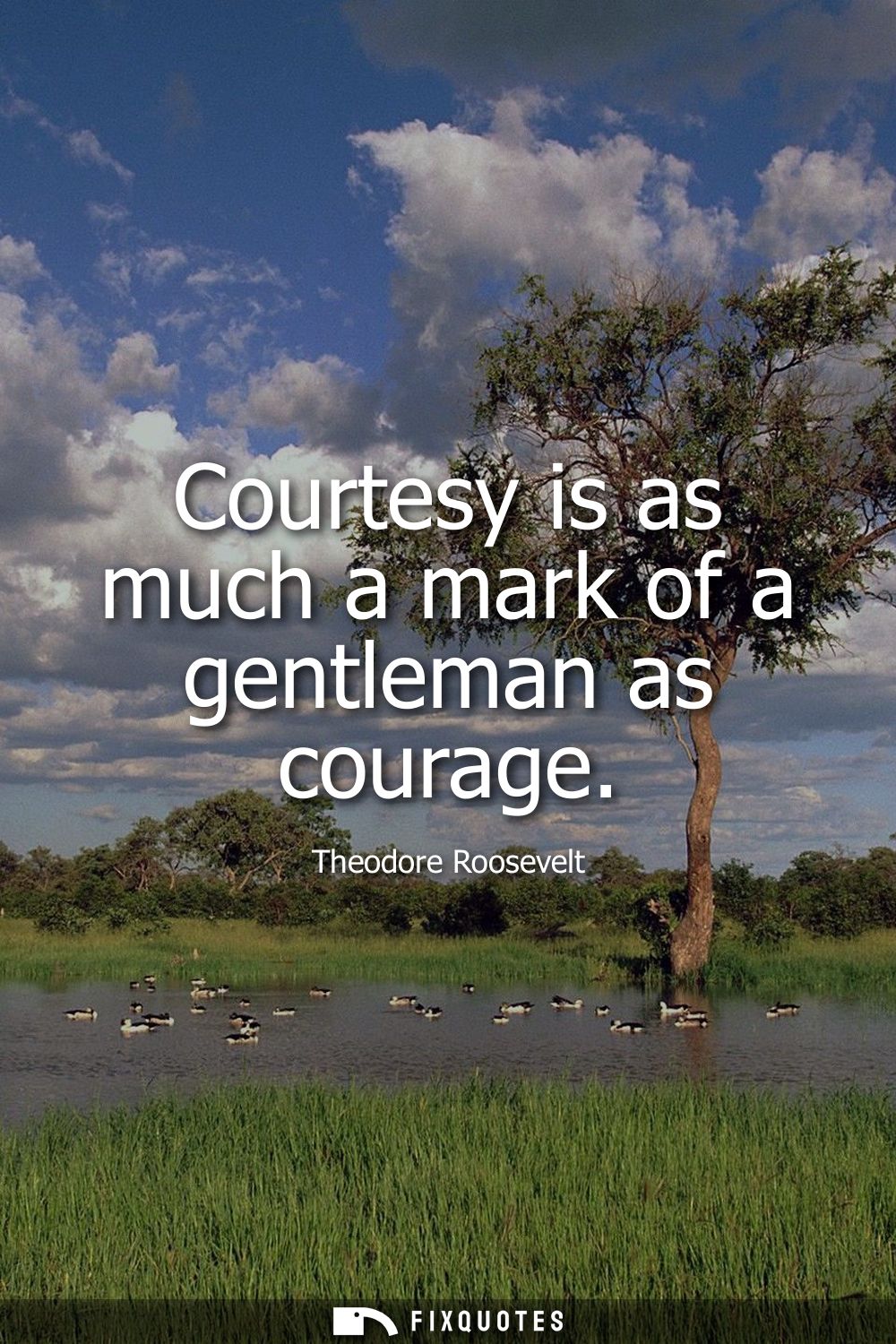
"Courtesy is as much a mark of a gentleman as courage"
About this Quote
Roosevelt welds two virtues together that polite society often keeps in separate rooms: manners and muscle. By insisting that courtesy is as much a mark of a gentleman as courage, he’s refusing the era’s favorite loophole, where “real men” get to be loud, domineering, and excused because they’re brave. The line is a rebuke to swagger masquerading as strength. Courage, in Roosevelt’s telling, isn’t proven by the willingness to fight; it’s proven by the ability to restrain yourself when you could win by force.
The subtext is political as much as personal. Roosevelt’s America is industrializing fast, anxious about softness, and enthralled by frontier mythology. He cultivated a public persona built on toughness, sport, and war service, but he also understood that a republic can’t run on intimidation. Courtesy becomes a civic technology: a way to conduct power without turning every disagreement into a dominance contest. It’s “gentlemanly” not in the snobbish sense of inherited status, but as a standard for those who hold authority.
Rhetorically, the sentence works because it equalizes the values. Courtesy isn’t framed as a decorative add-on to courage; it’s co-equal, a qualifying trait. That move quietly redefines masculinity: the strong person who can’t manage basic respect is not strong, just uncontrolled. Roosevelt is selling a disciplined ideal of leadership, one that can charge up San Juan Hill and still hold the door afterward, not as performance, but as proof of character.
The subtext is political as much as personal. Roosevelt’s America is industrializing fast, anxious about softness, and enthralled by frontier mythology. He cultivated a public persona built on toughness, sport, and war service, but he also understood that a republic can’t run on intimidation. Courtesy becomes a civic technology: a way to conduct power without turning every disagreement into a dominance contest. It’s “gentlemanly” not in the snobbish sense of inherited status, but as a standard for those who hold authority.
Rhetorically, the sentence works because it equalizes the values. Courtesy isn’t framed as a decorative add-on to courage; it’s co-equal, a qualifying trait. That move quietly redefines masculinity: the strong person who can’t manage basic respect is not strong, just uncontrolled. Roosevelt is selling a disciplined ideal of leadership, one that can charge up San Juan Hill and still hold the door afterward, not as performance, but as proof of character.
Quote Details
| Topic | Respect |
|---|---|
| Source | Help us find the source |
| Cite |
Citation Formats
APA Style (7th ed.)
Roosevelt, Theodore. (2026, January 15). Courtesy is as much a mark of a gentleman as courage. FixQuotes. https://fixquotes.com/quotes/courtesy-is-as-much-a-mark-of-a-gentleman-as-13773/
Chicago Style
Roosevelt, Theodore. "Courtesy is as much a mark of a gentleman as courage." FixQuotes. January 15, 2026. https://fixquotes.com/quotes/courtesy-is-as-much-a-mark-of-a-gentleman-as-13773/.
MLA Style (9th ed.)
"Courtesy is as much a mark of a gentleman as courage." FixQuotes, 15 Jan. 2026, https://fixquotes.com/quotes/courtesy-is-as-much-a-mark-of-a-gentleman-as-13773/. Accessed 30 Mar. 2026.
More Quotes by Theodore
Add to List