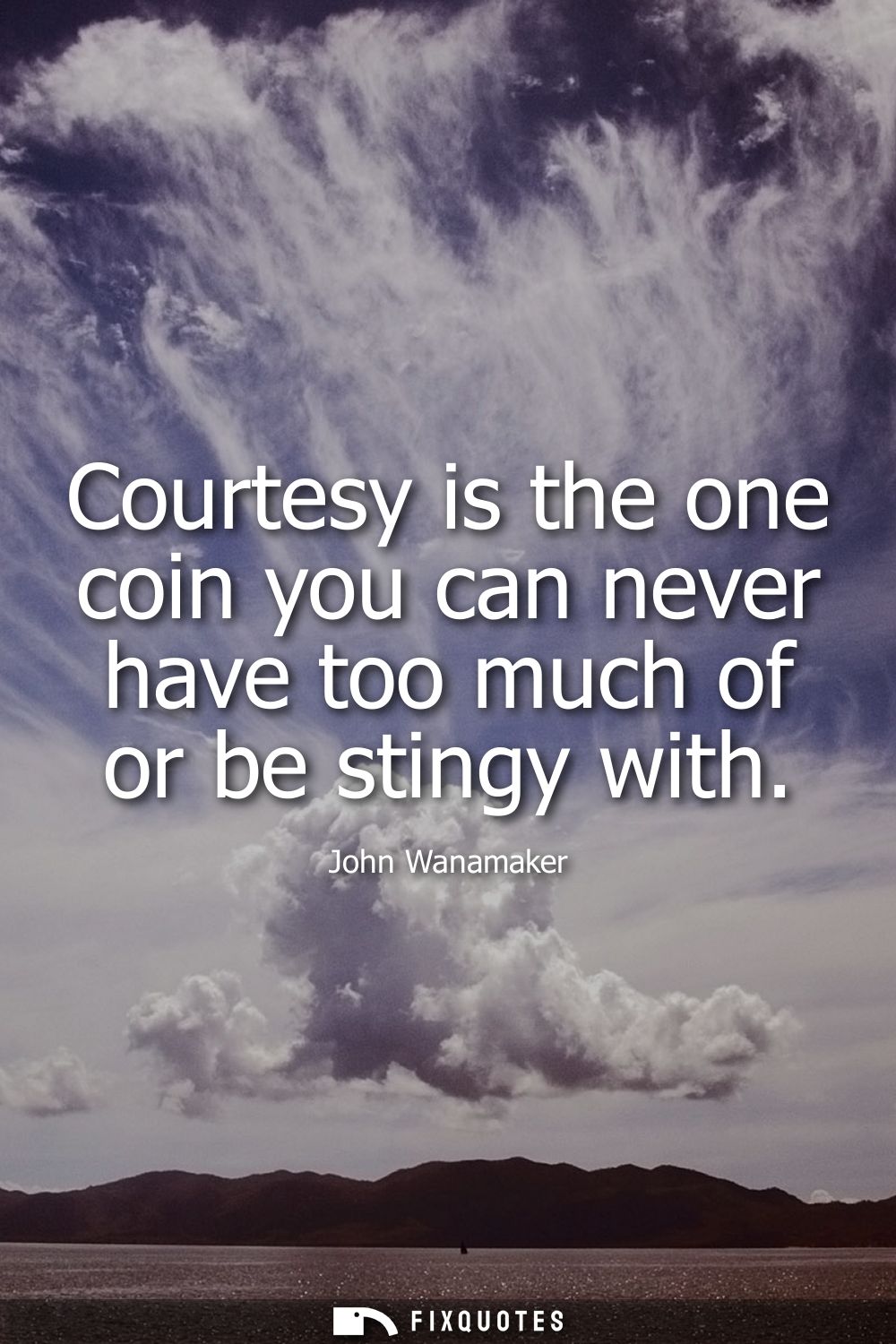
"Courtesy is the one coin you can never have too much of or be stingy with"
About this Quote
The line works because it flips the usual logic of scarcity. Most “coins” get hoarded, counted, protected. Courtesy, he argues, only grows in value when it circulates. The warning against being “stingy” hints at a familiar managerial temptation: treating decency as an overhead cost, something you ration when margins tighten or status insulates you. Wanamaker insists that the opposite is true - the least powerful person in the room may still be the most consequential to your standing, and courtesy is the cheapest way to acknowledge that.
There’s subtext, too, about class and modernity. Wanamaker helped build department-store culture, where strangers transact at scale. In that world, courtesy becomes a technology for smoothing friction between people who don’t share community ties. It’s also a quiet assertion of control: be polite, and you can set the terms of interaction without raising your voice.
As a businessman’s creed, it’s disarmingly idealistic and slightly strategic. Courtesy is presented as altruism, but it’s also risk management - a buffer against conflict, a multiplier of goodwill, a form of soft power you’re foolish to underinvest in.
Quote Details
| Topic | Kindness |
|---|---|
| Source | Help us find the source |
| Cite |
Citation Formats
APA Style (7th ed.)
Wanamaker, John. (2026, January 15). Courtesy is the one coin you can never have too much of or be stingy with. FixQuotes. https://fixquotes.com/quotes/courtesy-is-the-one-coin-you-can-never-have-too-47131/
Chicago Style
Wanamaker, John. "Courtesy is the one coin you can never have too much of or be stingy with." FixQuotes. January 15, 2026. https://fixquotes.com/quotes/courtesy-is-the-one-coin-you-can-never-have-too-47131/.
MLA Style (9th ed.)
"Courtesy is the one coin you can never have too much of or be stingy with." FixQuotes, 15 Jan. 2026, https://fixquotes.com/quotes/courtesy-is-the-one-coin-you-can-never-have-too-47131/. Accessed 12 Feb. 2026.