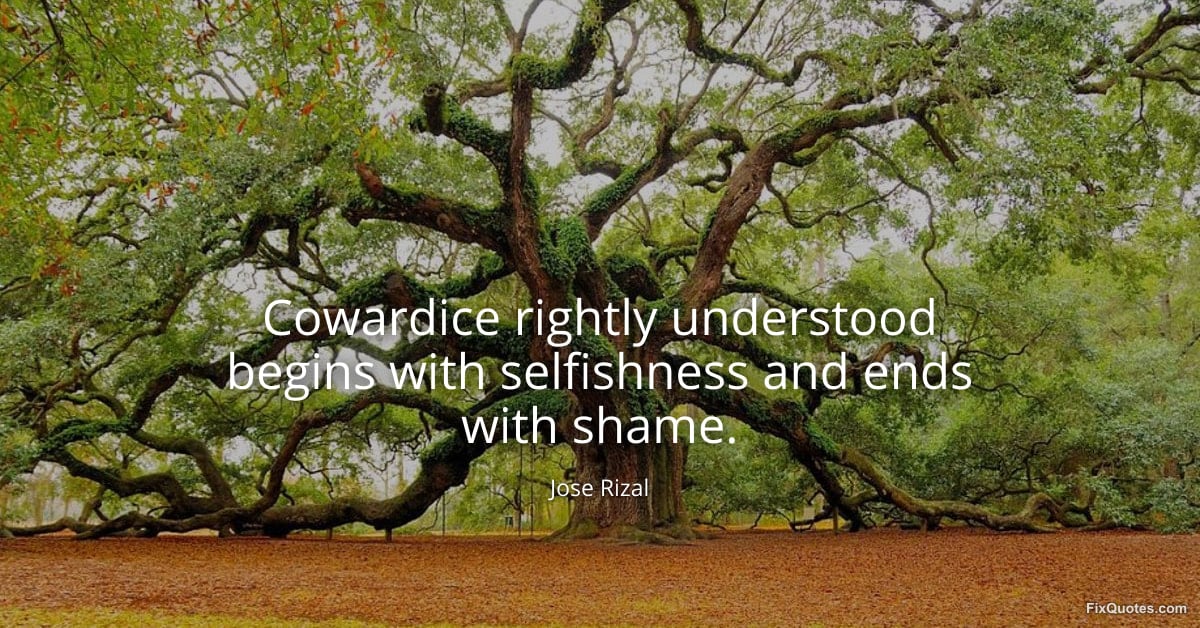
"Cowardice rightly understood begins with selfishness and ends with shame"
About this Quote
Cowardice, for Rizal, isn’t a lack of swagger; it’s a moral accounting problem. The line moves with the clean logic of an indictment: it starts where the rot begins (selfishness) and lands where it always pays out (shame). That “rightly understood” is the tell. Rizal is preempting the convenient definition of cowardice as mere fear, the kind that earns sympathy or excuses. He’s narrowing it into something harsher: a choice to protect the self at the expense of duty, truth, or community.
Written in the shadow of Spanish colonial rule in the Philippines, the subtext is political even when it sounds personal. Rizal knew the colonial system depended less on constant force than on everyday compliance: the educated staying quiet, the comfortable avoiding risk, the fearful rationalizing silence as prudence. In that environment, “selfishness” isn’t just greed; it’s the instinct to preserve status, safety, and reputation while others absorb the violence. Cowardice becomes a social contract with the oppressor, signed in private and paid in public consequences.
The ending matters: shame. Not punishment, not defeat, not even regret. Shame implies an internal tribunal that eventually convenes, even if no one else calls you out. Rizal is betting on a reader’s conscience as the last colonizer-proof institution. It’s also a strategic dare: if you keep choosing yourself, you’ll still have to live with yourself.
Written in the shadow of Spanish colonial rule in the Philippines, the subtext is political even when it sounds personal. Rizal knew the colonial system depended less on constant force than on everyday compliance: the educated staying quiet, the comfortable avoiding risk, the fearful rationalizing silence as prudence. In that environment, “selfishness” isn’t just greed; it’s the instinct to preserve status, safety, and reputation while others absorb the violence. Cowardice becomes a social contract with the oppressor, signed in private and paid in public consequences.
The ending matters: shame. Not punishment, not defeat, not even regret. Shame implies an internal tribunal that eventually convenes, even if no one else calls you out. Rizal is betting on a reader’s conscience as the last colonizer-proof institution. It’s also a strategic dare: if you keep choosing yourself, you’ll still have to live with yourself.
Quote Details
| Topic | Ethics & Morality |
|---|---|
| Source | Help us find the source |
| Cite |
Citation Formats
APA Style (7th ed.)
Rizal, Jose. (2026, February 10). Cowardice rightly understood begins with selfishness and ends with shame. FixQuotes. https://fixquotes.com/quotes/cowardice-rightly-understood-begins-with-185084/
Chicago Style
Rizal, Jose. "Cowardice rightly understood begins with selfishness and ends with shame." FixQuotes. February 10, 2026. https://fixquotes.com/quotes/cowardice-rightly-understood-begins-with-185084/.
MLA Style (9th ed.)
"Cowardice rightly understood begins with selfishness and ends with shame." FixQuotes, 10 Feb. 2026, https://fixquotes.com/quotes/cowardice-rightly-understood-begins-with-185084/. Accessed 25 Mar. 2026.
More Quotes by Jose
Add to List