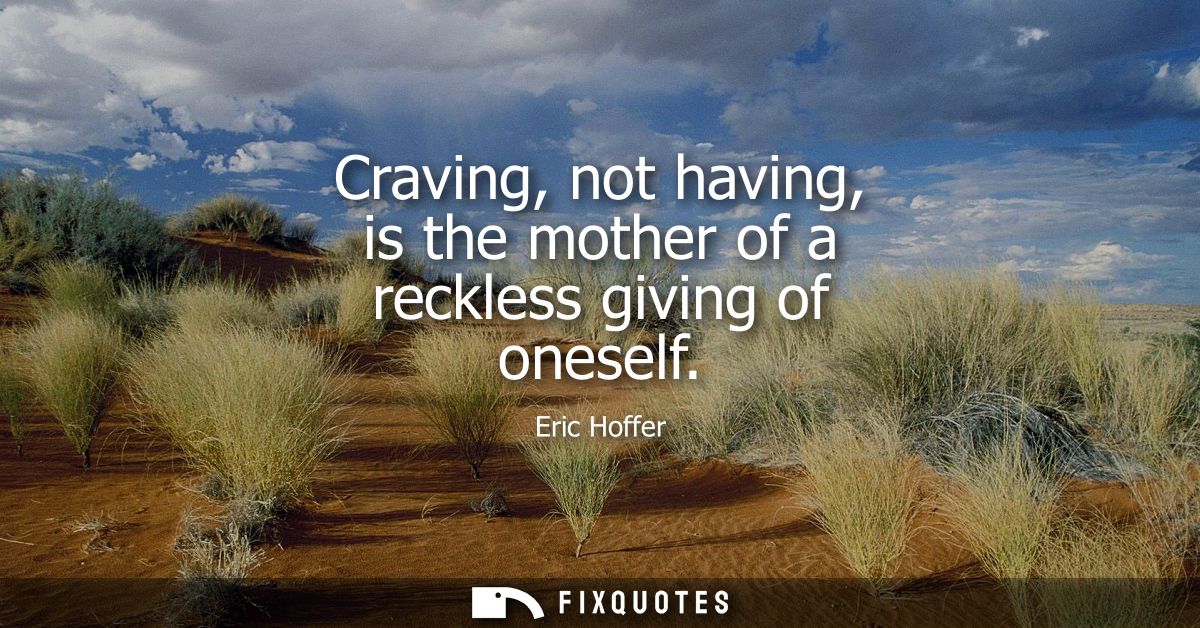
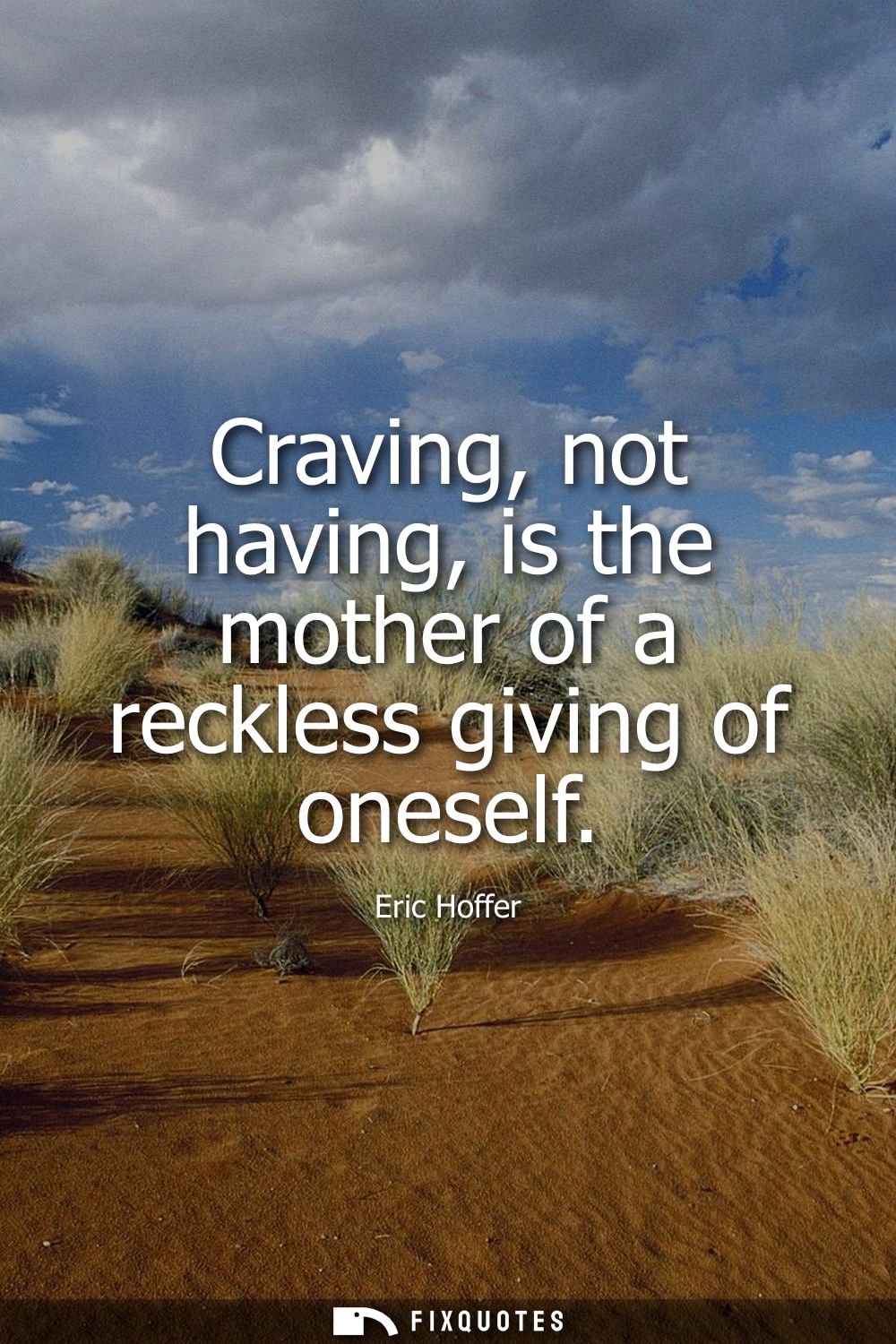
"Craving, not having, is the mother of a reckless giving of oneself"
About this Quote
Hoffer’s line has the sting of a moral diagnosis disguised as a proverb: the most dangerous generosity isn’t kindness, it’s hunger. By making “craving” the “mother” of self-giving, he frames self-sacrifice as something born less from virtue than from lack - a need that reproduces itself by seeking dramatic proof. The rhythm matters: “Craving, not having” sets up a blunt contrast that refuses the romantic gloss we tend to smear over devotion. It’s not what you possess that drives you to give; it’s what you can’t stand not to possess.
The subtext is a critique of the grand gesture. “Reckless giving of oneself” points to the way people throw their identities into causes, lovers, movements, even jobs, not because they’ve found meaning but because meaning feels like an emergency. Craving demands quick relief, and self-abandonment is a fast-acting drug: dissolve the self, stop the ache. Hoffer is warning that this can masquerade as altruism while actually being a form of emotional bargaining - if I give everything, I’ll finally be held, recognized, forgiven, made whole.
Contextually, Hoffer’s work circles mass movements, true believers, and the psychology of surrender. He’s skeptical of purity narratives and impatient with self-mythology. The intent here is not to shame giving but to interrogate its motive: when “giving” is fueled by deprivation, it easily becomes coercive, volatile, or self-erasing. The reckless giver isn’t noble; they’re needy with a halo, and the bill eventually comes due.
The subtext is a critique of the grand gesture. “Reckless giving of oneself” points to the way people throw their identities into causes, lovers, movements, even jobs, not because they’ve found meaning but because meaning feels like an emergency. Craving demands quick relief, and self-abandonment is a fast-acting drug: dissolve the self, stop the ache. Hoffer is warning that this can masquerade as altruism while actually being a form of emotional bargaining - if I give everything, I’ll finally be held, recognized, forgiven, made whole.
Contextually, Hoffer’s work circles mass movements, true believers, and the psychology of surrender. He’s skeptical of purity narratives and impatient with self-mythology. The intent here is not to shame giving but to interrogate its motive: when “giving” is fueled by deprivation, it easily becomes coercive, volatile, or self-erasing. The reckless giver isn’t noble; they’re needy with a halo, and the bill eventually comes due.
Quote Details
| Topic | Wisdom |
|---|---|
| Source | Help us find the source |
| Cite |
Citation Formats
APA Style (7th ed.)
Hoffer, Eric. (2026, January 17). Craving, not having, is the mother of a reckless giving of oneself. FixQuotes. https://fixquotes.com/quotes/craving-not-having-is-the-mother-of-a-reckless-31076/
Chicago Style
Hoffer, Eric. "Craving, not having, is the mother of a reckless giving of oneself." FixQuotes. January 17, 2026. https://fixquotes.com/quotes/craving-not-having-is-the-mother-of-a-reckless-31076/.
MLA Style (9th ed.)
"Craving, not having, is the mother of a reckless giving of oneself." FixQuotes, 17 Jan. 2026, https://fixquotes.com/quotes/craving-not-having-is-the-mother-of-a-reckless-31076/. Accessed 16 Mar. 2026.
More Quotes by Eric
Add to List