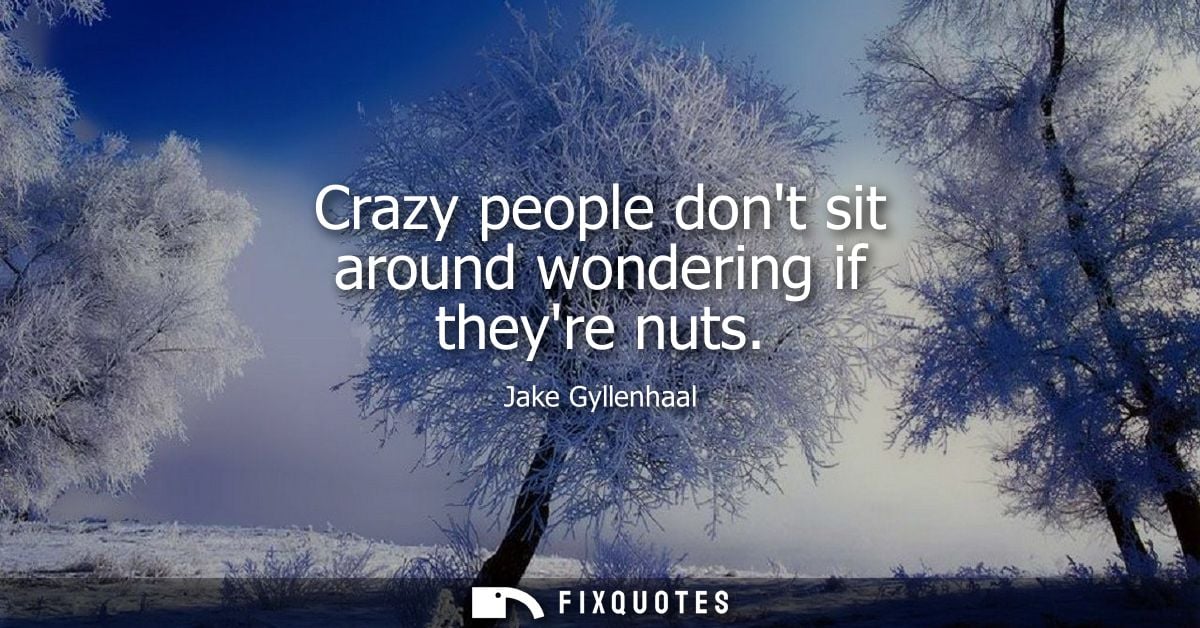
"Crazy people don't sit around wondering if they're nuts"
About this Quote
Gyllenhaal’s line works because it drags “sanity” off its clinical pedestal and drops it into everyday insecurity. It’s not a diagnosis; it’s a pressure valve. The punch is in the inversion: the very act of self-scrutiny becomes evidence of stability. That’s a comforting logic loop for anyone stuck in the late-night spiral of “What if I’m broken?” It offers an off-ramp: if you can articulate the fear, you’re already participating in reality-testing, the skill that tends to go missing when someone is truly unmoored.
The subtext is less about “crazy people” than about the modern performance of mental competence. We live in a culture where being “well” is both a personal responsibility and a social brand. People don’t just suffer; they audit themselves for symptoms, measure their reactions against internet checklists, and worry that ordinary stress is secretly pathology. Gyllenhaal’s phrasing cuts through that doom-scrolling hypochondria with a streetwise reassurance: obsession with your own mental state is often anxiety talking, not insanity arriving.
It also carries an actor’s pragmatic understanding of interiority. Gyllenhaal is known for characters who hover at the edge of control; this quip reads like a backstage rule for staying grounded while inhabiting chaos. Still, there’s a sharpened edge: the line is meant to soothe, but it simplifies. Some people with serious conditions do question themselves, and self-doubt can coexist with real instability. As a cultural aphorism, though, it lands because it gives shame a smaller stage and hands the listener a tool: check your fear, don’t let it narrate your identity.
The subtext is less about “crazy people” than about the modern performance of mental competence. We live in a culture where being “well” is both a personal responsibility and a social brand. People don’t just suffer; they audit themselves for symptoms, measure their reactions against internet checklists, and worry that ordinary stress is secretly pathology. Gyllenhaal’s phrasing cuts through that doom-scrolling hypochondria with a streetwise reassurance: obsession with your own mental state is often anxiety talking, not insanity arriving.
It also carries an actor’s pragmatic understanding of interiority. Gyllenhaal is known for characters who hover at the edge of control; this quip reads like a backstage rule for staying grounded while inhabiting chaos. Still, there’s a sharpened edge: the line is meant to soothe, but it simplifies. Some people with serious conditions do question themselves, and self-doubt can coexist with real instability. As a cultural aphorism, though, it lands because it gives shame a smaller stage and hands the listener a tool: check your fear, don’t let it narrate your identity.
Quote Details
| Topic | Mental Health |
|---|---|
| Source | Evidence: Julia Derek. Crazy people don't sit around wondering if they're nuts . -Jake Gyllenhaal GET FOUR FREE BOOKS BY JOINING MY MAILING LIST ! Other candidates (1) Proof (Jake Gyllenhaal, 2001)50.0% Because! Crazy people don't sit around wondering if they're nuts. (Page 10-11 (based on script pagination visible in ... |
| Cite |
Citation Formats
APA Style (7th ed.)
Gyllenhaal, Jake. (2026, March 13). Crazy people don't sit around wondering if they're nuts. FixQuotes. https://fixquotes.com/quotes/crazy-people-dont-sit-around-wondering-if-theyre-132993/
Chicago Style
Gyllenhaal, Jake. "Crazy people don't sit around wondering if they're nuts." FixQuotes. March 13, 2026. https://fixquotes.com/quotes/crazy-people-dont-sit-around-wondering-if-theyre-132993/.
MLA Style (9th ed.)
"Crazy people don't sit around wondering if they're nuts." FixQuotes, 13 Mar. 2026, https://fixquotes.com/quotes/crazy-people-dont-sit-around-wondering-if-theyre-132993/. Accessed 30 Mar. 2026.
More Quotes by Jake
Add to List