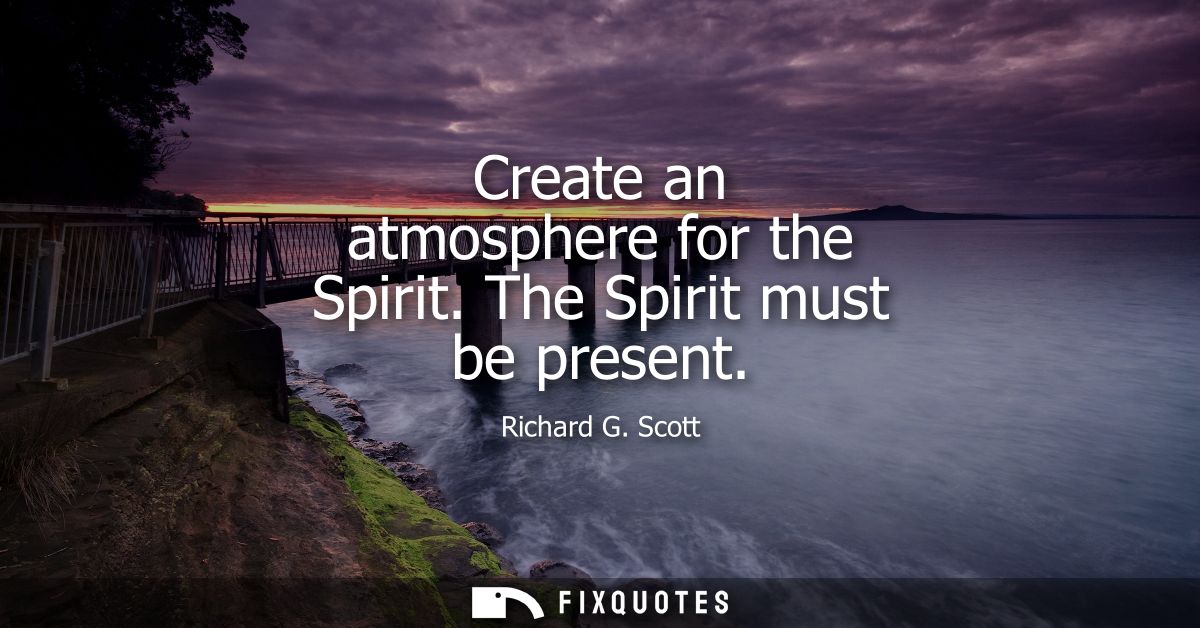
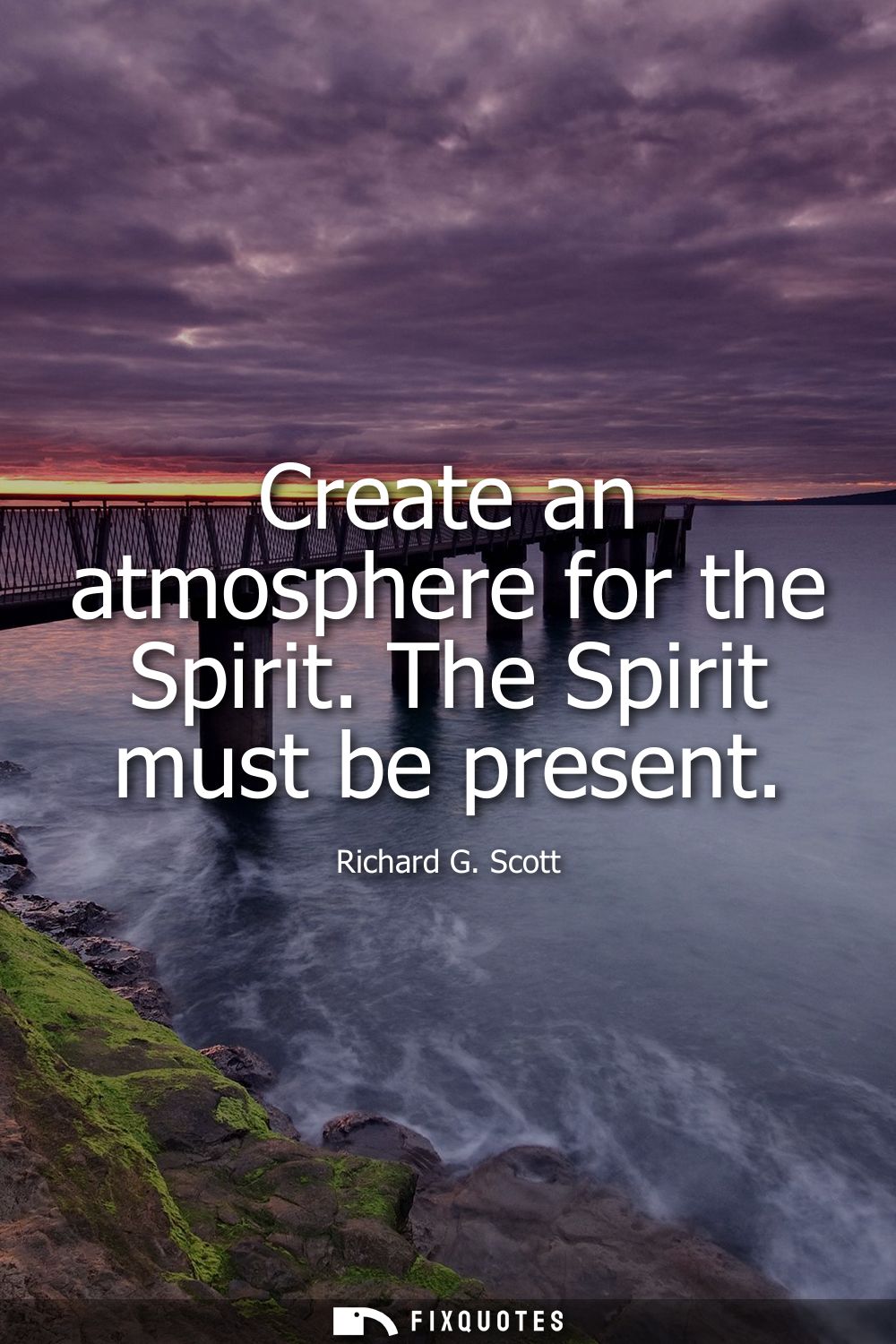
"Create an atmosphere for the Spirit. The Spirit must be present"
About this Quote
A command disguised as a gentle reminder, Richard G. Scott's line turns spirituality into something you actively host, not passively await. "Create an atmosphere" is domestic language: you set the table, dim the lights, lower your voice. The instruction is managerial, almost procedural, and that is the point. In many religious settings, especially Latter-day Saint culture where Scott spoke with authority, holiness is framed as both gift and discipline. You don't just hope to feel something; you engineer conditions for it.
The subtext is accountability. If "the Spirit must be present", then absence becomes a diagnosis: the room is wrong, the tone is wrong, you are wrong. It's pastoral counsel with an edge, because it relocates spiritual experience from mystery to responsibility. That can be empowering (you have agency over reverence, music, media, conversation) and quietly coercive (if you don't feel it, you failed to prepare). The sentence is short, repetitive, and absolute; the second clause doesn't argue, it closes the case.
Context matters: Scott was a senior LDS leader speaking into a community that emphasizes personal revelation and "worthiness" as prerequisites for guidance. The line functions as both invitation and boundary marker, reinforcing norms of behavior and emotional register. It also reveals a modern religious anxiety: the fear that noise, distraction, and irony have crowded out transcendence. So the quote works as a culture note as much as a spiritual one: curate your environment, because the sacred is sensitive - and the institution expects you to make room for it.
The subtext is accountability. If "the Spirit must be present", then absence becomes a diagnosis: the room is wrong, the tone is wrong, you are wrong. It's pastoral counsel with an edge, because it relocates spiritual experience from mystery to responsibility. That can be empowering (you have agency over reverence, music, media, conversation) and quietly coercive (if you don't feel it, you failed to prepare). The sentence is short, repetitive, and absolute; the second clause doesn't argue, it closes the case.
Context matters: Scott was a senior LDS leader speaking into a community that emphasizes personal revelation and "worthiness" as prerequisites for guidance. The line functions as both invitation and boundary marker, reinforcing norms of behavior and emotional register. It also reveals a modern religious anxiety: the fear that noise, distraction, and irony have crowded out transcendence. So the quote works as a culture note as much as a spiritual one: curate your environment, because the sacred is sensitive - and the institution expects you to make room for it.
Quote Details
| Topic | Faith |
|---|---|
| Source | Help us find the source |
| Cite |
Citation Formats
APA Style (7th ed.)
Scott, Richard G. (2026, January 15). Create an atmosphere for the Spirit. The Spirit must be present. FixQuotes. https://fixquotes.com/quotes/create-an-atmosphere-for-the-spirit-the-spirit-165696/
Chicago Style
Scott, Richard G. "Create an atmosphere for the Spirit. The Spirit must be present." FixQuotes. January 15, 2026. https://fixquotes.com/quotes/create-an-atmosphere-for-the-spirit-the-spirit-165696/.
MLA Style (9th ed.)
"Create an atmosphere for the Spirit. The Spirit must be present." FixQuotes, 15 Jan. 2026, https://fixquotes.com/quotes/create-an-atmosphere-for-the-spirit-the-spirit-165696/. Accessed 24 Mar. 2026.
More Quotes by Richard
Add to List