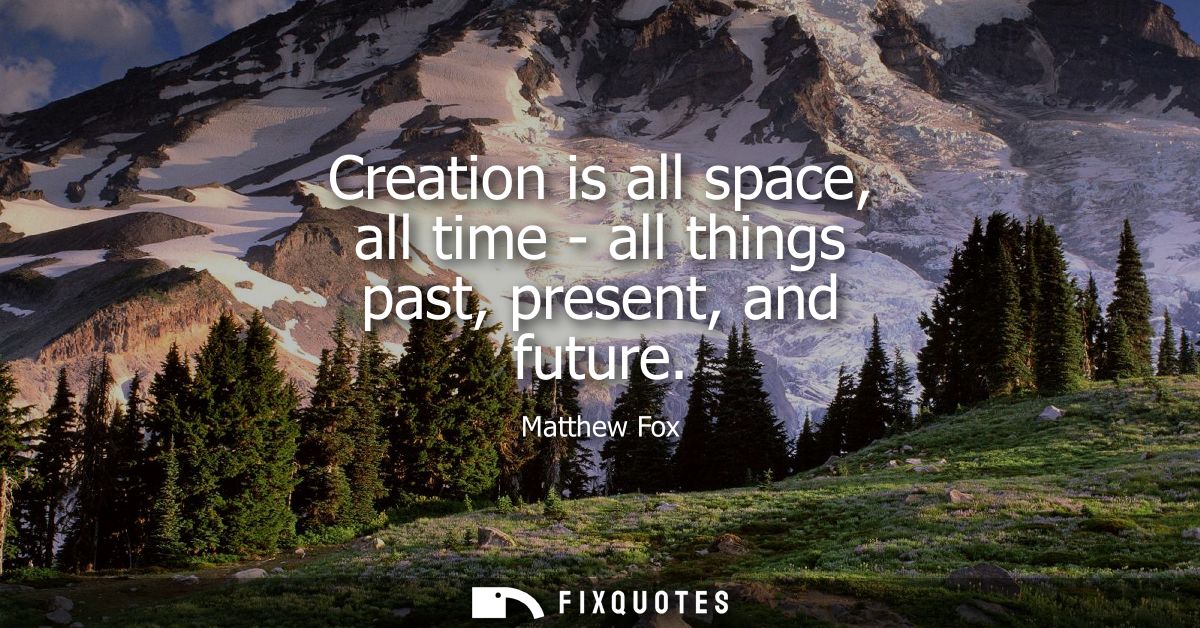
"Creation is all space, all time - all things past, present, and future"
About this Quote
Fox blows the doors off the small, managed idea of “creation” as a one-time event and recasts it as a living field: “all space, all time - all things past, present, and future.” The line works because it refuses the comforting timeline most Western religious language smuggles in (first there was nothing, then there was something, now we administer it). Instead, he makes creation less like a product and more like an atmosphere you’re already breathing. The dash functions like a hinge: it pivots from the measurable (“space,” “time”) to the totalizing (“all things”), collapsing the boundary between physics and meaning.
Fox’s intent is theological, but not in the rulebook sense. As a Christian writer associated with “creation spirituality,” he’s trying to reroute spiritual attention away from sin-management and toward awe, responsibility, and participation. If creation is everything across time, then the sacred isn’t trapped in a distant beginning or quarantined in churches. It’s the ongoing fabric of reality, which quietly raises the stakes: ecological damage isn’t just policy failure; it’s desecration. Artistic work isn’t a hobby; it’s collaboration with the deepest currents of being.
The subtext is also a critique of human exceptionalism. By stretching creation across past and future, Fox dethrones the present moment’s illusion of ownership. You don’t “have” the world; you inherit it and borrow it from what comes next. In a late-20th-century context of environmental crisis and institutional religious backlash, the sentence reads like a manifesto disguised as a metaphysical definition.
Fox’s intent is theological, but not in the rulebook sense. As a Christian writer associated with “creation spirituality,” he’s trying to reroute spiritual attention away from sin-management and toward awe, responsibility, and participation. If creation is everything across time, then the sacred isn’t trapped in a distant beginning or quarantined in churches. It’s the ongoing fabric of reality, which quietly raises the stakes: ecological damage isn’t just policy failure; it’s desecration. Artistic work isn’t a hobby; it’s collaboration with the deepest currents of being.
The subtext is also a critique of human exceptionalism. By stretching creation across past and future, Fox dethrones the present moment’s illusion of ownership. You don’t “have” the world; you inherit it and borrow it from what comes next. In a late-20th-century context of environmental crisis and institutional religious backlash, the sentence reads like a manifesto disguised as a metaphysical definition.
Quote Details
| Topic | Wisdom |
|---|---|
| Source | Help us find the source |
| Cite |
Citation Formats
APA Style (7th ed.)
Fox, Matthew. (2026, January 16). Creation is all space, all time - all things past, present, and future. FixQuotes. https://fixquotes.com/quotes/creation-is-all-space-all-time-all-things-past-114758/
Chicago Style
Fox, Matthew. "Creation is all space, all time - all things past, present, and future." FixQuotes. January 16, 2026. https://fixquotes.com/quotes/creation-is-all-space-all-time-all-things-past-114758/.
MLA Style (9th ed.)
"Creation is all space, all time - all things past, present, and future." FixQuotes, 16 Jan. 2026, https://fixquotes.com/quotes/creation-is-all-space-all-time-all-things-past-114758/. Accessed 25 Mar. 2026.
More Quotes by Matthew
Add to List