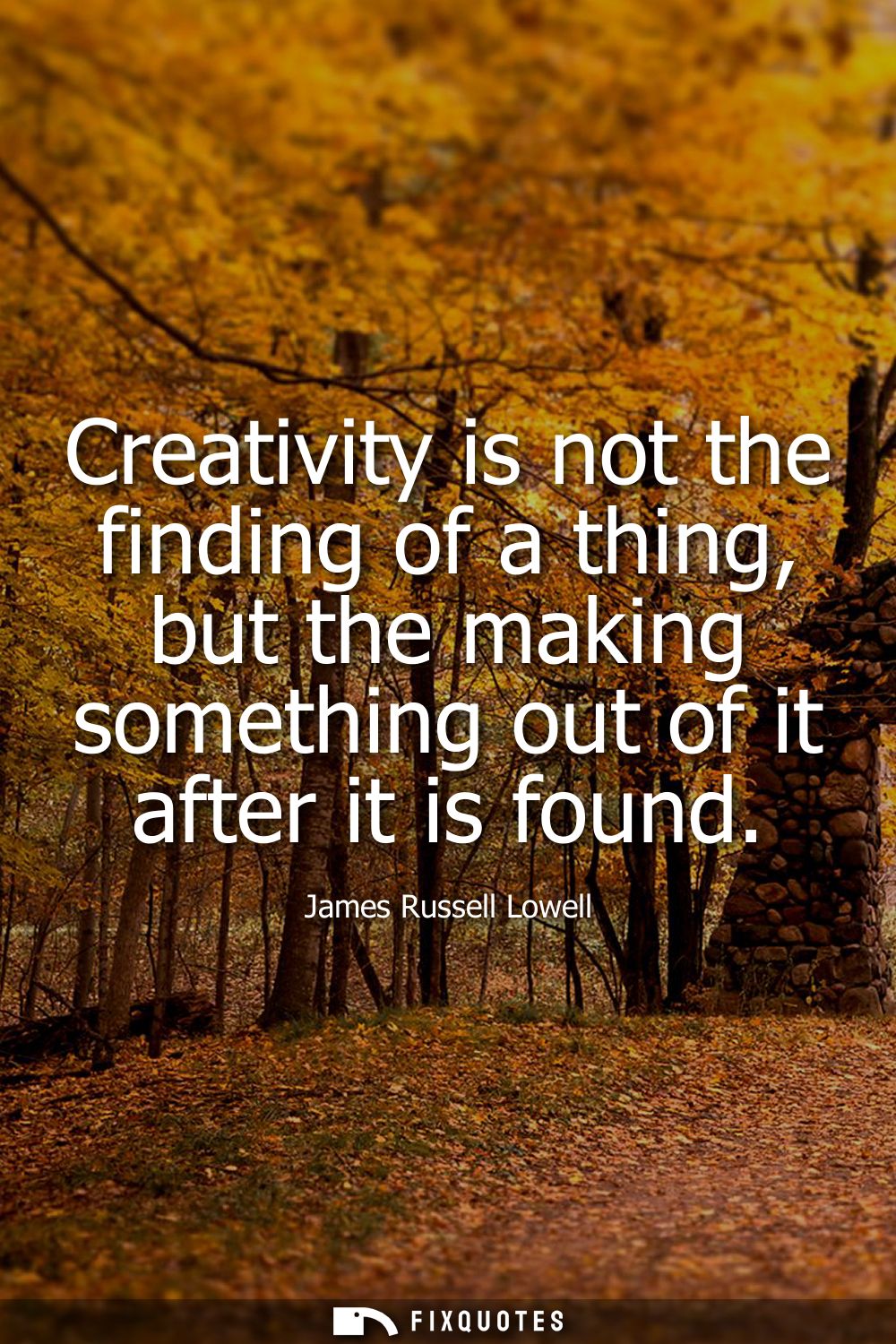
"Creativity is not the finding of a thing, but the making something out of it after it is found"
About this Quote
Lowell’s line quietly dethrones the romantic myth of inspiration as a rare lightning strike. He draws a clean, almost workmanlike boundary between discovery and creation: finding is passive luck, but making is active judgment. That distinction matters because it relocates the drama of art from the moment of “having an idea” to the less glamorous, more consequential work that follows: selection, shaping, revision, sacrifice.
The phrasing does a sly rhetorical job. “Not the finding” is a rebuke to the collector mentality, the person who mistakes novelty for authorship. “After it is found” implies that raw material is everywhere - facts, memories, borrowed forms, overheard speech - and that the moral claim of the artist isn’t ownership of the ingredients but responsibility for the transformation. Lowell is arguing, in effect, that creativity is less about immaculate conception than about craftsmanship plus conscience: what you choose to do with what the world hands you.
Context sharpens the intent. Lowell wrote in an era of American literary self-definition, when culture was wrestling with influence from Europe, industrial change, and the rise of mass print. His view makes room for tradition and remix without collapsing into mere imitation. It also anticipates a modern truth: originality often looks like an arrangement, not an invention. The subtext is bracingly democratic - the “found” is available to many; the making is where talent, discipline, and taste separate the artist from the scavenger.
The phrasing does a sly rhetorical job. “Not the finding” is a rebuke to the collector mentality, the person who mistakes novelty for authorship. “After it is found” implies that raw material is everywhere - facts, memories, borrowed forms, overheard speech - and that the moral claim of the artist isn’t ownership of the ingredients but responsibility for the transformation. Lowell is arguing, in effect, that creativity is less about immaculate conception than about craftsmanship plus conscience: what you choose to do with what the world hands you.
Context sharpens the intent. Lowell wrote in an era of American literary self-definition, when culture was wrestling with influence from Europe, industrial change, and the rise of mass print. His view makes room for tradition and remix without collapsing into mere imitation. It also anticipates a modern truth: originality often looks like an arrangement, not an invention. The subtext is bracingly democratic - the “found” is available to many; the making is where talent, discipline, and taste separate the artist from the scavenger.
Quote Details
| Topic | Art |
|---|
More Quotes by James
Add to List