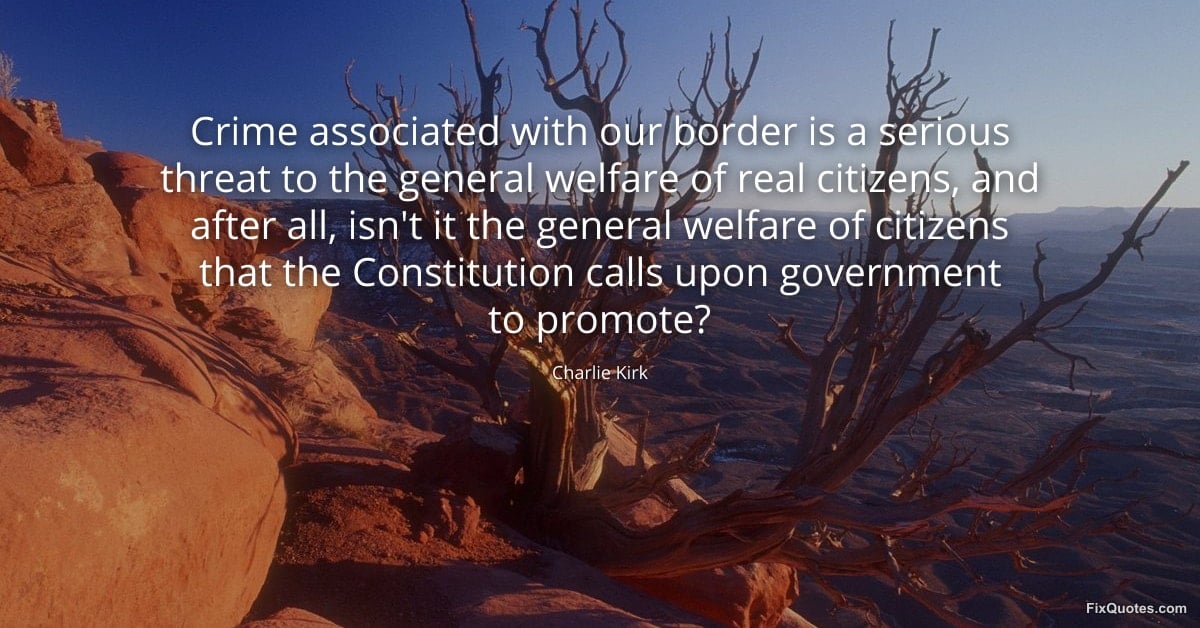
"Crime associated with our border is a serious threat to the general welfare of real citizens, and after all, isn't it the general welfare of citizens that the Constitution calls upon government to promote?"
About this Quote
Kirk’s line is built to smuggle a contested political claim inside a civics-class platitude. He starts with a phrase designed to feel unarguable: “crime associated with our border.” It’s intentionally elastic. “Associated with” doesn’t mean caused by immigration, committed by migrants, or even statistically concentrated there; it just creates a foggy linkage that lets anxiety do the work evidence would normally have to do.
Then comes the real tell: “real citizens.” That adjective is doing ideological triage. Legally, citizenship is a status, not a vibe, but the rhetoric invites the audience to sort people into deserving and undeserving categories anyway: the authentic public versus outsiders, immigrants, and even citizens perceived as disloyal or culturally alien. It’s a classic populist move that turns policy into identity defense.
The constitutional name-drop is the payoff. By invoking “general welfare,” Kirk wraps a hardline border agenda in the soft legitimacy of founding-language. The question format (“after all, isn’t it…?”) is a pressure tactic: dissent becomes a refusal of the Constitution itself. It also quietly narrows what “general welfare” is allowed to mean, shifting it from a broad charge (public health, infrastructure, social stability) into a permission slip for exclusion and enforcement.
Context matters: this kind of framing thrives in moments when immigration is treated less as an administrative reality and more as a symbolic crisis. The line isn’t trying to win a debate; it’s trying to redefine the moral audience the government exists to serve.
Then comes the real tell: “real citizens.” That adjective is doing ideological triage. Legally, citizenship is a status, not a vibe, but the rhetoric invites the audience to sort people into deserving and undeserving categories anyway: the authentic public versus outsiders, immigrants, and even citizens perceived as disloyal or culturally alien. It’s a classic populist move that turns policy into identity defense.
The constitutional name-drop is the payoff. By invoking “general welfare,” Kirk wraps a hardline border agenda in the soft legitimacy of founding-language. The question format (“after all, isn’t it…?”) is a pressure tactic: dissent becomes a refusal of the Constitution itself. It also quietly narrows what “general welfare” is allowed to mean, shifting it from a broad charge (public health, infrastructure, social stability) into a permission slip for exclusion and enforcement.
Context matters: this kind of framing thrives in moments when immigration is treated less as an administrative reality and more as a symbolic crisis. The line isn’t trying to win a debate; it’s trying to redefine the moral audience the government exists to serve.
Quote Details
| Topic | Justice |
|---|
More Quotes by Charlie
Add to List