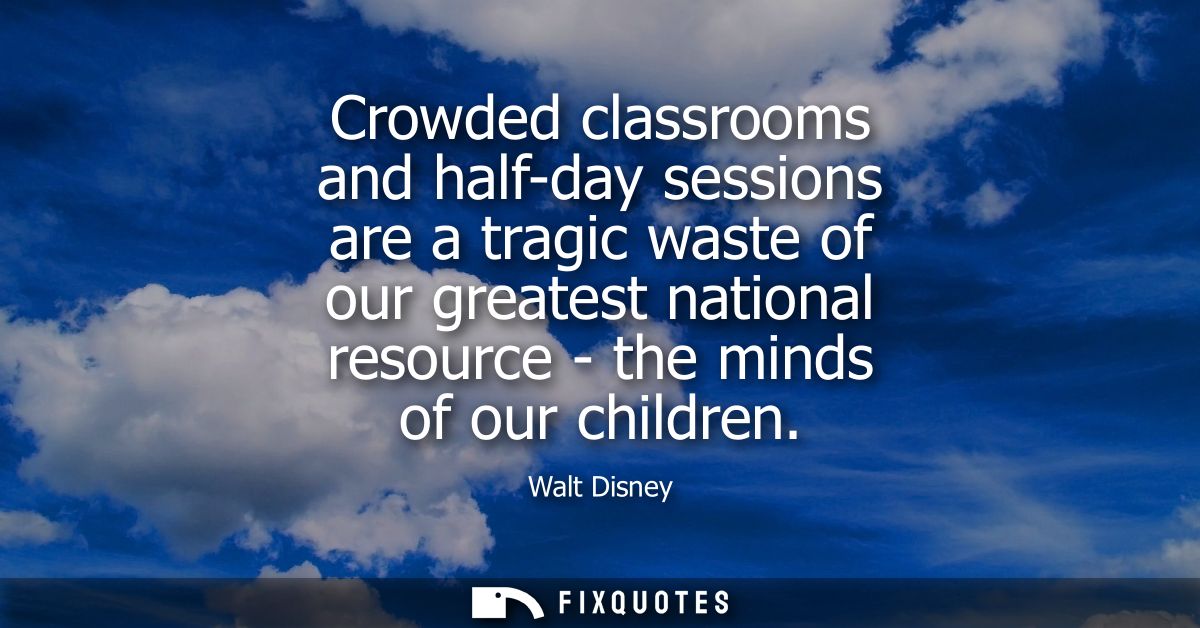
"Crowded classrooms and half-day sessions are a tragic waste of our greatest national resource - the minds of our children"
About this Quote
Calling children “our greatest national resource” is a deliberately American piece of persuasion. It borrows the language of industry and wartime planning - resources, investment, return - and redirects it toward education, a domain too often sentimentalized or treated as local housekeeping. The subtext is blunt: a country that prides itself on innovation is sabotaging the pipeline that makes innovation possible. It’s also a savvy political move. By framing kids’ minds as national capital, he speaks to people who might not be moved by pedagogical theory but will respond to competitiveness, growth, and national pride.
Disney’s context matters: mid-century America sold itself as the future, even as public institutions strained under the baby boom and Cold War anxiety about “winning” science and technology. From the creator who built an empire on imagination and training talent at industrial scale, the warning lands with extra bite: the nation is starving the very raw material it claims to celebrate.
Quote Details
| Topic | Learning |
|---|---|
| Source | Help us find the source |
| Cite |
Citation Formats
APA Style (7th ed.)
Disney, Walt. (2026, January 18). Crowded classrooms and half-day sessions are a tragic waste of our greatest national resource - the minds of our children. FixQuotes. https://fixquotes.com/quotes/crowded-classrooms-and-half-day-sessions-are-a-15030/
Chicago Style
Disney, Walt. "Crowded classrooms and half-day sessions are a tragic waste of our greatest national resource - the minds of our children." FixQuotes. January 18, 2026. https://fixquotes.com/quotes/crowded-classrooms-and-half-day-sessions-are-a-15030/.
MLA Style (9th ed.)
"Crowded classrooms and half-day sessions are a tragic waste of our greatest national resource - the minds of our children." FixQuotes, 18 Jan. 2026, https://fixquotes.com/quotes/crowded-classrooms-and-half-day-sessions-are-a-15030/. Accessed 12 Feb. 2026.