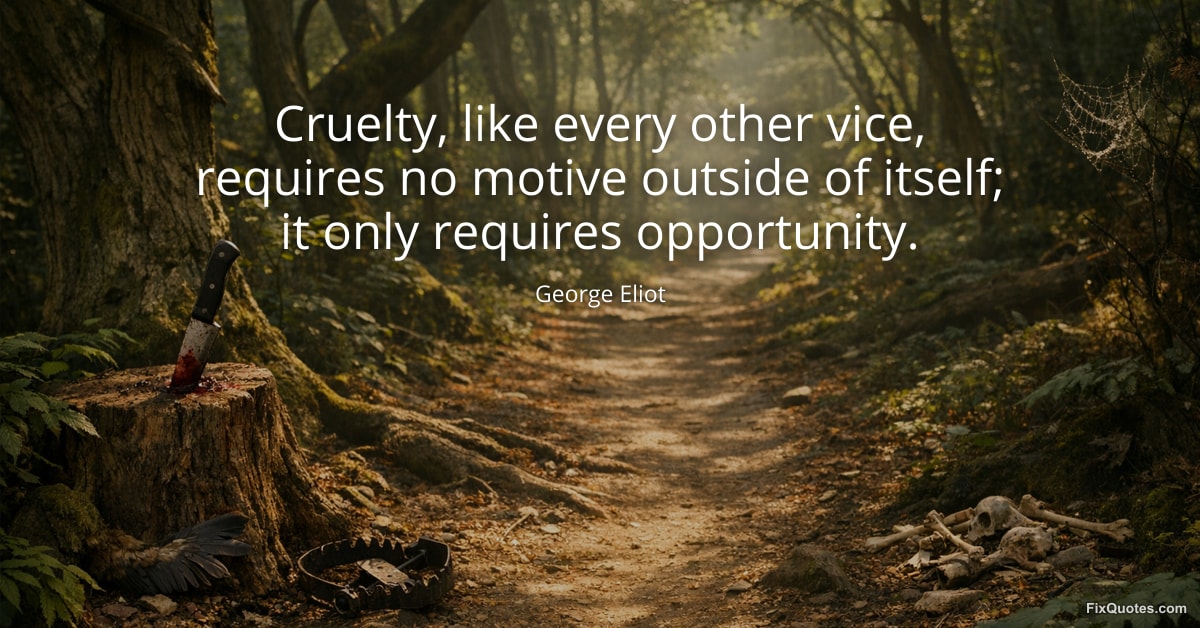
"Cruelty, like every other vice, requires no motive outside of itself; it only requires opportunity"
About this Quote
Eliot was a novelist obsessed with moral causality, but not the tidy kind. In Middlemarch and her other works, harm often arrives not from cartoon villains but from respectable people, insulated by custom and self-regard. That’s the context humming beneath this aphorism: the Victorian world of propriety, hierarchy, and gendered dependence, where “opportunity” isn’t random luck but social structure. Cruelty becomes possible because someone can get away with it - in marriage, in class relations, in reputational economies where the vulnerable are easy to punish and hard to believe.
The subtext is a warning against comforting narratives. If we insist cruelty must have an external motive, we can keep imagining it belongs to monsters. Eliot refuses that relief. She points instead to situational ethics: remove oversight, grant impunity, create asymmetry, and vice doesn’t need ideology to bloom. Opportunity is motive enough - which is precisely why moral seriousness can’t just be private virtue. It has to be public design.
Quote Details
| Topic | Ethics & Morality |
|---|---|
| Source | Verified source: Scenes of Clerical Life ("Janet's Repentance") (George Eliot, 1858)
Evidence: Cruelty, like every other vice, requires no motive outside itself , it only requires opportunity. (Chapter XIII (page shown as 335 in the OTA HTML transcription)). This sentence appears in George Eliot’s short story "Janet's Repentance," which was later collected in book form in Scenes of Clerical Life (published in 1858). The Oxford Text Archive (Bodleian Libraries) HTML transcription shows it in Chapter XIII, with an in-text page marker displayed as "[Page 335]" immediately after the word "craving for" in the next sentence. The commonly-circulated variant with a semicolon and "outside of itself" is a later paraphrase/punctuation change; the primary-text wording is "outside itself" (no "of"). Other candidates (1) Over 100 Ways to Stop Sabotaging Your Life (James Egan, 2015) compilation95.0% ... Cruelty , like every other vice , requires no motive outside of itself ; it only requires opportunity . - George ... |
| Cite |
Citation Formats
APA Style (7th ed.)
Eliot, George. (2026, February 27). Cruelty, like every other vice, requires no motive outside of itself; it only requires opportunity. FixQuotes. https://fixquotes.com/quotes/cruelty-like-every-other-vice-requires-no-motive-28219/
Chicago Style
Eliot, George. "Cruelty, like every other vice, requires no motive outside of itself; it only requires opportunity." FixQuotes. February 27, 2026. https://fixquotes.com/quotes/cruelty-like-every-other-vice-requires-no-motive-28219/.
MLA Style (9th ed.)
"Cruelty, like every other vice, requires no motive outside of itself; it only requires opportunity." FixQuotes, 27 Feb. 2026, https://fixquotes.com/quotes/cruelty-like-every-other-vice-requires-no-motive-28219/. Accessed 8 Apr. 2026.