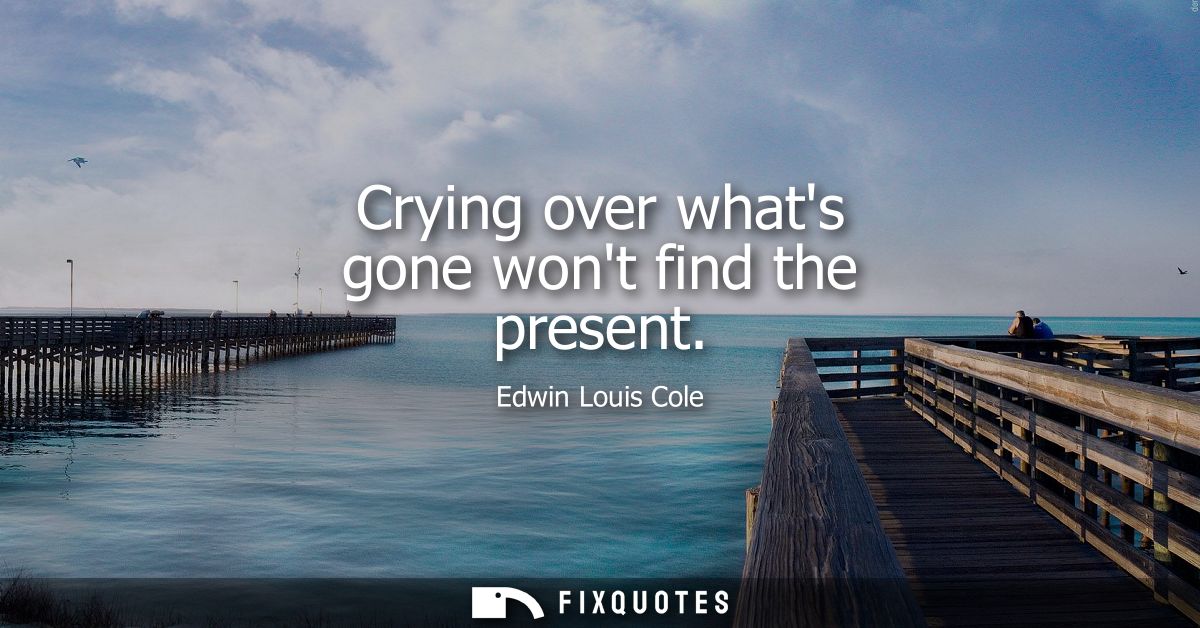
"Crying over what's gone won't find the present"
About this Quote
Grief is framed here less as a feeling to be honored than as a habit that misplaces you in time. Cole’s line works because it turns mourning into a navigation error: “crying over what’s gone” isn’t just sad, it’s a futile search party sent to the wrong coordinates. The verb choice matters. “Find” implies the present isn’t guaranteed; it’s something you locate through attention and action. That quietly rewrites the usual self-help promise that “being present” is effortless if you just calm down. Cole suggests the opposite: the present is easy to miss, especially when your emotional energy is tied up in what can’t be recovered.
The subtext is pastoral and pragmatic. As a Christian men’s movement leader and motivational author, Cole wrote in a culture steeped in testimony, repentance, and forward motion. There’s an implied moral economy: tears that don’t convert into change become indulgence, a kind of sentimental procrastination. The quote nudges the reader from lament to responsibility without sounding like a scold; it keeps compassion at arm’s length by focusing on outcomes. You can hear a counselor’s impatience with rumination, the stalled life, the person who keeps paying interest on a closed chapter.
It also smuggles in a theological timekeeping: the past is fixed, the future is uncertain, the present is where obedience (or growth, or repair) actually happens. The line isn’t anti-emotion so much as anti-capture. Feel it, yes, but don’t live there.
The subtext is pastoral and pragmatic. As a Christian men’s movement leader and motivational author, Cole wrote in a culture steeped in testimony, repentance, and forward motion. There’s an implied moral economy: tears that don’t convert into change become indulgence, a kind of sentimental procrastination. The quote nudges the reader from lament to responsibility without sounding like a scold; it keeps compassion at arm’s length by focusing on outcomes. You can hear a counselor’s impatience with rumination, the stalled life, the person who keeps paying interest on a closed chapter.
It also smuggles in a theological timekeeping: the past is fixed, the future is uncertain, the present is where obedience (or growth, or repair) actually happens. The line isn’t anti-emotion so much as anti-capture. Feel it, yes, but don’t live there.
Quote Details
| Topic | Letting Go |
|---|---|
| Source | Help us find the source |
| Cite |
Citation Formats
APA Style (7th ed.)
Cole, Edwin Louis. (2026, January 17). Crying over what's gone won't find the present. FixQuotes. https://fixquotes.com/quotes/crying-over-whats-gone-wont-find-the-present-49368/
Chicago Style
Cole, Edwin Louis. "Crying over what's gone won't find the present." FixQuotes. January 17, 2026. https://fixquotes.com/quotes/crying-over-whats-gone-wont-find-the-present-49368/.
MLA Style (9th ed.)
"Crying over what's gone won't find the present." FixQuotes, 17 Jan. 2026, https://fixquotes.com/quotes/crying-over-whats-gone-wont-find-the-present-49368/. Accessed 31 Mar. 2026.
More Quotes by Edwin
Add to List