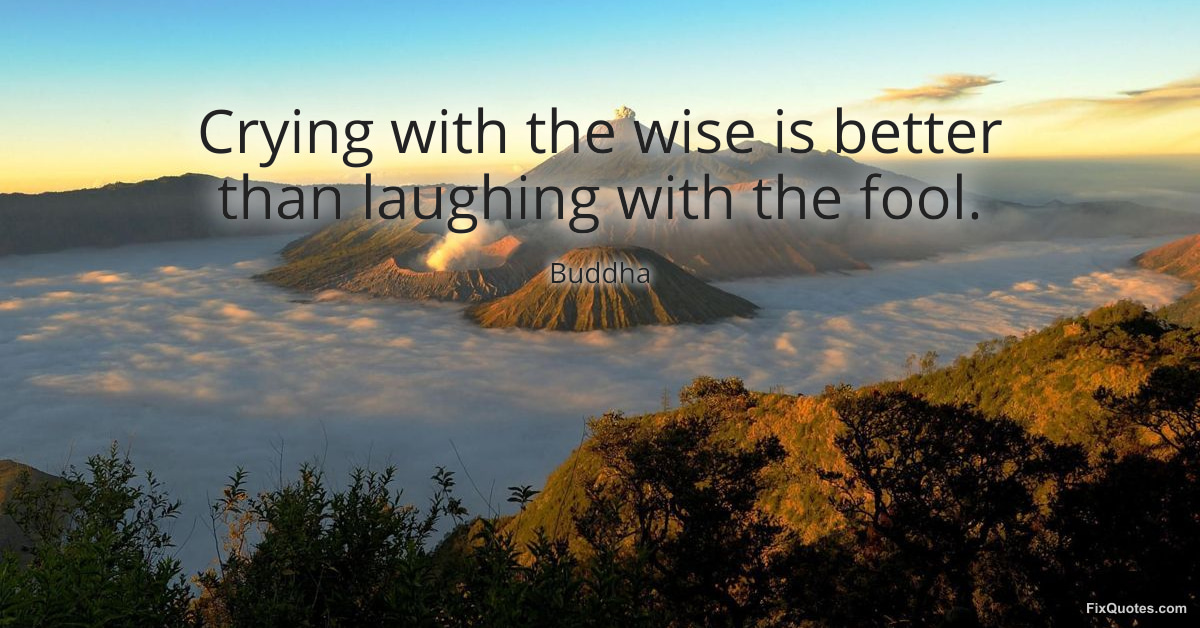
"Crying with the wise is better than laughing with the fool"
About this Quote
What gives this line its staying power is its refusal of easy pleasure. Buddha sets up a choice between two social worlds: one shaped by insight, even when it hurts, and one animated by noise, distraction, and bad company. The comparison is severe on purpose. Crying is not merely sadness here; it suggests the discomfort of seeing clearly. Laughing with a fool is not innocent joy; it is complicity in delusion.
That moral contrast sits at the center of Buddhist thought. Suffering, in this tradition, is not an embarrassing exception to life but one of its basic conditions. Wisdom begins when a person stops decorating reality and starts facing it. So the line works by overturning ordinary instinct. Most people would choose laughter over tears without hesitation. Buddha asks whether the emotional surface of an experience tells the truth about its value. His answer is no. Pain in the company of the wise may be the beginning of liberation; pleasure in the company of the foolish may deepen ignorance.
The subtext is also social. This is advice about influence, about who gets to shape your mind. A wise companion may confront you, unsettle you, force you into honesty. A foolish one offers the more seductive bargain: comfort without clarity, amusement without growth. For a historical spiritual leader speaking into a culture preoccupied with status, ritual, and attachment, that is a radical recalibration of what counts as good company. The line endures because it understands a hard truth modern life keeps rediscovering: not every good feeling is good for you.
That moral contrast sits at the center of Buddhist thought. Suffering, in this tradition, is not an embarrassing exception to life but one of its basic conditions. Wisdom begins when a person stops decorating reality and starts facing it. So the line works by overturning ordinary instinct. Most people would choose laughter over tears without hesitation. Buddha asks whether the emotional surface of an experience tells the truth about its value. His answer is no. Pain in the company of the wise may be the beginning of liberation; pleasure in the company of the foolish may deepen ignorance.
The subtext is also social. This is advice about influence, about who gets to shape your mind. A wise companion may confront you, unsettle you, force you into honesty. A foolish one offers the more seductive bargain: comfort without clarity, amusement without growth. For a historical spiritual leader speaking into a culture preoccupied with status, ritual, and attachment, that is a radical recalibration of what counts as good company. The line endures because it understands a hard truth modern life keeps rediscovering: not every good feeling is good for you.
Quote Details
| Topic | Wisdom |
|---|---|
| Source | Help us find the source |
| Cite |
Citation Formats
APA Style (7th ed.)
Buddha. (2026, March 10). Crying with the wise is better than laughing with the fool. FixQuotes. https://fixquotes.com/quotes/crying-with-the-wise-is-better-than-laughing-with-185975/
Chicago Style
Buddha. "Crying with the wise is better than laughing with the fool." FixQuotes. March 10, 2026. https://fixquotes.com/quotes/crying-with-the-wise-is-better-than-laughing-with-185975/.
MLA Style (9th ed.)
"Crying with the wise is better than laughing with the fool." FixQuotes, 10 Mar. 2026, https://fixquotes.com/quotes/crying-with-the-wise-is-better-than-laughing-with-185975/. Accessed 4 Apr. 2026.
More Quotes by Buddha
Add to List