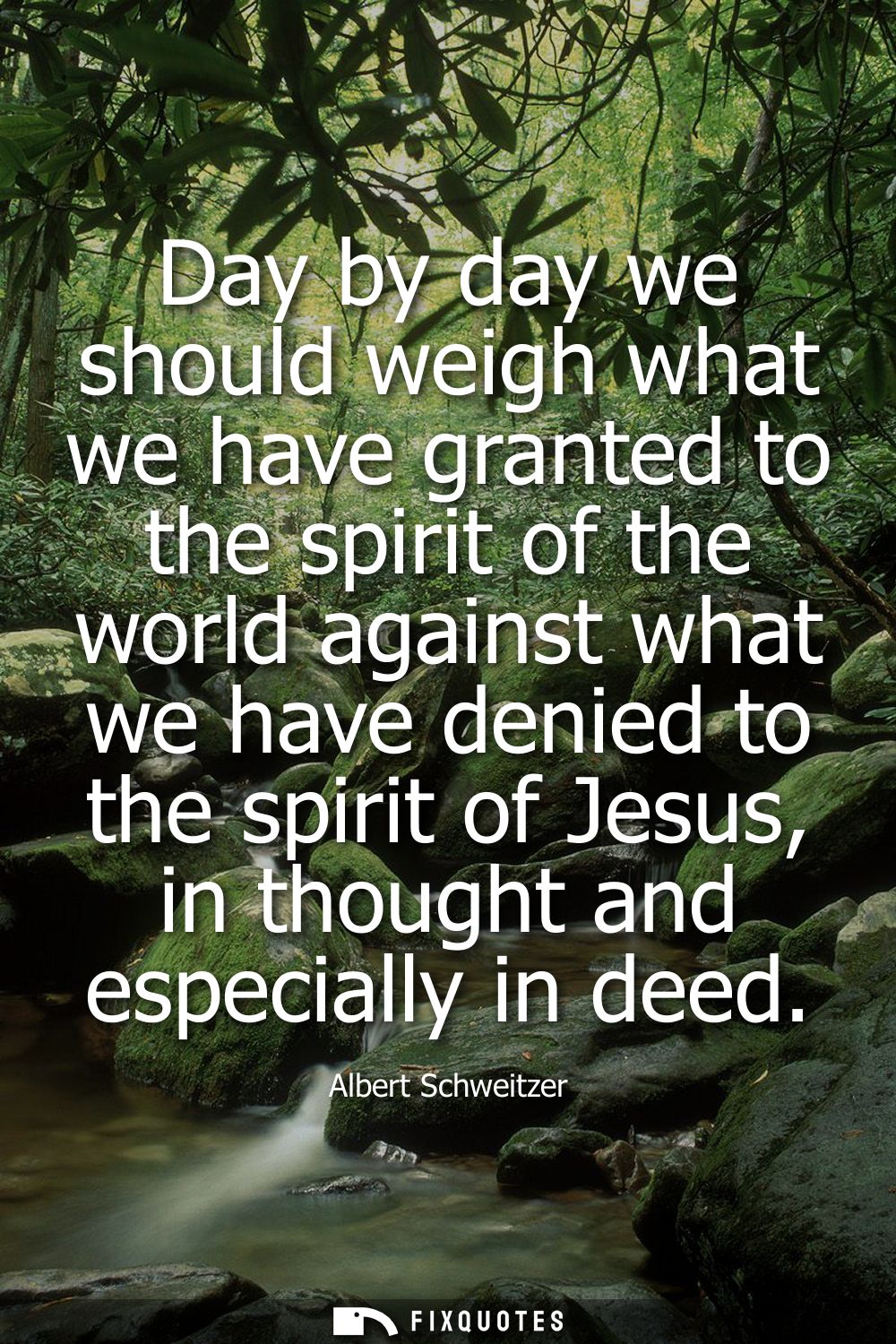
"Day by day we should weigh what we have granted to the spirit of the world against what we have denied to the spirit of Jesus, in thought and especially in deed"
About this Quote
The subtext is a critique of modern compromise. “The spirit of the world” isn’t just sin in the cartoon sense; it’s the ambient logic of status, comfort, productivity, nationalism, and self-importance-the stuff that feels inevitable because it’s everywhere. Schweitzer frames it as something we actively “grant,” implicating us in systems we might prefer to call neutral. Meanwhile, the “spirit of Jesus” is framed as something we refuse, not merely fail to achieve. That’s harsher: denial is willful.
The line “in thought and especially in deed” is the trapdoor. Schweitzer, a theologian who lived his ethics as a medical missionary, refuses to let belief do the work of behavior. Thoughts matter, but deeds are where the world’s spirit cashes its checks-and where Jesus’ spirit looks either real or ornamental.
Contextually, this reads like early 20th-century Christianity wrestling with modernity’s temptations: rationalization, empire, institutional religion as social décor. Schweitzer’s intent is not to inspire vague piety, but to force a daily audit of complicity-and demand receipts.
Quote Details
| Topic | Faith |
|---|---|
| Source | Help us find the source |
| Cite |
Citation Formats
APA Style (7th ed.)
Schweitzer, Albert. (2026, January 17). Day by day we should weigh what we have granted to the spirit of the world against what we have denied to the spirit of Jesus, in thought and especially in deed. FixQuotes. https://fixquotes.com/quotes/day-by-day-we-should-weigh-what-we-have-granted-29640/
Chicago Style
Schweitzer, Albert. "Day by day we should weigh what we have granted to the spirit of the world against what we have denied to the spirit of Jesus, in thought and especially in deed." FixQuotes. January 17, 2026. https://fixquotes.com/quotes/day-by-day-we-should-weigh-what-we-have-granted-29640/.
MLA Style (9th ed.)
"Day by day we should weigh what we have granted to the spirit of the world against what we have denied to the spirit of Jesus, in thought and especially in deed." FixQuotes, 17 Jan. 2026, https://fixquotes.com/quotes/day-by-day-we-should-weigh-what-we-have-granted-29640/. Accessed 19 Feb. 2026.