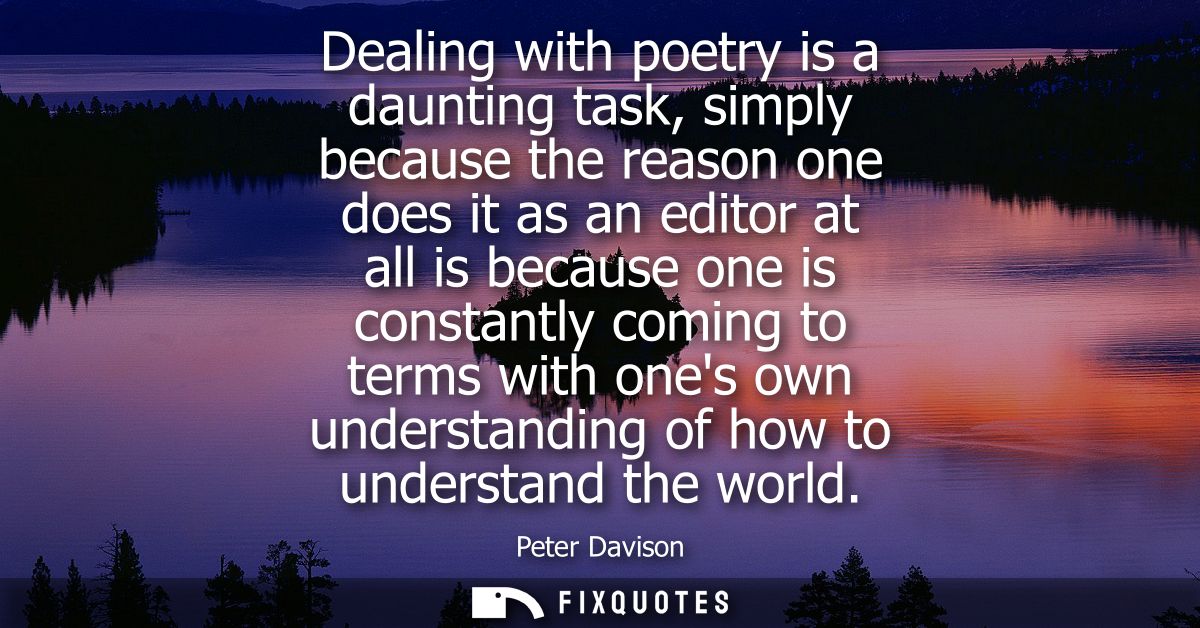
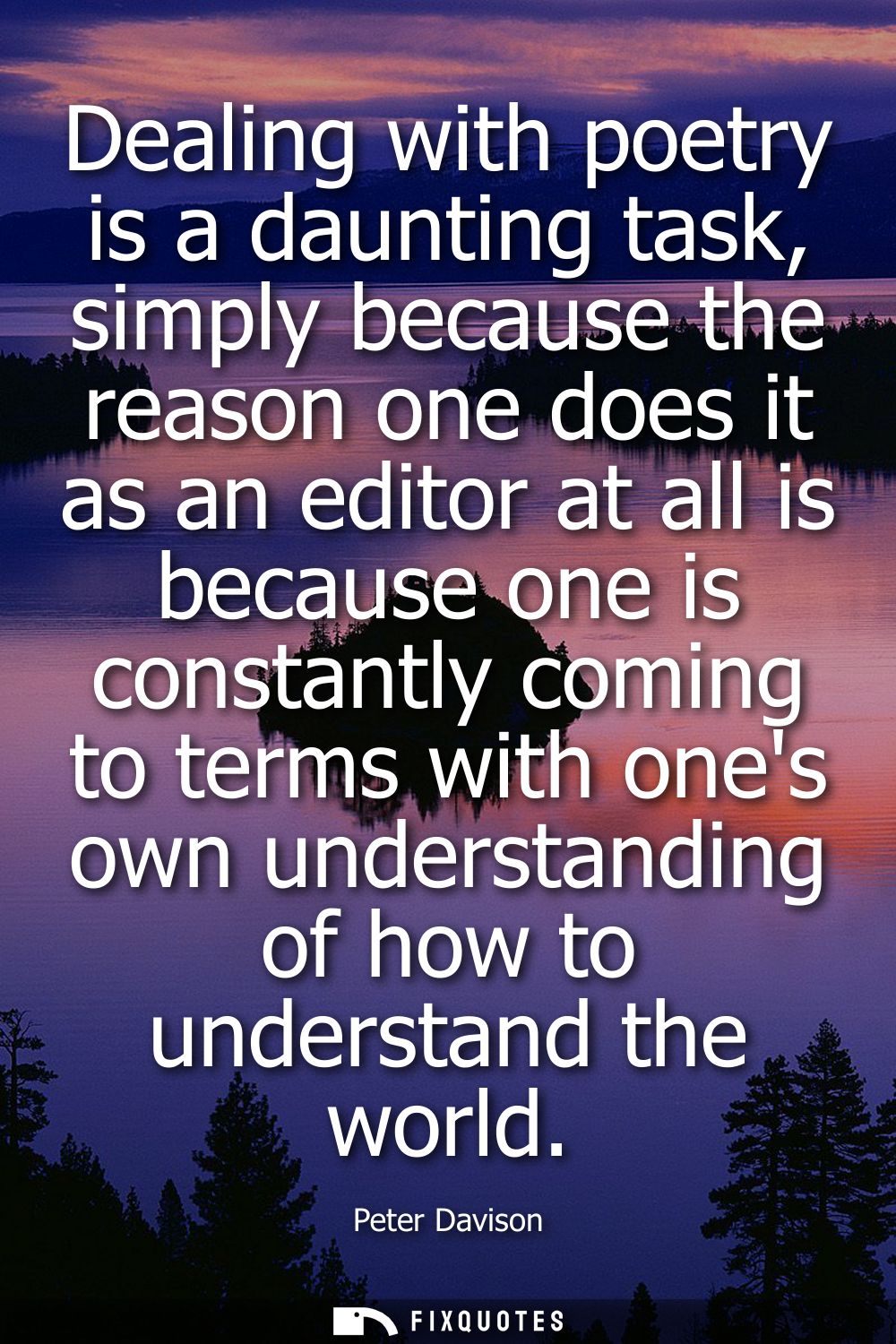
"Dealing with poetry is a daunting task, simply because the reason one does it as an editor at all is because one is constantly coming to terms with one's own understanding of how to understand the world"
About this Quote
The sentence loops on itself - “understanding of how to understand” - and that recursion is the point. Poetry resists being reduced to a single, clean paraphrase, so the editor’s role becomes less referee and more co-struggler. Every decision (keep the strange adjective, cut the sentimental line, preserve the ambiguity) doubles as a worldview test: What do you think clarity looks like? What counts as truth? What kinds of confusion are allowed to remain beautiful?
Coming from an actor, the insight lands with particular force. Actors live inside interpretation: you don’t just recite words, you decide what’s underneath them, what the silence means, what motivates a turn of phrase. Davison frames editing the same way - a performance of judgment that inevitably reveals the editor’s temperament, biases, and hunger for coherence. The subtext is bracing: the editor isn’t outside the poem; the editor is implicated, negotiating not just a text but a life-sized question of how to read the world without flattening it.
Quote Details
| Topic | Poetry |
|---|---|
| Source | Help us find the source |
| Cite |
Citation Formats
APA Style (7th ed.)
Davison, Peter. (2026, January 16). Dealing with poetry is a daunting task, simply because the reason one does it as an editor at all is because one is constantly coming to terms with one's own understanding of how to understand the world. FixQuotes. https://fixquotes.com/quotes/dealing-with-poetry-is-a-daunting-task-simply-134386/
Chicago Style
Davison, Peter. "Dealing with poetry is a daunting task, simply because the reason one does it as an editor at all is because one is constantly coming to terms with one's own understanding of how to understand the world." FixQuotes. January 16, 2026. https://fixquotes.com/quotes/dealing-with-poetry-is-a-daunting-task-simply-134386/.
MLA Style (9th ed.)
"Dealing with poetry is a daunting task, simply because the reason one does it as an editor at all is because one is constantly coming to terms with one's own understanding of how to understand the world." FixQuotes, 16 Jan. 2026, https://fixquotes.com/quotes/dealing-with-poetry-is-a-daunting-task-simply-134386/. Accessed 27 Mar. 2026.