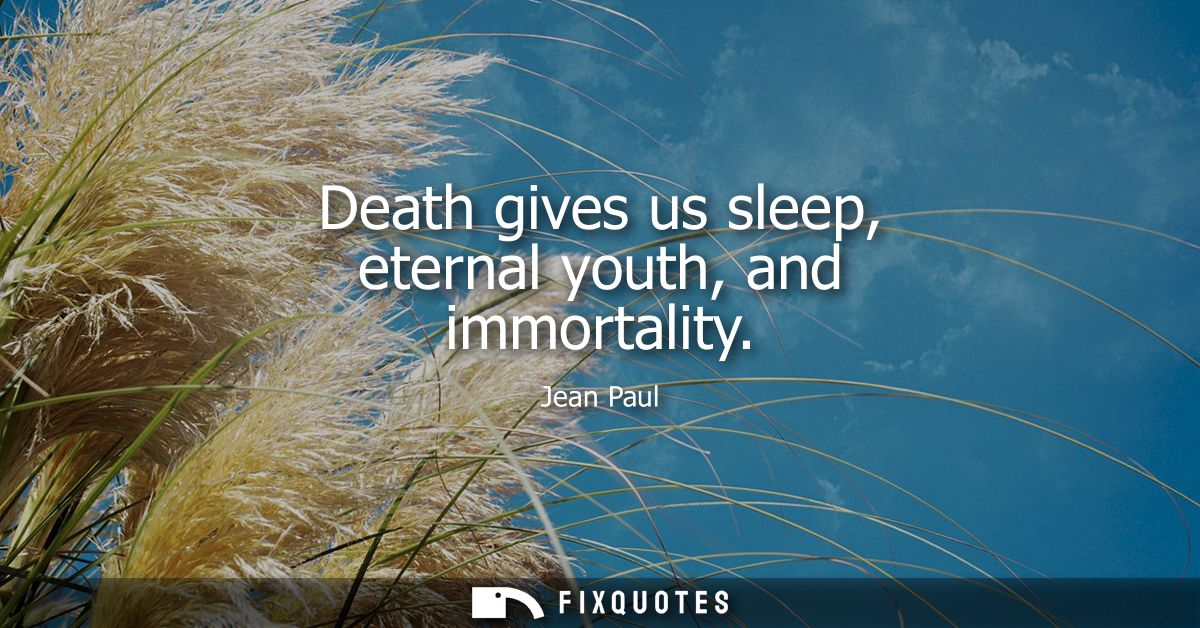
"Death gives us sleep, eternal youth, and immortality"
About this Quote
Jean Paul sells death the way a shrewd adman sells a dubious product: by borrowing the language of comfort and upgrading it into luxury. Sleep, youth, immortality. Each term is a wish, and the line works because it stacks them like a staircase, inviting the reader to climb out of dread into desire. The subtext is almost taunting: you already crave these things, so why recoil when the bill comes due?
As a Romantic-era writer, Jean Paul is operating in a cultural moment obsessed with the afterlife but newly uneasy about old certainties. His genius is to dodge doctrine. He doesn’t argue for heaven, resurrection, or moral accounting. He reframes death as a kind of radical care: the body finally rests; time finally stops; decay is arrested, not defeated. “Eternal youth” is the sly hinge here, because it exposes the paradox. Death can’t restore youth in any lived sense, but it can freeze you at the age you die, embalmed in memory or myth. The line flatters our vanity even as it admits the only way to keep youth is to exit the timeline entirely.
There’s also a mordant cynicism in offering “immortality” via death. It’s a trick of perspective: the self is gone, but the fear is neutralized, because nothing remains to suffer it. Jean Paul’s intent feels less like consolation than a darkly playful deflation of the ego, a reminder that the promises we beg life for are delivered most cleanly by its end.
As a Romantic-era writer, Jean Paul is operating in a cultural moment obsessed with the afterlife but newly uneasy about old certainties. His genius is to dodge doctrine. He doesn’t argue for heaven, resurrection, or moral accounting. He reframes death as a kind of radical care: the body finally rests; time finally stops; decay is arrested, not defeated. “Eternal youth” is the sly hinge here, because it exposes the paradox. Death can’t restore youth in any lived sense, but it can freeze you at the age you die, embalmed in memory or myth. The line flatters our vanity even as it admits the only way to keep youth is to exit the timeline entirely.
There’s also a mordant cynicism in offering “immortality” via death. It’s a trick of perspective: the self is gone, but the fear is neutralized, because nothing remains to suffer it. Jean Paul’s intent feels less like consolation than a darkly playful deflation of the ego, a reminder that the promises we beg life for are delivered most cleanly by its end.
Quote Details
| Topic | Mortality |
|---|---|
| Source | Help us find the source |
| Cite |
Citation Formats
APA Style (7th ed.)
Paul, Jean. (2026, January 15). Death gives us sleep, eternal youth, and immortality. FixQuotes. https://fixquotes.com/quotes/death-gives-us-sleep-eternal-youth-and-immortality-146959/
Chicago Style
Paul, Jean. "Death gives us sleep, eternal youth, and immortality." FixQuotes. January 15, 2026. https://fixquotes.com/quotes/death-gives-us-sleep-eternal-youth-and-immortality-146959/.
MLA Style (9th ed.)
"Death gives us sleep, eternal youth, and immortality." FixQuotes, 15 Jan. 2026, https://fixquotes.com/quotes/death-gives-us-sleep-eternal-youth-and-immortality-146959/. Accessed 22 Mar. 2026.
More Quotes by Jean
Add to List