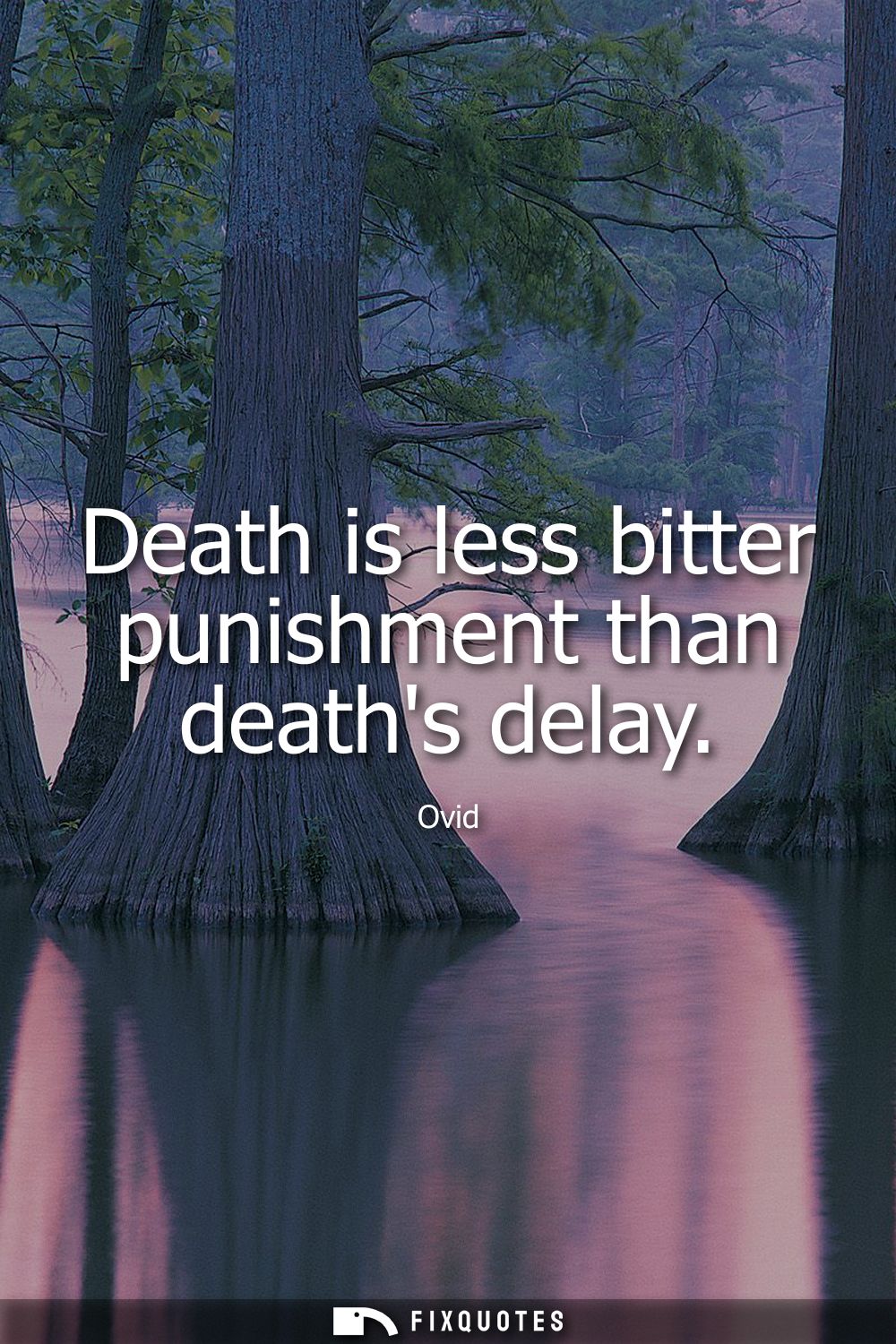
"Death is less bitter punishment than death's delay"
About this Quote
Ovid’s line hits with the cold efficiency of a curse: the cruelty isn’t dying, it’s being made to wait for it. “Less bitter punishment” flips our usual hierarchy of fears. Death, the supposed ultimate loss, becomes almost merciful next to the drawn-out torment of postponement. The phrase “death’s delay” personifies time as a sadist, turning uncertainty into an active sentence handed down by fate or power.
That matters in Ovid’s world, where punishment is rarely clean. His poems are full of transformations and protracted consequences: bodies stretched into new shapes, desires that linger, exile that doesn’t kill you but keeps you alive in the wrong place. Read against his biography, the subtext sharpens. Banished by Augustus to Tomis at the edge of the empire, Ovid endured a slow unmaking: cut off from Rome’s cultural bloodstream, pleading for recall, living in suspended animation. Exile is “death’s delay” in political form - a state can neutralize you without granting the release of martyrdom.
The line also critiques a certain moral theater. Empires and gods alike prefer punishments that demonstrate control: not the decisive act, but the prolonged reminder that you are at their mercy. Ovid’s genius is to frame that not as abstract philosophy but as an emotional verdict. The dread of the unknown becomes the real instrument of domination. If death is finality, delay is leverage.
That matters in Ovid’s world, where punishment is rarely clean. His poems are full of transformations and protracted consequences: bodies stretched into new shapes, desires that linger, exile that doesn’t kill you but keeps you alive in the wrong place. Read against his biography, the subtext sharpens. Banished by Augustus to Tomis at the edge of the empire, Ovid endured a slow unmaking: cut off from Rome’s cultural bloodstream, pleading for recall, living in suspended animation. Exile is “death’s delay” in political form - a state can neutralize you without granting the release of martyrdom.
The line also critiques a certain moral theater. Empires and gods alike prefer punishments that demonstrate control: not the decisive act, but the prolonged reminder that you are at their mercy. Ovid’s genius is to frame that not as abstract philosophy but as an emotional verdict. The dread of the unknown becomes the real instrument of domination. If death is finality, delay is leverage.
Quote Details
| Topic | Mortality |
|---|---|
| Source | Help us find the source |
| Cite |
Citation Formats
APA Style (7th ed.)
Ovid. (2026, January 14). Death is less bitter punishment than death's delay. FixQuotes. https://fixquotes.com/quotes/death-is-less-bitter-punishment-than-deaths-delay-18220/
Chicago Style
Ovid. "Death is less bitter punishment than death's delay." FixQuotes. January 14, 2026. https://fixquotes.com/quotes/death-is-less-bitter-punishment-than-deaths-delay-18220/.
MLA Style (9th ed.)
"Death is less bitter punishment than death's delay." FixQuotes, 14 Jan. 2026, https://fixquotes.com/quotes/death-is-less-bitter-punishment-than-deaths-delay-18220/. Accessed 11 Feb. 2026.
More Quotes by Ovid
Add to List