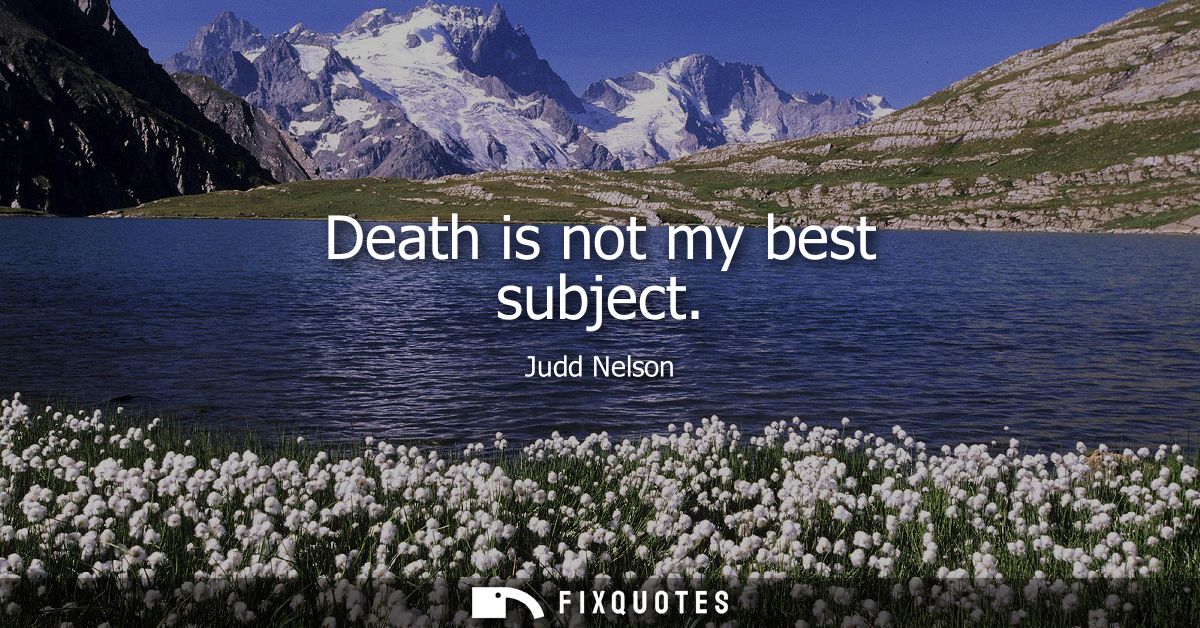
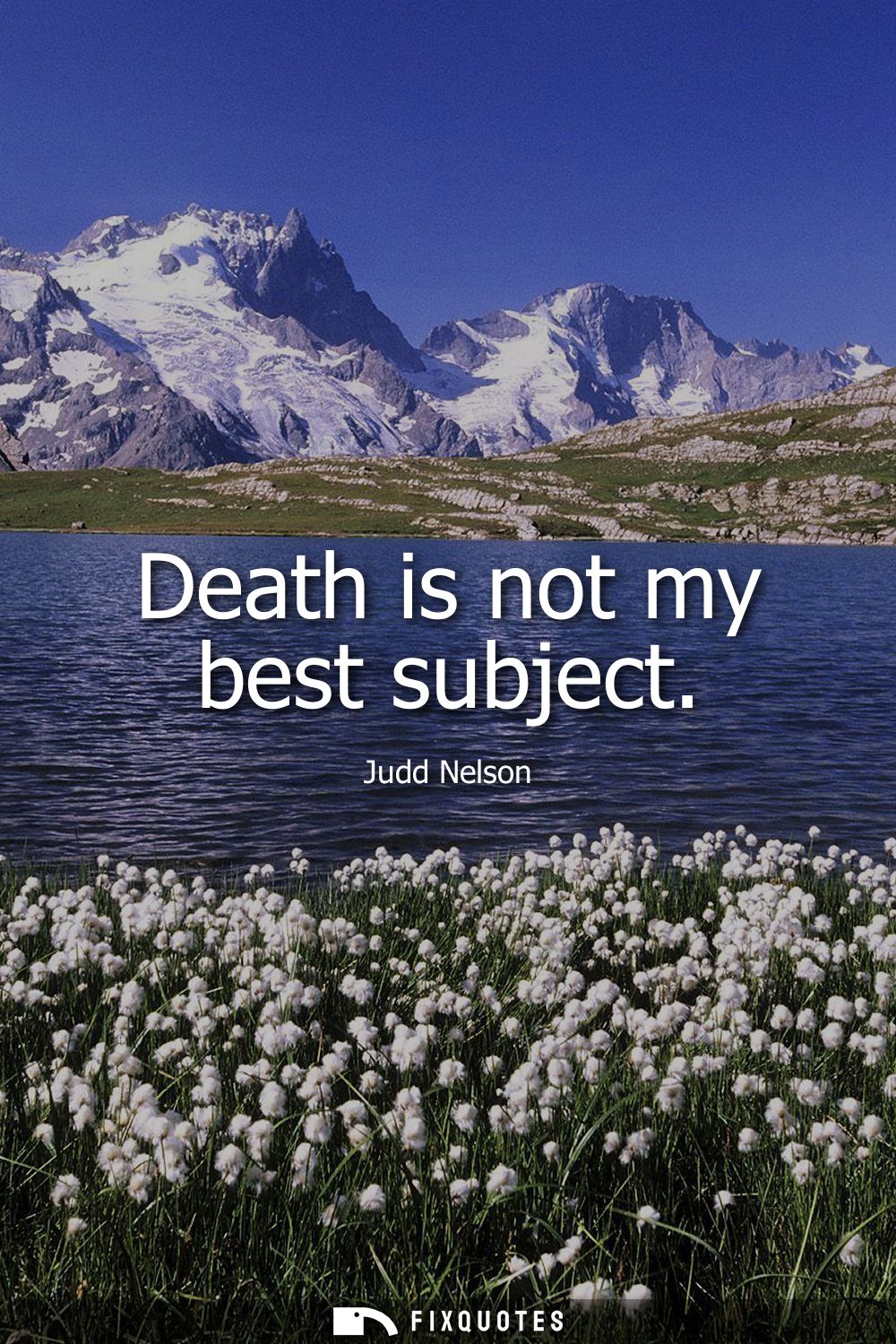
"Death is not my best subject"
About this Quote
"Death is not my best subject" lands like a shrug in the face of the one topic that refuses to be shrugged off. Coming from Judd Nelson, an actor forever tied to a certain 1980s brand of smart-mouthed vulnerability, the line reads as performance and confession at once: a defensive joke that admits, indirectly, fear. It works because it treats mortality less as a grand philosophical problem and more as an awkward conversational category you keep failing in school. Not tragedy, not transcendence: a subject you bomb on.
The phrasing is doing sly work. "Not my best" implies there are better subjects, strengths, maybe even a personal curriculum of emotions and roles where control is possible. Death, by contrast, is the exam no one studies for and everyone must take. The line dodges sentimentality by using the language of competence, which is culturally familiar and quietly damning. In a world that rewards expertise and polish, admitting you're bad at death is admitting you can't optimize your way out of the ending.
Contextually, it fits an actor's relationship to death: surrounded by it as story material, rarely asked to metabolize it without a script. Actors "do" grief on cue; real mortality doesn't give notes. The subtext is a critique of our own coping style, too: we turn existential dread into quips because humor is the only acceptable crack in the armor. Nelson's line is funny, but the laugh catches, because it’s honest about the limits of charm.
The phrasing is doing sly work. "Not my best" implies there are better subjects, strengths, maybe even a personal curriculum of emotions and roles where control is possible. Death, by contrast, is the exam no one studies for and everyone must take. The line dodges sentimentality by using the language of competence, which is culturally familiar and quietly damning. In a world that rewards expertise and polish, admitting you're bad at death is admitting you can't optimize your way out of the ending.
Contextually, it fits an actor's relationship to death: surrounded by it as story material, rarely asked to metabolize it without a script. Actors "do" grief on cue; real mortality doesn't give notes. The subtext is a critique of our own coping style, too: we turn existential dread into quips because humor is the only acceptable crack in the armor. Nelson's line is funny, but the laugh catches, because it’s honest about the limits of charm.
Quote Details
| Topic | Mortality |
|---|---|
| Source | Help us find the source |
| Cite |
Citation Formats
APA Style (7th ed.)
Nelson, Judd. (2026, January 16). Death is not my best subject. FixQuotes. https://fixquotes.com/quotes/death-is-not-my-best-subject-87686/
Chicago Style
Nelson, Judd. "Death is not my best subject." FixQuotes. January 16, 2026. https://fixquotes.com/quotes/death-is-not-my-best-subject-87686/.
MLA Style (9th ed.)
"Death is not my best subject." FixQuotes, 16 Jan. 2026, https://fixquotes.com/quotes/death-is-not-my-best-subject-87686/. Accessed 12 Feb. 2026.
More Quotes by Judd
Add to List