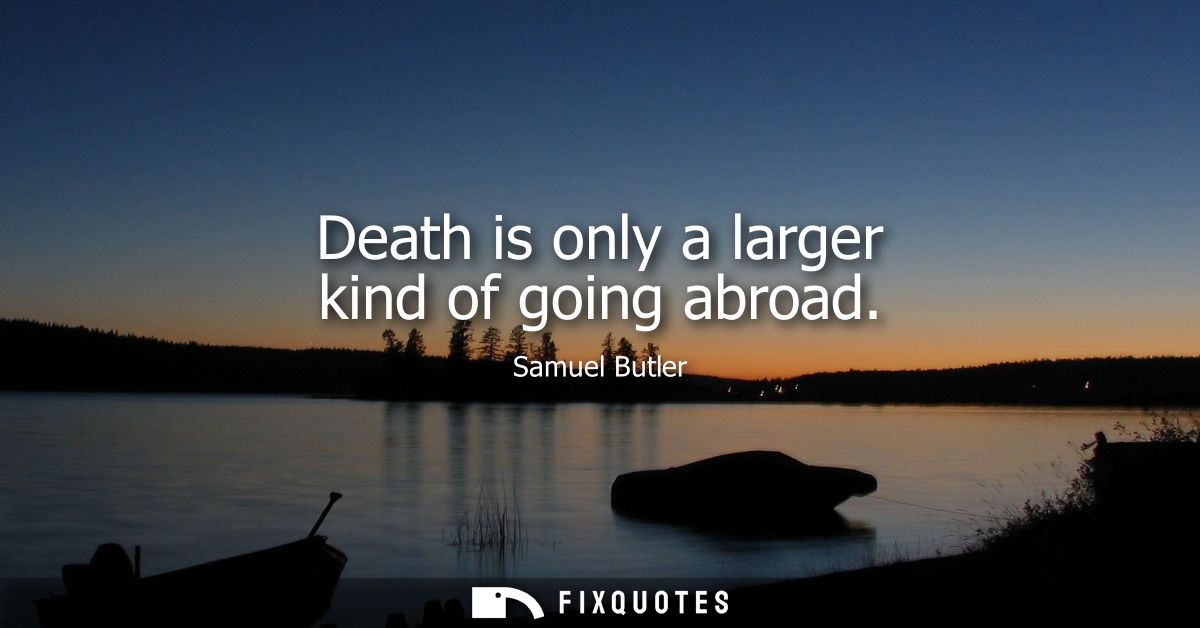
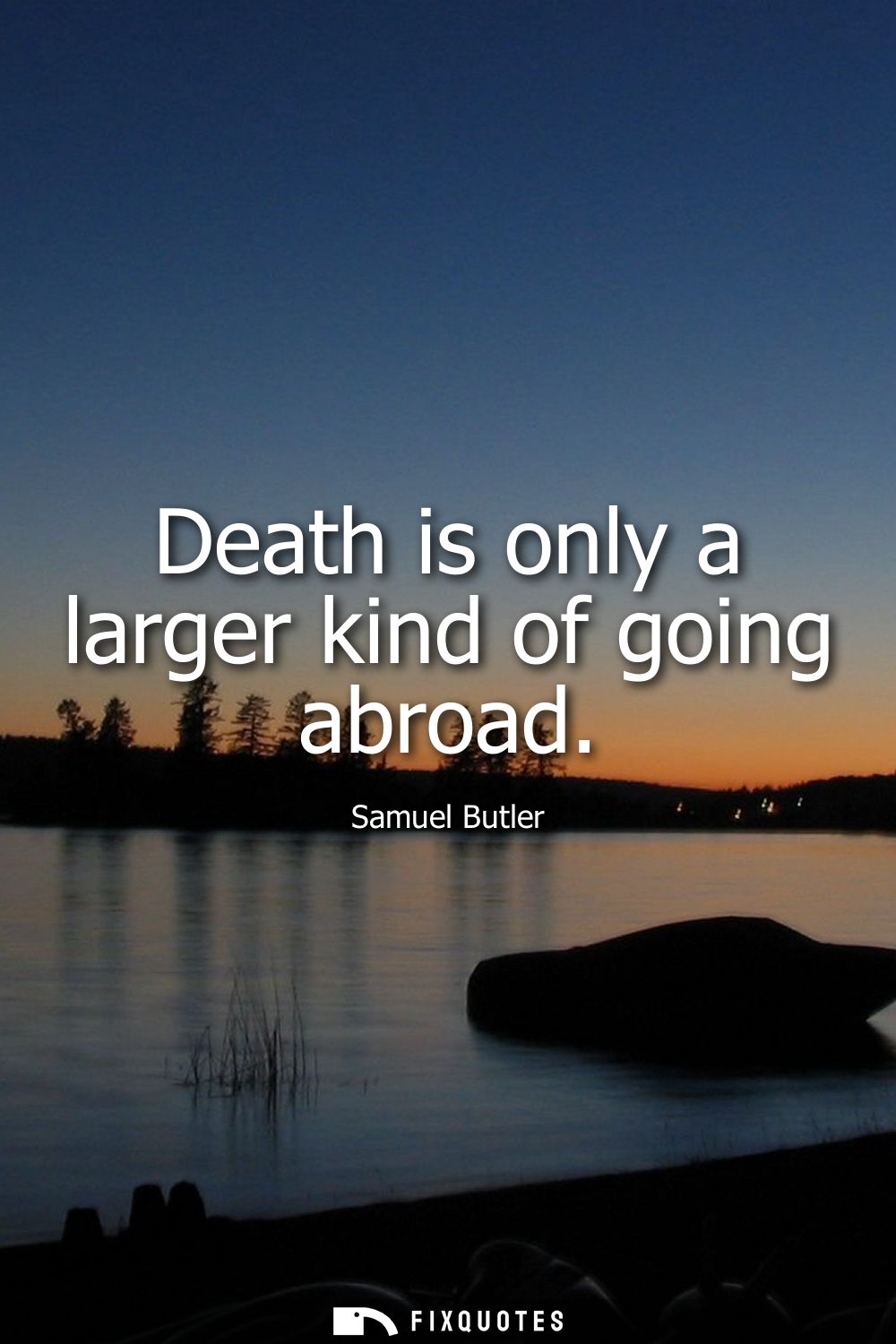
"Death is only a larger kind of going abroad"
About this Quote
Butler turns the ultimate cliff-edge into a travel arrangement, shrinking death down to the scale of a timetable. The line works because it sounds almost breezily practical: not annihilation, not judgment, not cosmic terror, just the next, larger departure. That understated phrasing is the whole weapon. It siphons drama out of the topic that usually demands it, replacing metaphysical panic with the familiar anxieties of leaving home: distance, customs, the unsettling prospect of not knowing the language.
Calling death “going abroad” also smuggles in a Victorian worldview. For Butler’s class, travel was both aspiration and dislocation, a symbol of education and empire but also of separation and risk. He borrows that cultural script to make mortality legible. “Larger” does double duty: it concedes that death is qualitatively different, but refuses to let it become unspeakable. The joke is quiet, but it’s there: humans insist on domesticating the unknowable with the vocabulary of luggage and itineraries.
The subtext is less comfort than critique. Butler, a skeptic shaped by Darwin-era upheaval and famously suspicious of sanctimony, sidesteps religious choreography. No heaven, no hell, no sermon. Just movement. That’s an intellectual stance disguised as a soothing metaphor: if the afterlife can’t be proven, at least we can frame death as a change of country rather than a final verdict.
It’s also a line about identity. Travel remakes you; you return altered or you don’t return at all. Butler suggests the same of dying, leaving readers with a strangely modern thought: the fear isn’t only ending, it’s crossing into a place where the self no longer has familiar coordinates.
Calling death “going abroad” also smuggles in a Victorian worldview. For Butler’s class, travel was both aspiration and dislocation, a symbol of education and empire but also of separation and risk. He borrows that cultural script to make mortality legible. “Larger” does double duty: it concedes that death is qualitatively different, but refuses to let it become unspeakable. The joke is quiet, but it’s there: humans insist on domesticating the unknowable with the vocabulary of luggage and itineraries.
The subtext is less comfort than critique. Butler, a skeptic shaped by Darwin-era upheaval and famously suspicious of sanctimony, sidesteps religious choreography. No heaven, no hell, no sermon. Just movement. That’s an intellectual stance disguised as a soothing metaphor: if the afterlife can’t be proven, at least we can frame death as a change of country rather than a final verdict.
It’s also a line about identity. Travel remakes you; you return altered or you don’t return at all. Butler suggests the same of dying, leaving readers with a strangely modern thought: the fear isn’t only ending, it’s crossing into a place where the self no longer has familiar coordinates.
Quote Details
| Topic | Mortality |
|---|---|
| Source | Help us find the source |
| Cite |
Citation Formats
APA Style (7th ed.)
Butler, Samuel. (2026, January 18). Death is only a larger kind of going abroad. FixQuotes. https://fixquotes.com/quotes/death-is-only-a-larger-kind-of-going-abroad-17346/
Chicago Style
Butler, Samuel. "Death is only a larger kind of going abroad." FixQuotes. January 18, 2026. https://fixquotes.com/quotes/death-is-only-a-larger-kind-of-going-abroad-17346/.
MLA Style (9th ed.)
"Death is only a larger kind of going abroad." FixQuotes, 18 Jan. 2026, https://fixquotes.com/quotes/death-is-only-a-larger-kind-of-going-abroad-17346/. Accessed 14 Mar. 2026.
More Quotes by Samuel
Add to List