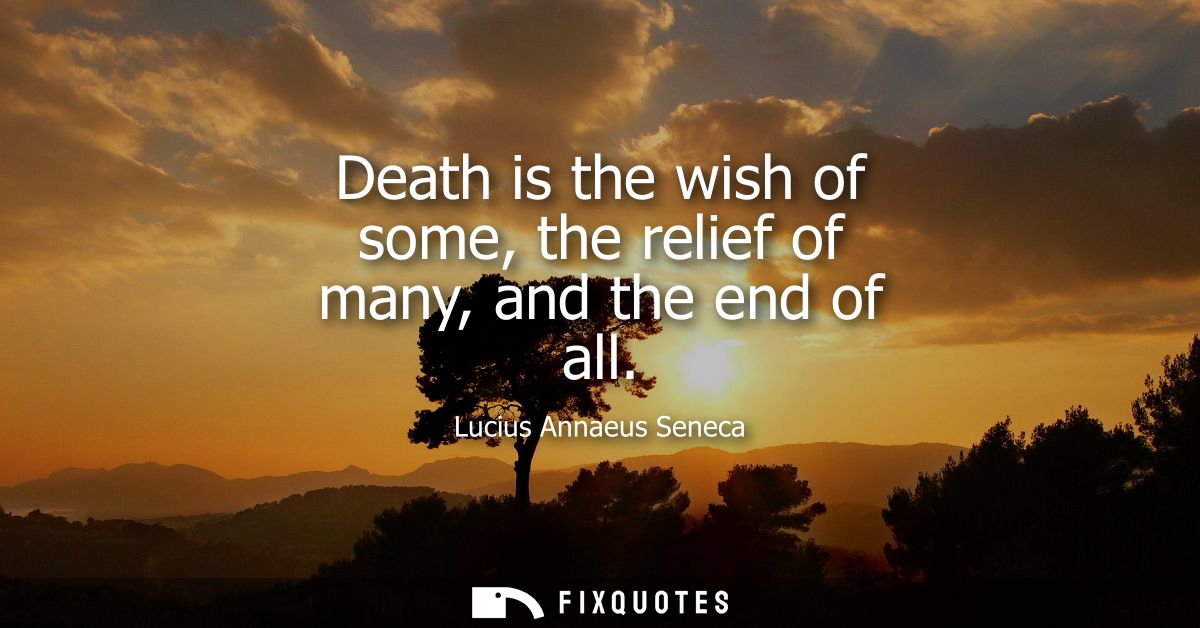
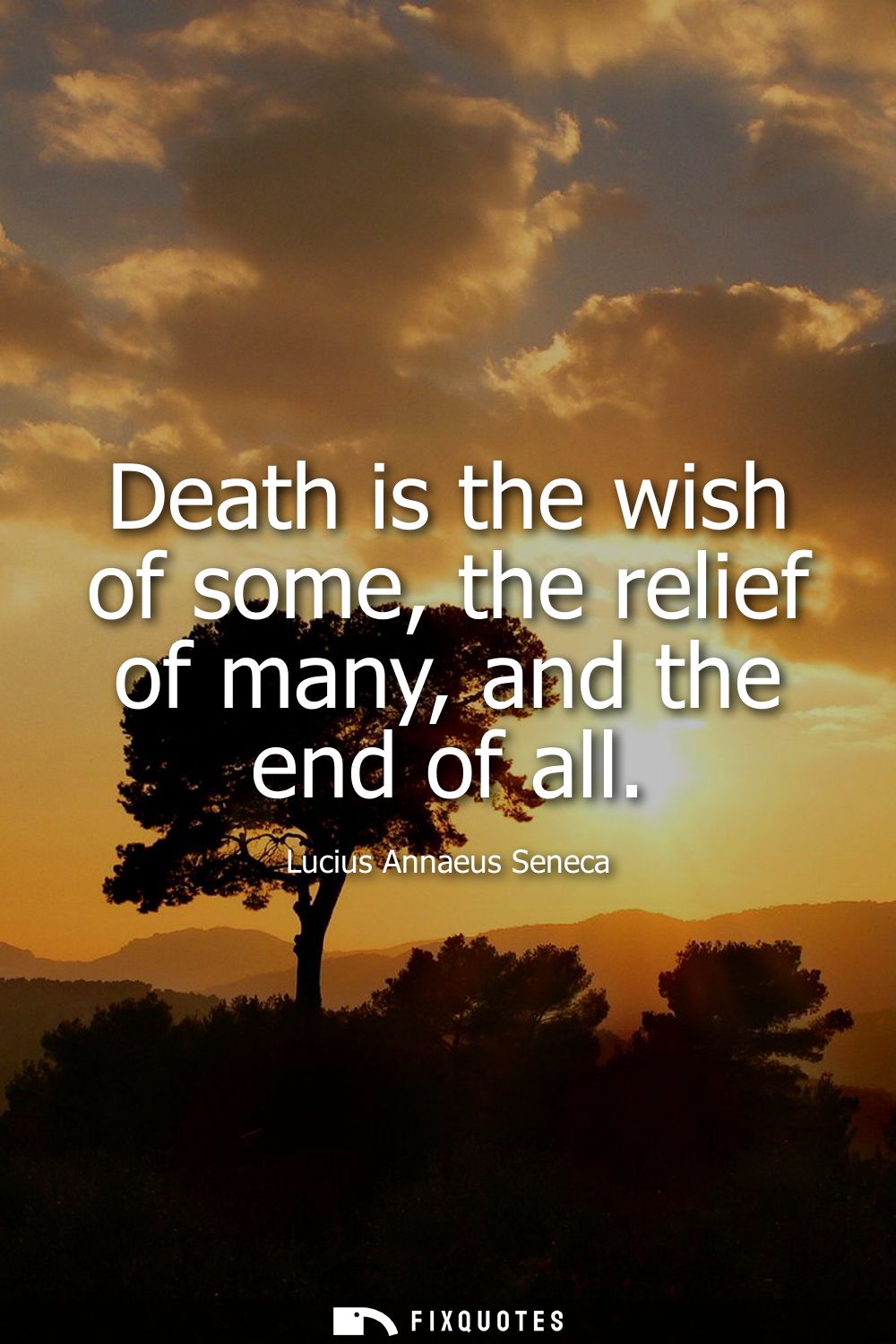
"Death is the wish of some, the relief of many, and the end of all"
About this Quote
Death, for Seneca, isn’t a gothic prop or a mystical doorway. It’s a political fact and a moral instrument, sharpened by life in an empire where exile, forced suicide, and sudden reversals were routine tools of governance. When he calls death “the wish of some, the relief of many, and the end of all,” he’s doing classic Stoic jiu-jitsu: stripping the event of its monopoly on terror by dividing it into human use-cases. Desire, release, inevitability. The sentence is engineered to feel clinical, almost administrative, which is the point. If death can be categorized, it can be managed.
The subtext is aimed at panic. “Wish” acknowledges the allure of control in a world where personal agency is scarce; there’s an edge of warning here against romanticizing self-destruction as freedom. “Relief” speaks to suffering - physical pain, humiliation, debt, disgrace - the very pressures Rome specialized in applying. Seneca doesn’t sentimentalize that relief; he legitimizes it, which quietly re-centers compassion inside a philosophy often caricatured as austere.
Then he lands the final clause like a gavel: “the end of all.” No exceptions, no heroic loopholes, no afterlife bargaining. It flattens status. Caesar and slave meet the same terminus. For a statesman who served Nero and was later ordered to die, that egalitarian finish carries bite: power can choreograph the manner of your death, not the fact of it. The line works because it weaponizes inevitability against fear, turning mortality from a threat into a steadying horizon.
The subtext is aimed at panic. “Wish” acknowledges the allure of control in a world where personal agency is scarce; there’s an edge of warning here against romanticizing self-destruction as freedom. “Relief” speaks to suffering - physical pain, humiliation, debt, disgrace - the very pressures Rome specialized in applying. Seneca doesn’t sentimentalize that relief; he legitimizes it, which quietly re-centers compassion inside a philosophy often caricatured as austere.
Then he lands the final clause like a gavel: “the end of all.” No exceptions, no heroic loopholes, no afterlife bargaining. It flattens status. Caesar and slave meet the same terminus. For a statesman who served Nero and was later ordered to die, that egalitarian finish carries bite: power can choreograph the manner of your death, not the fact of it. The line works because it weaponizes inevitability against fear, turning mortality from a threat into a steadying horizon.
Quote Details
| Topic | Mortality |
|---|---|
| Source | Help us find the source |
| Cite |
Citation Formats
APA Style (7th ed.)
Younger, Seneca the. (2026, January 15). Death is the wish of some, the relief of many, and the end of all. FixQuotes. https://fixquotes.com/quotes/death-is-the-wish-of-some-the-relief-of-many-and-34129/
Chicago Style
Younger, Seneca the. "Death is the wish of some, the relief of many, and the end of all." FixQuotes. January 15, 2026. https://fixquotes.com/quotes/death-is-the-wish-of-some-the-relief-of-many-and-34129/.
MLA Style (9th ed.)
"Death is the wish of some, the relief of many, and the end of all." FixQuotes, 15 Jan. 2026, https://fixquotes.com/quotes/death-is-the-wish-of-some-the-relief-of-many-and-34129/. Accessed 13 Feb. 2026.
More Quotes by Seneca
Add to List