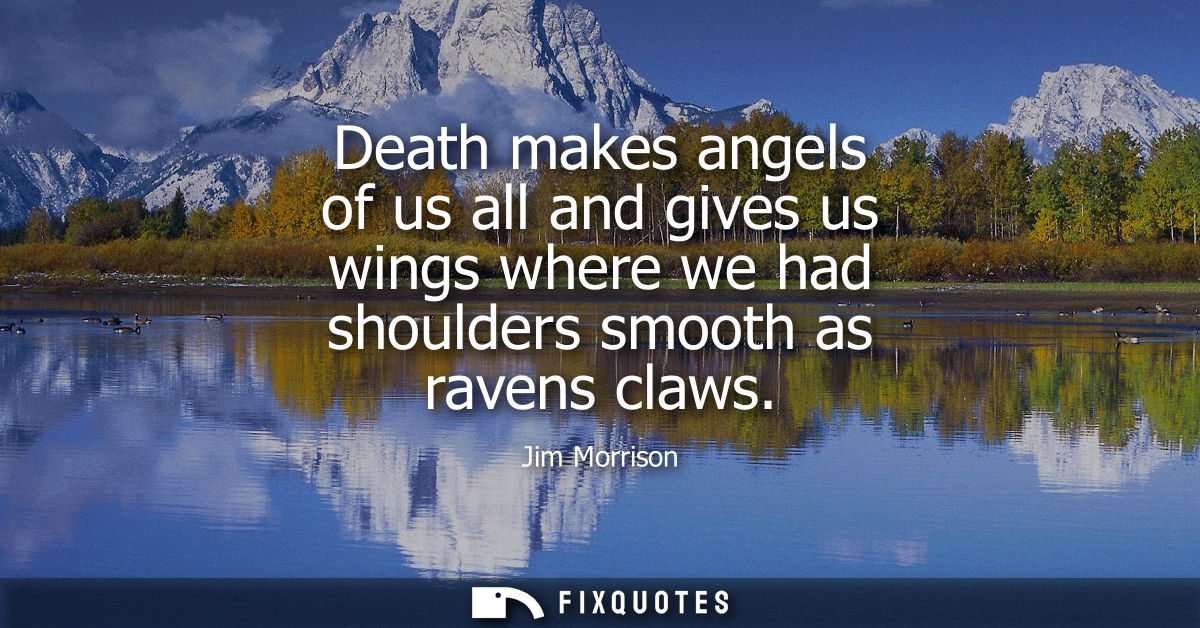
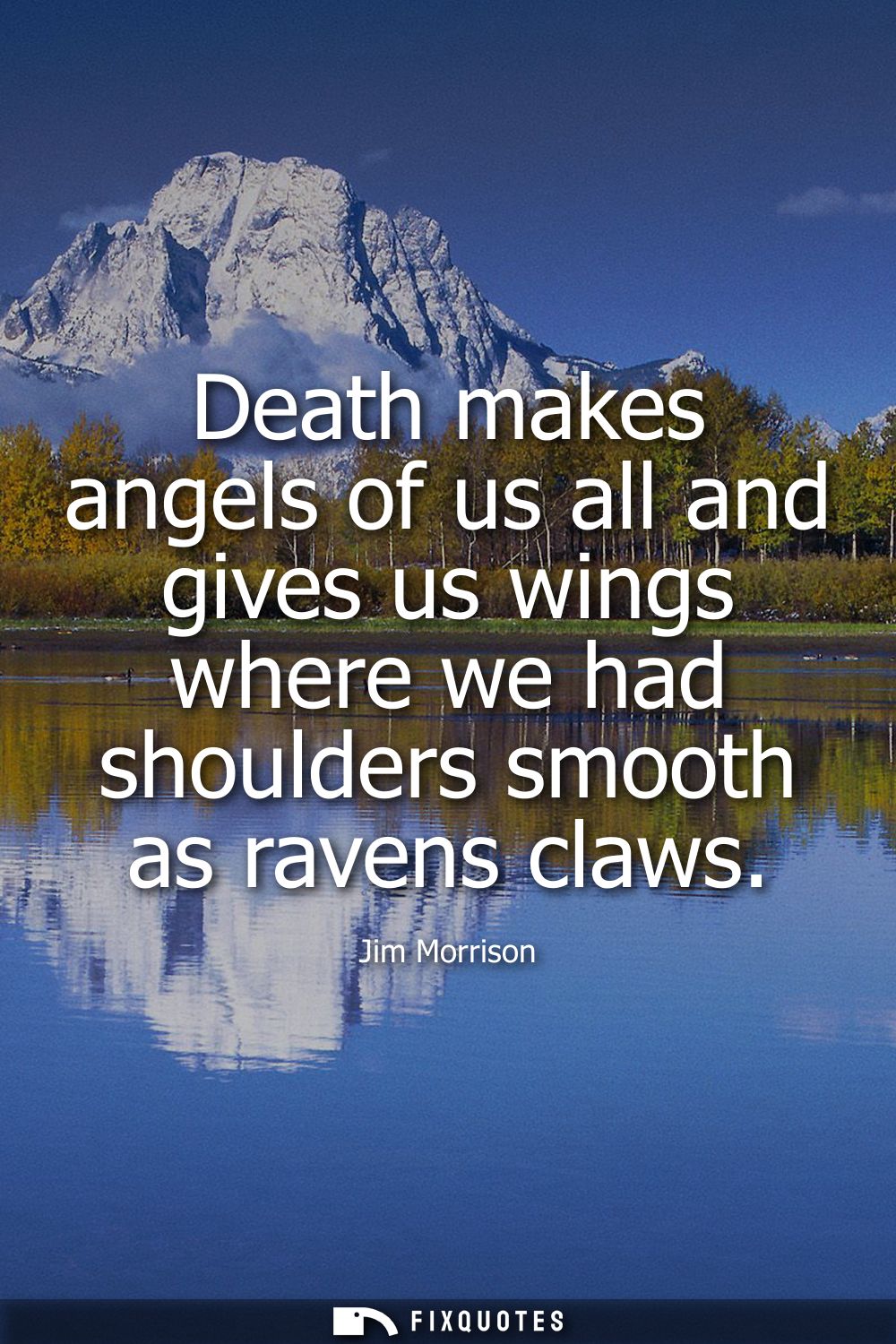
"Death makes angels of us all, and gives us wings where we had shoulders smooth as ravens' claws"
About this Quote
The line's intent isn't to promise an afterlife so much as to expose our need to mythologize loss. "Death makes angels of us all" reads like a critique of instant sainthood: the way the dead get edited into symbols, absolved by absence. In Morrison's hands, that sentimental upgrade is inseparable from violence. Wings don't arrive as a reward; they arrive because the self is stripped down to an icon people can carry.
Context matters: Morrison was writing from the late-60s American fever dream, where mortality was public (Vietnam, assassinations) and transcendence was a consumer product (psychedelia, rock spectacle). His stage persona flirted with martyrdom, and this line feels like him narrating that bargain: become myth, get wings; pay with your body, your mess, your ordinary shoulders. It's romantic, but it isn't comforting. It's a dare to look at how quickly we turn grief into a halo.
Quote Details
| Topic | Mortality |
|---|---|
| Source | Help us find the source |
| Cite |
Citation Formats
APA Style (7th ed.)
Morrison, Jim. (2026, February 19). Death makes angels of us all, and gives us wings where we had shoulders smooth as ravens' claws. FixQuotes. https://fixquotes.com/quotes/death-makes-angels-of-us-all-and-gives-us-wings-31962/
Chicago Style
Morrison, Jim. "Death makes angels of us all, and gives us wings where we had shoulders smooth as ravens' claws." FixQuotes. February 19, 2026. https://fixquotes.com/quotes/death-makes-angels-of-us-all-and-gives-us-wings-31962/.
MLA Style (9th ed.)
"Death makes angels of us all, and gives us wings where we had shoulders smooth as ravens' claws." FixQuotes, 19 Feb. 2026, https://fixquotes.com/quotes/death-makes-angels-of-us-all-and-gives-us-wings-31962/. Accessed 4 Apr. 2026.