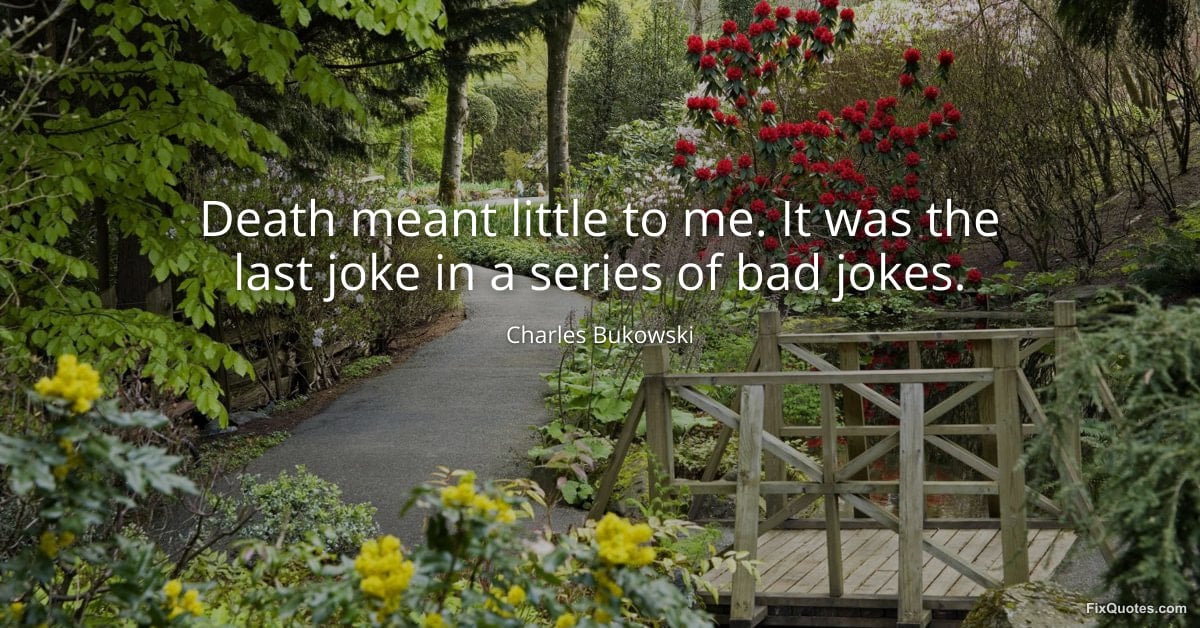
"Death meant little to me. It was the last joke in a series of bad jokes"
About this Quote
The subtext is exhaustion disguised as insolence. "Meant little to me" reads like indifference, but it’s really the numbness of someone who’s seen too many variations of the same disappointment: work that grinds you down, love that curdles, bodies that fail, the daily humiliations of being alive and broke. By framing life as "a series of bad jokes", Bukowski implies a world where the universe isn’t maliciously orchestrated, just cheaply written. Death becomes the final, predictable gag - not a cosmic tragedy, more like the house lights coming up after a mediocre show.
Context matters because Bukowski’s whole project was to drag art away from respectable suffering and into the barroom, the cheap room, the unglamorous ache. The intent isn’t to flirt with suicide so much as to puncture sentimental narratives about meaning. If the culture wants death to be profound, Bukowski answers with a shrug and a grim smirk: the only honest response to a rigged routine is to laugh at the closer.
Quote Details
| Topic | Mortality |
|---|---|
| Source | Charles Bukowski (1979). “Shakespeare Never Did this” |
| Cite |
Citation Formats
APA Style (7th ed.)
Bukowski, Charles. (2026, February 10). Death meant little to me. It was the last joke in a series of bad jokes. FixQuotes. https://fixquotes.com/quotes/death-meant-little-to-me-it-was-the-last-joke-in-185184/
Chicago Style
Bukowski, Charles. "Death meant little to me. It was the last joke in a series of bad jokes." FixQuotes. February 10, 2026. https://fixquotes.com/quotes/death-meant-little-to-me-it-was-the-last-joke-in-185184/.
MLA Style (9th ed.)
"Death meant little to me. It was the last joke in a series of bad jokes." FixQuotes, 10 Feb. 2026, https://fixquotes.com/quotes/death-meant-little-to-me-it-was-the-last-joke-in-185184/. Accessed 7 Mar. 2026.