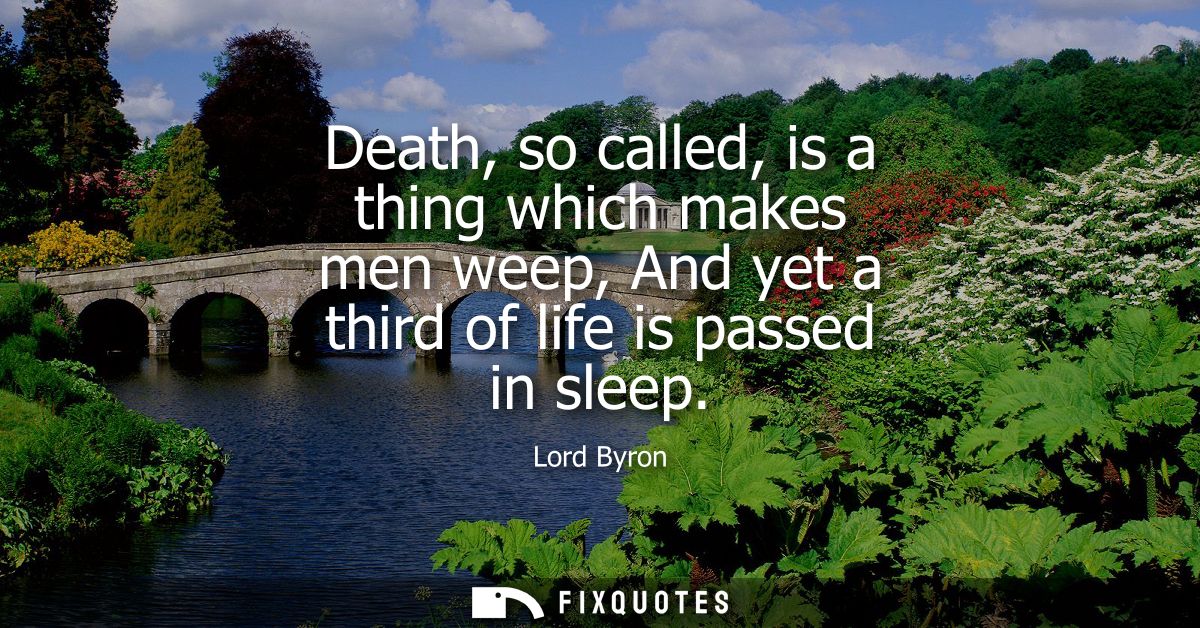
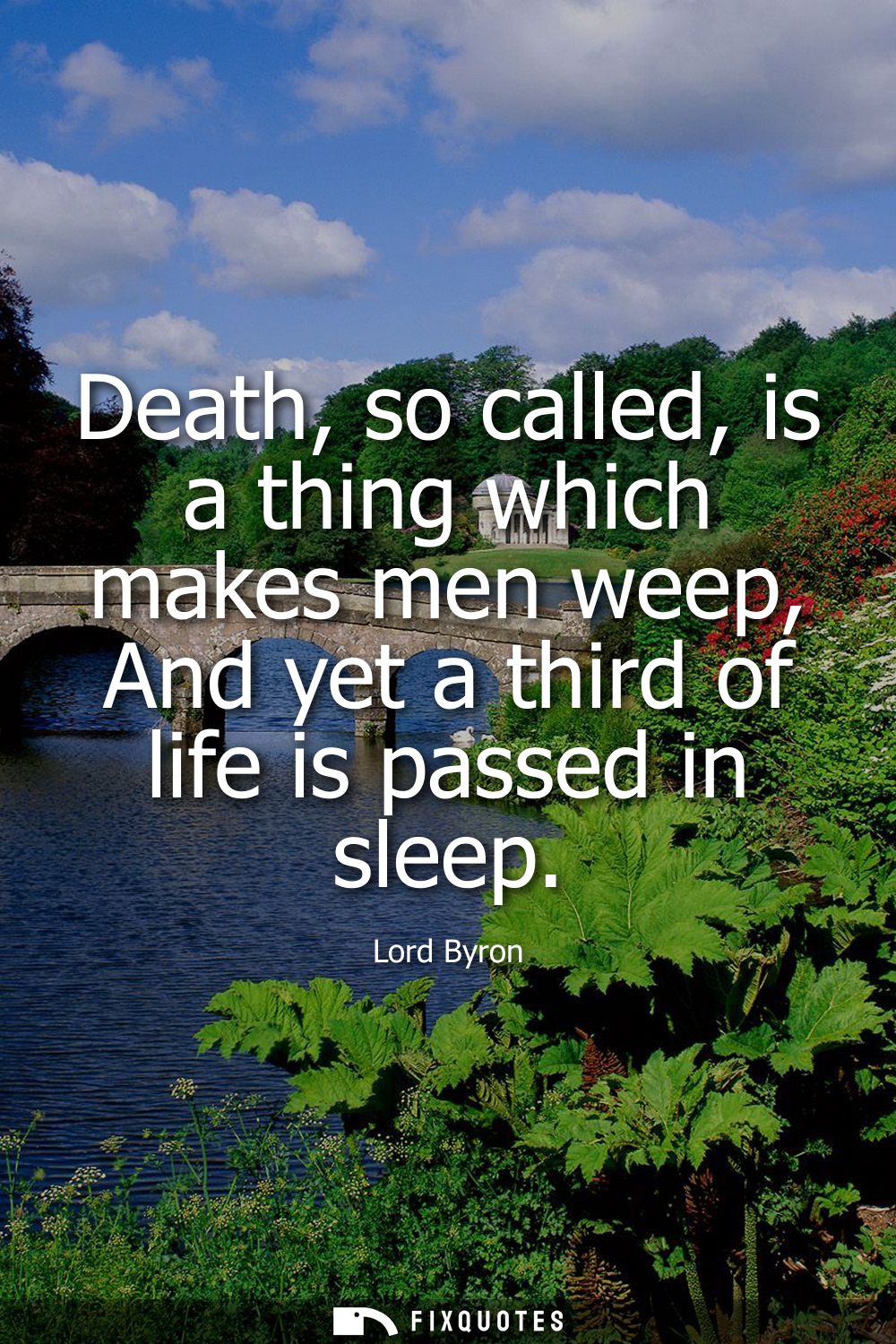
"Death, so called, is a thing which makes men weep, And yet a third of life is passed in sleep"
About this Quote
Calling death "so called" is the sly hinge. It’s a shrug at the grand noun itself, as if the label is partly responsible for the panic. Byron, the Romantic who specialized in posing and puncturing, pulls off a double move: he grants death its emotional power ("makes men weep") while quietly indicting the performance. If unconsciousness is tolerable when it comes with pillows and morning light, what exactly are we mourning? Control. Continuity. The fantasy that we’re more than a flicker between interruptions.
Context matters: Byron writes in an era thick with early deaths, war, and disease, but also with Romantic fixation on the sublime and the tragic. His couplet reads like a corrective to fashionable despair, not by denying grief but by exposing its inconsistency. The rhyme and measured cadence are part of the point: he packages existential unease in a form as tidy as a bedtime routine. It’s wit as scalpel, cutting through sentiment to show how habit, not philosophy, governs what we fear.
Quote Details
| Topic | Mortality |
|---|---|
| Source | Help us find the source |
| Cite |
Citation Formats
APA Style (7th ed.)
Byron, Lord. (2026, January 15). Death, so called, is a thing which makes men weep, And yet a third of life is passed in sleep. FixQuotes. https://fixquotes.com/quotes/death-so-called-is-a-thing-which-makes-men-weep-510/
Chicago Style
Byron, Lord. "Death, so called, is a thing which makes men weep, And yet a third of life is passed in sleep." FixQuotes. January 15, 2026. https://fixquotes.com/quotes/death-so-called-is-a-thing-which-makes-men-weep-510/.
MLA Style (9th ed.)
"Death, so called, is a thing which makes men weep, And yet a third of life is passed in sleep." FixQuotes, 15 Jan. 2026, https://fixquotes.com/quotes/death-so-called-is-a-thing-which-makes-men-weep-510/. Accessed 12 Feb. 2026.