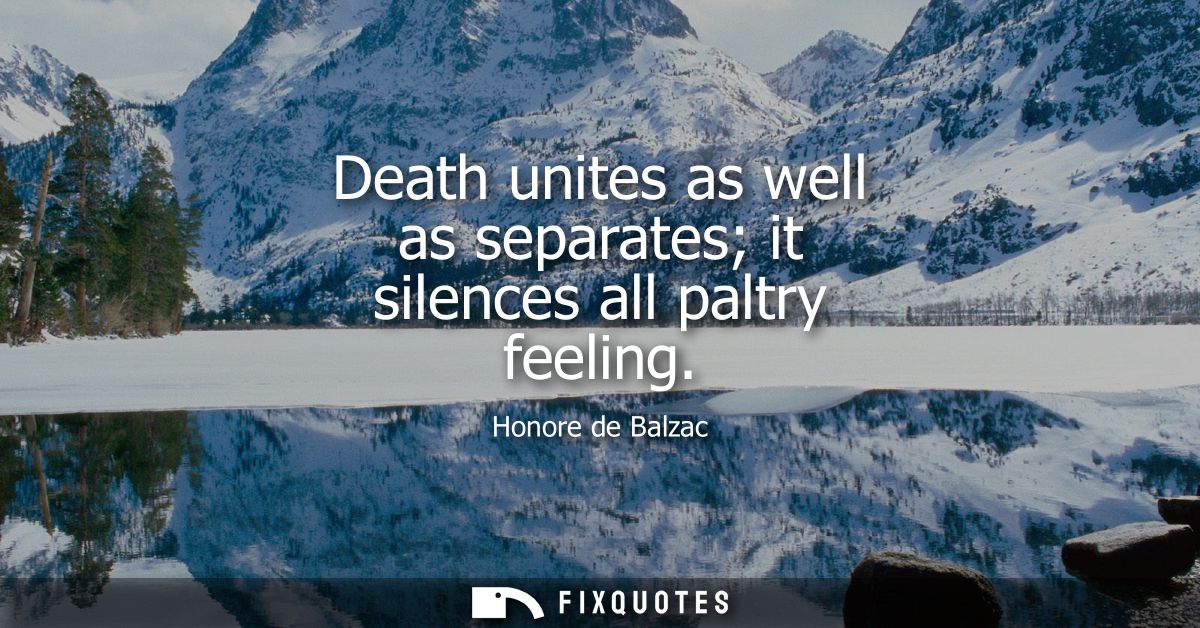
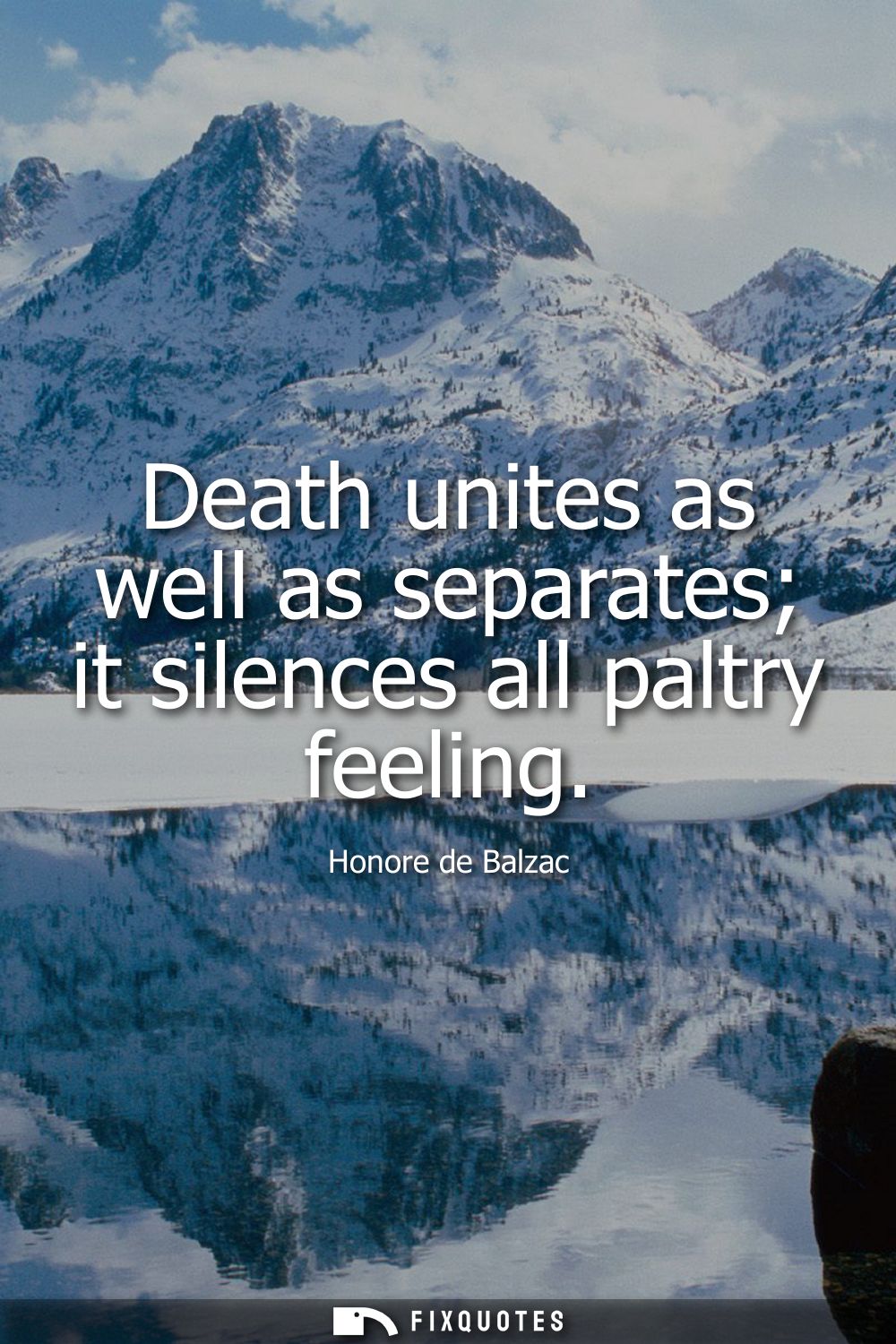
"Death unites as well as separates; it silences all paltry feeling"
About this Quote
Balzac treats death less like an ending than a ruthless editor: it strikes out the petty lines people waste their lives reciting. "Death unites as well as separates" is built on a hard paradox. The obvious truth is separation: the dead are gone, the living remain. Balzac pushes the other side just as forcefully, suggesting that loss can fuse the survivors into a temporary community of shared shock, logistics, inheritance, remembrance. Grief becomes a social contract, forcing rivals into the same room, making even estranged relatives speak in the same lowered register.
The second clause is the dagger: death "silences all paltry feeling". The word choice matters. "Paltry" doesn’t mean emotion itself is small; it means the smallness we indulge - vanity, grudges, jealousies, the little internal courtroom dramas that feel enormous until a body makes them ridiculous. Balzac’s subtext is moral but not sentimental: death doesn’t purify people because it’s noble; it purifies because it’s final. It removes the future that petty feelings feed on - the next chance to win, to retaliate, to be right.
In Balzac’s world of salons, status games, and transactional intimacy, this is also social critique. He’s reminding us that the hierarchies and feuds that structure everyday life are revealed as paper-thin at the graveside. Death becomes the one event that temporarily equalizes, not by making people better, but by making their usual performances unsustainable.
The second clause is the dagger: death "silences all paltry feeling". The word choice matters. "Paltry" doesn’t mean emotion itself is small; it means the smallness we indulge - vanity, grudges, jealousies, the little internal courtroom dramas that feel enormous until a body makes them ridiculous. Balzac’s subtext is moral but not sentimental: death doesn’t purify people because it’s noble; it purifies because it’s final. It removes the future that petty feelings feed on - the next chance to win, to retaliate, to be right.
In Balzac’s world of salons, status games, and transactional intimacy, this is also social critique. He’s reminding us that the hierarchies and feuds that structure everyday life are revealed as paper-thin at the graveside. Death becomes the one event that temporarily equalizes, not by making people better, but by making their usual performances unsustainable.
Quote Details
| Topic | Mortality |
|---|---|
| Source | Verified source: Mémoires de deux jeunes mariées (Honore de Balzac, 1841)
Evidence: La mort rapproche autant qu’elle sépare, elle fait taire les passions mesquines. (Chapter LVII (57) / Lettre datée « Au Chalet, 7 août »). This is Balzac’s original French wording as printed in the novel. The commonly-circulated English quotation (“Death unites as well as separates; it silences all paltry feeling”) is a translation, found for example in the English edition titled "Letters of Two Brides" (translator: R. S. Scott) and appears in the corresponding passage describing Louise’s reconciliation with her family. The novel itself was first published in 1841 (French). Other candidates (1) Delphi Complete Works of Honoré de Balzac (Illustrated) (Honoré de Balzac, 2013) compilation95.0% Honoré de Balzac. duchesses spend all their evenings at the chalet. Death unites as well as separates; it silences al... |
| Cite |
Citation Formats
APA Style (7th ed.)
Balzac, Honore de. (2026, February 8). Death unites as well as separates; it silences all paltry feeling. FixQuotes. https://fixquotes.com/quotes/death-unites-as-well-as-separates-it-silences-all-24207/
Chicago Style
Balzac, Honore de. "Death unites as well as separates; it silences all paltry feeling." FixQuotes. February 8, 2026. https://fixquotes.com/quotes/death-unites-as-well-as-separates-it-silences-all-24207/.
MLA Style (9th ed.)
"Death unites as well as separates; it silences all paltry feeling." FixQuotes, 8 Feb. 2026, https://fixquotes.com/quotes/death-unites-as-well-as-separates-it-silences-all-24207/. Accessed 8 Apr. 2026.
More Quotes by Honore
Add to List